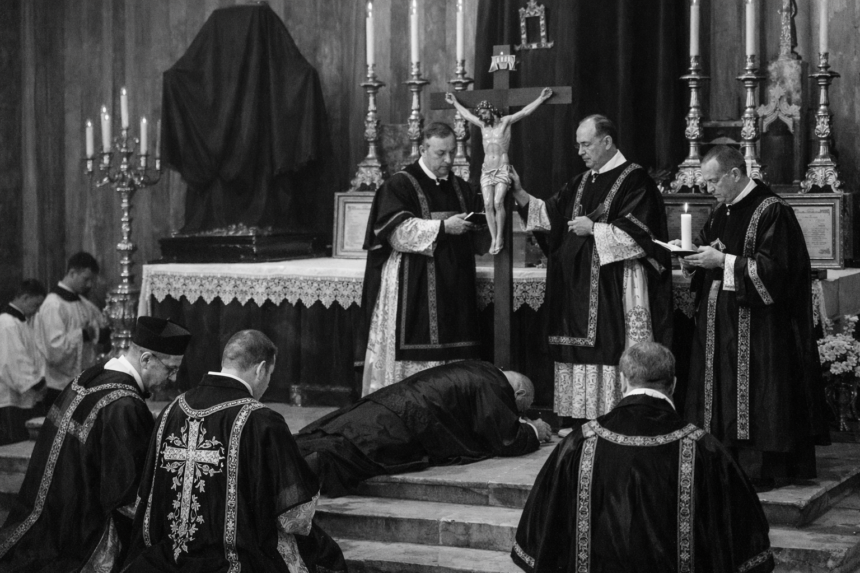
Good Friday, the Friday preceding Easter, commemorates Christ’s crucifixion and death on Calvary. It’s also known as Holy Friday, Great Friday, Great and Holy Friday, or Black Friday. In pre-reformed liturgical texts, the Good Friday rite was called the “Mass of the Pre-Sanctified,” resembling the Eastern “Liturgy of the Pre-Sanctified Gifts.” This liturgy underwent its most significant changes in the post-1955 reforms.
Late Pe. Nascimento Mascarenhas from Sáligão explained that in both pre- and post-reform forms, priests and ministers initially wore black vestments (now replaced by red). The pre-1955 rite started with a bare altar holding only two unlit candles and a veiled cross on the mensa. Ministers genuflected to the cross upon entering the sanctuary. The celebrant prostrated before the altar as assistants spread a single cloth over it and positioned the missal on the Epistle side. The priest then ascended, kissed the altar, and immediately began the lesson, often read by a competent lector from the subdeacon’s usual spot, rather than chanted.

After removing outer vestments, the priest and ministers retrieved the veiled cross from the altar and unveiled it progressively in three stages, per Pe. Mascarenhas. A violet carpet covered the altar’s lowest step, and the cross was laid on the floor for veneration. The faithful approached on knees, offering three genuflections before bending low to adore it. Once finished, the cross returned to the altar.
The starkest contrast with the 1955 reformed rite follows: the priest and ministers processed solemnly from the altar of repose with a veiled chalice containing the pre-consecrated host, accompanied by incense akin to Maundy Thursday’s procession. At the altar, they unveiled the chalice, placed the host on the paten over a corporal, and poured plain wine into the chalice without prayers or rituals. The host, chalice, cross, and altar received standard incensation; the priest silently washed his hands. He then prayed the Secret prayer quietly, followed by the Orate Fratres without the faithful’s response. After purification, all departed in silence as the altar was stripped bare once more. Pre-Vatican II emphases included the priest’s black cope and stole, the absence of a tabernacle (reserved at a side altar of repose), and specific prayers like the Reproaches (Improperia) chanted during veneration, with the choir singing the Trisagion (“Holy God, Holy Mighty One”) in Greek and Latin. No consecration occurred, underscoring the “pre-sanctified” nature no words of institution, no peace greeting, and a stark, mournful tone evoking Christ’s passion.
The 1955 reformed rite, dubbed the “Solemn Liturgical Action,” began with a completely stripped altar, no cross, candles, or cloths during the initial prostration, to deliberately avoid Mass-like appearances. Post-Passion reading, the priest doffed the chasuble and donned a cope to emphasize no Mass was taking place. Solemn intercessions proceeded similarly otherwise. He then removed the cope as the deacon, with candle-bearing ministers, fetched the veiled cross from the sacristy. Unveiled traditionally in stages, it was held aloft by assistants (not laid down) for veneration. Afterward, vesting shifted to violet without maniples; a corporal was spread, and the deacon fetched the ciborium from the repose altar unceremoniously. Post-Communion, the priest purified his fingers in water; the ciborium returned to the main tabernacle. He chanted three new Good Friday prayers before silent departure. Additional pre-Vatican II elements included the Ecce Lignum Crucis proclamation (“Behold the wood of the Cross”), hammer blows symbolizing nails during the Reproaches, and strict rubrics forbidding music, bells, or Gloria until the Easter Vigil.
Mr. Agnelo Andrade from Ambajim, Goa, recalls: “We avoided music or TV to share in Jesus’ passion by abstaining from pleasures.” Homes served simple meals of rice gruel (kanji or péz in Konkani), with pickle or salted fish, alongside fasting and abstinence.
Goa preserved a unique tradition: young boys crucified garden lizards (Thopio or Sheddo; three in some villages) on coconut trees or palm petioles using lemon tree or Flacourtia jangomas thorns during Good Friday morning. Explanations varied, elders in Ambajim and Margão said the lizard intermediated Judas Iscariot’s betrayal for 30 silver pieces, meriting punishment. Another tale claimed it teased Christ at 3 p.m. from behind a tree during the crucifixion. This may stem from certain pre-conversion locals viewing lizards as omens (bad luck if falling on someone); crucifying them killed the “evil” while absorbing church teachings. If bitten by a poisonous variety (Sorop shilli) while hunting, victims were submerged neck-deep in ponds to halt toxin spread until aid arrived.
Joyce Carvalho e Aguiar from Colva, South Goa, adds: “Boys loved it, then awaited Easter Vigil to toss Pandanus (Ketok) leaves from church choir lofts onto massgoers, especially girls heading to Communion.”