Vivek Menezes
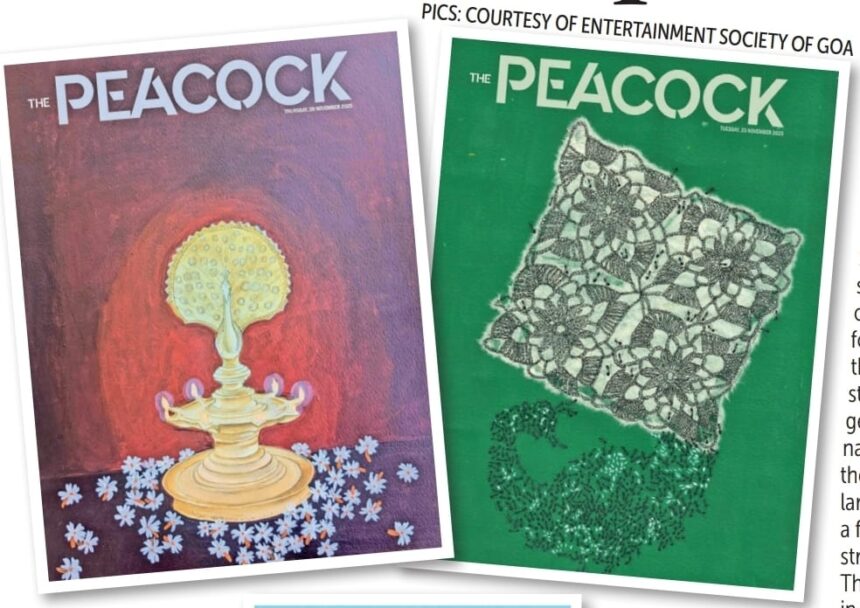
There’s no way to stay strictly neutral about the unique, homegrown The Peacock daily newspaper at the International Film Festival of India each year in Panjim, because I’m part of the small team which launched it 11 years ago, and still comes together with great dedication to put it out each successive edition. The record speaks for itself, however: Entertainment Society of Goa prints 9000 copies, and almost every single one is taken home as a collector’s item. Unlike the other printed material accumulating in vast drifts of wasted paper, The Peacock is carefully collated to be re-read once again in the delegates’ hometowns across India and the world. Part of the reason, no doubt, is its urgent coverage of tomorrow’s hits, and pointed conversations with the best emerging film-makers. Nonetheless, we are all perfectly clear what makes the difference is art, and especially the exclusive covers. Every year, a different stellar artist of Goa has undertaken to do them: Kedar DK, Amruta Patil, Siddharth Gosavi, Pradeep Naik, Sonia Rodrigues Sabharwal, Praveen Naik, Bhisaji Gadekar, Govit Morajkar, Sagar Naik Mule. This year, in an astonishing return – she was invited again because her first stint was never printed in the agonizing “socially distanced” pandemictimes IFFI – it has been Shilpa Mayenkar Naik in one of the most evocative series ever: parijat blossoms, the traditional abolim fati, and an especially exquisite crochet handkerchief juxtaposed with her signature ants. There have been over 100 covers like these over the past 11 years, about which the curator Lina Vincent says “I have been deeply moved by the expressive vigour and aesthetic clarity they carry – many of the artists have brought forward their creative best in the challenging production of nine compositions. The success of the covers and the way they have been treated as collectibles, is a testament to the powerful voice of Goan artists, when given the space and time.” Vincent is making a short documentary video about the covers. She says they are “an ongoing mapping of the visual, material and performative culture of Goa, seen through the perspectives of the various artists. From azulejo to kaavi, chittaari woodwork and kunbi weaves, the lions and ‘soldado’, the betaal and Sateri ma, the glorious churches, temples, homes and khazan lands. This is significant in terms of the shifting socio-cultural and environmental scenario, and the urgency of conserving the heritage that is being lost. Even in showcasing the beautiful side of things, the artists introduce subtle commentaries on these changing realities, marching alongside the strong discussions in text. The Peacock covers are a fitting companion to a film festival – a perfect combination of craft and expression, reality and imagination, the personal and the collective.” Over the past dozen years, Vincent has been “working and interacting with art students and young practicing artists in Goa as a mentor and curator.” She says “I have understood and shared their concerns on the dearth of exhibition avenues and platforms for experimentation and discourse in the arts. With an exception of a few stellar names, Goan artists over several generations have been sidelined in national and regional art histories; despite the fact there is immense talent it remains largely unseen outside Goa, because only a few are able to crossover into the tight strongholds of gallery representation. Those of us working and teaching in the cultural industry understand the complexities of this competitive economy, in which youngsters from smaller states and peripheral towns lose out due to various factors, despite having skill and technique.” Vincent says “a platform like The Peacock covers may appear as a simple exercise in publishing, but it is actually a transformative space with enormous advantages. It has given several young artists, the opportunity to paint and draw with creative freedom, energising practices that have been at low ebb. The platform has generated the possibility for the artists to share their work with wider national and international audiences, bringing them recognition and further opportunity, kickstarting new careers. When these artists are able to offer so much within curated guidelines and crisp timelines – how much more can they achieve in any other programme?”