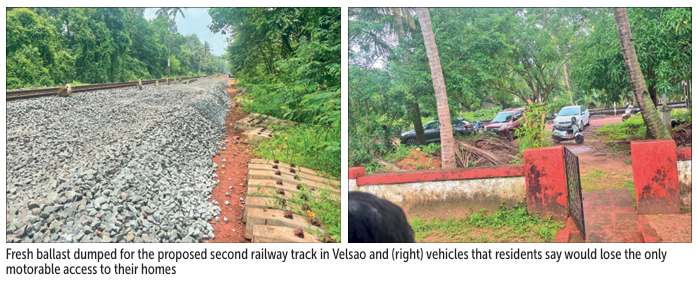
A fresh confron tation erupted in Velsao on Wednesday after Rail Vikas Nigam Limited (RVNL) re sumed work on the South Western Railway’s con troversial double-tracking project, with villagers and activists blocking trucks carrying ballast and accus ing the authorities of allow ing construction to proceed despite pending directions issued by the district ad ministration remaining un implemented. The standoff began early in the morning when trucks carrying ballast, accom panied by earth-moving machinery, arrived to lay the ballast bed for the pro posed second railway track immediately alongside a row of heritage houses, some more than 200 years old. Police personnel were deployed as residents and activists gathered at the site and prevented any further dumping of ballast. The protesters main tained that the issue was not opposition to railwaydevelopment but what they described as the au thorities’ decision to press ahead with the work before complying with directions issued by the Deputy Col lector, Mormugao, follow ing complaints over the loss of the villagers’ traditional motorable access.
Explaining the basis of the protest, Goencho Ekvott founder Orville Dourado Rodrigues said the agitation stemmed from representa tions submitted by senior citizens led by Max de Souza, who had approached the Deputy Collector over the threat to the traditional access road serving the her itage homes. Rodrigues said that dur ing a meeting convened on June 19, attended by the Ta lathi, Mamlatdar, Inspector of Survey and Land Records (ISLR), representatives of the Railways, RVNL and the affected villagers, RVNL was directed to produce land records, acquisition details, title documents and a plan ensuring uninter rupted access to residents. He said the minutes also re corded that officials found no evidence of the alter native access road claimed by RVNL during the site inspection. According to Rodrigues, the ISLR was further direct ed to conduct a joint site inspection with RVNL and the complainants within a week and submit a site in spection report along with a sketch before the next re view meeting. “We are only asking the authorities to implement their own direc tions. The title documents have still not been pro duced, and the ISLR survey has not been conducted, yet the work has resumed,” Rodrigues said. Residents alleged that neither the title documents sought by the Deputy Col lector had been produced nor had the ordered joint ISLR survey been conduct ed before work recom menced on Wednesday. They further claimed there had been no land acquisition for the disputed stretch and said affected landowners had already submitted Portuguese-era title documents before the District Court, Margao, and the Court of the ISLR while challenging the Railways’ claim over the land.

As the protest continued, residents led police personnel and media representatives along the affected stretch to demonstrate how the proposed second track would run im mediately beside the heritage homes. They argued that the existing motorable access serving the houses would effec tively disappear once the project was completed. They alleged that by proceeding without safeguarding the traditional access, residents were being deprived of their Right of Way, leaving several families effectively landlocked within their own properties. Protesters said more than 20 houses would lose vehicular access. “Tomorrow, it may not just be our cars. It could be an ambulance or a fire tender that cannot reach us,” one resident told the media. Residents also recalled the recent fire that damaged one of the heritage houses, saying fire tenders were already de layed because of access constraints along the railway corri dor. They argued that laying a second railway line without first securing an alternative approach would further hamper the movement of ambulances, fire tenders and other emer gency services. Several villagers questioned how construction could continue when the concerns raised before the district ad ministration remained unresolved and asked where affect ed residents were expected to turn if the authorities’ own directions had not been implemented. They reiterated that their agitation was against the loss of their only traditional motorable access, not against railway expansion.
Despite a heavy police presence, protesters refused to move and insisted that no further ballast would be dumped until the pending administrative directions were complied with. They maintained they were prepared to continue physically blocking the trucks, if necessary, to prevent the work from progressing. Rodrigues said only the pending ISLR survey would estab lish what measures, if any, the authorities proposed to en sure continued motorable access for the affected residents. He added that none of the landowners was willing to surren der “even a square inch” of inherited land until the legal and administrative process had been completed. Calling Wednesday’s blockade only a temporary victory, the villagers said their agitation would continue until the Deputy Collector’s directions were implemented, the joint ISLR survey completed, the title documents produced be fore the authorities, and the long-standing access issue re solved before any further work is permitted on the disputed stretch.