SHASHWAT GUPTA RAY
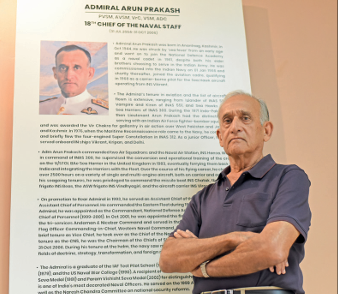
Fifty-four years after he flew a daring strike deep into enemy territory, former Indian Navy Chief Admiral Arun Prakash vividly recalls bombing West Pakistan’s critical Chak lala air base—now Noor Khan—as a young Lieu tenant during the 1971 Bangladesh Liberation War. Awarded the Vir Chakra for his bravery, Prakash had flown Hawker Hunter aircraft with an Indian Air Force squadron, an ex traordinary chapter in a career that would later culminate at the helm of the Navy. Speaking from Dabolim in South Goa, the decorated veteran reflected on his first combat mission, the evolution of warfare over five decades, and Goa’s growing strategic importance in India’s maritime security architecture. “It was the first time I was going into a war. There were butterflies in my stom ach as I crossed the border into enemy territory. But once that settled, the focus was on navigation, locating the target and scanning the skies for enemy fighters,” he recalled. The December 4, 1971 mission was far from straightforward. Poor visibil ity initially obscured the target, but the fog suddenly lifted to reveal the Chaklala runways below “It was a moment of great thrill for both of us. We struck whatever aircraft we saw on the runway and destroyed them. That memory still lingers,” he said. “There was heavy incoming fire from anti-aircraft guns, but we were fortu nate not to be hit. The mission was completed successfully and we returned safely.” Acts of valour by Indian armed forces during the 1971 war ultimately led to the surrender of nearly 90,000 East Pakistan troops on December 16, paving the way for the birth of Bangladesh—commemorated annually as Vijay Di was. Changing nature of warfare Reflecting on how conflict has transformed since 1971, Admiral Prakash said conventional warfare has increasing ly given way to what is now described as “grey zone” con flict—an undeclared state between war and peace. “But we see two adversaries fighting with each other through other domains like cyber warfare and propaganda, politics and so on. You are trying to inflict damage on your adversary without formally declaring war. During Opera tion Sindoor it was seen that a war could be fought with out the armed forces of two countries coming into physical contact with each other,” the Admiral said. He added that in 1971, the Army had to get into hand to-hand combat. The fighter jets had to come within a few hundred yards close to the target to deliver a weapon. “But during Op Sindoor, we saw that targets were being hit from 100-150 km away. Now, the speed of combat has also changed. In our flying days, the speed of our aircraft was 300 to 400 miles per hour. Now we have supersonic aircraft and hypersonic missiles. So, not only the range of weapons and speed of the weapon platforms have in creased, the accuracy also has improved by miles,” he said. Today the weapon systems are more sophisticated and hence expensive. For example, A BrahMos supersonic mis sile may cost about Rs 25 to 30 crore. “Therefore, a nation must think very carefully before en tering into a conflict because it can impose heavy costs on your economy and development plans,” he said. Importance of Goa The ex-navy chief, who had also commanded INAS Hansa (the naval air station at Goa), highlighted the strategic role Goa could play in the coming years. “Since its liberation in 1961, the Indian Navy decided to have its aviation forces in Goa. The State has progres sively assumed greater importance in the navy’s scheme of things today. The INS Hansa is the largest naval aviation base in the country. It has assets worth hundreds of crores in terms of aircraft, runways, training facilities which are based here. During Operation Sindoor, the naval aviation forces and personnel from Goa were involved in safeguard ing our western shores,” the former navy chief said. He added that INAS Hansa has a very critical role to play in the whole Indian Ocean Region. “Its location is ideal. Let us also not forget the Goa Shipyard. It is in the process of building two very powerful warships – two frigates – which will strengthen the navy’s fleet. So, Goa has a very crucial role to play in our maritime strategy,” he said. Way ahead Going ahead, Admiral Arun Prakash exhorted the gov ernment to formulate a national security strategy to coun ter the future security threats. “The country’s leadership has to decide on the role our country should play on the global stage in the next 40-50 years. Once you decide that, then you can prioritise how the money should be allocated in the defence budget for the three services and for gaining autonomy in defence manufacturing. In my mind, that’s a big lacuna which hasn’t been addressed and that is why we have failed to modern ise our armed forces,” he said