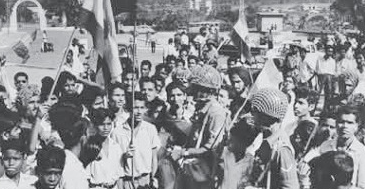
The first spark of Goa’s revolution was lit by Dr Ram Manohar Lohia on a Tuesday, June 18, 1946, along with his host and comrade Dr Juliao Menezes, a dermatologist. It was a revolutionary Tuesday in 1946, and so it was a Tuesday yet again on December 19, 1961.
Goa was liberated from the shackles of colonialism and the foreign yoke of Portugal that had begun way back on the island of Tiswadi, aka Ilhas, on November 25, 1510.

Undoubtedly, Goa was not uniformly under Portuguese rule for 451 years, as is often told. It was the island of Tiswadi that witnessed Portuguese rule for exactly 451 years, while the rest of Goa came under Portuguese rule in stages. In 1543, Bardez and Salcete came under Portuguese rule, while Ponda, Sanguem, Quepem and Canacona talukas came under Portuguese rule in 1763, followed by Bicholim and Sattari in 1781 and Pednem taluka in 1788.
Portuguese rule manifested itself in demerits and merits. Conversions and the Inquisition marked most of the 16th century, with revolts by the Cuncolkars in 1583, popularly known as the AVC Revolt: Assolna–Velim–Cuncolim, led by 16 gaunkars under the leadership of Aga Naik.
In 1787, two priests planned a revolt against the Portuguese ecclesiastical authorities, but to no avail. From 1852 to 1912, the Ranes revolted on 14 occasions, initially led by Deepaji Rane. These revolts witnessed the martyrdom of many locals. Voices against Portuguese repression had been heard through the auspices of Dr Francisco Luis Gomes, Bernardo Peres da Silva and later Menezes Braganca. The 20th century saw waves of many “isms”, reflecting the minds of many a thinker.
The first and foremost amongst these was definitely Dr T B Cunha, hailed as the Father of Goa’s struggle for freedom in 1928. Along with his nieces Berta and Dr Beatrice de Menezes Braganca, he founded the Goa Congress Committee (GCC) in 1928 in Bombay, with the singular mission of Goa’s liberation from Portuguese rule and her integration with Mother India—a goal that he pursued throughout his life. Unfortunately, he did not live to see Goa’s liberation, as he passed away in 1958, three years before Goa’s liberation. He even had his GCC affiliated with the Indian National Congress, which was fighting the British, to bring the cause of Goa’s liberation onto the national mainstream.
Many Goan nationalists influenced by Gandhiji, such as Purushottam Kakodkar, Nikubab Karapurkar and others, founded the Goa Seva Sangh in Margao in 1943 to realise the cherished goal of freedom eventually. In June 1946, Dr Ram Manohar Lohia arrived in Assolna in Goa at the invitation of his friend Dr Juliao Menezes to find some rest and retreat. However, he was met by Vasant Kare, Purushottam Kakodkar and Evagrio George, who urged him to lead a civil disobedience movement against Salazar’s dictatorship on June 18, 1946, in Margao.
On June 18, 1946, led to the spot by Laxmidas Borkar, Dr Lohia and Dr Menezes began to address a public meeting against the Portuguese ban on civil liberties. However, Dr Lohia was stopped from making a speech. Both Menezes and Lohia were arrested. A young girl, Vatsala Kirtani, was also arrested for raising the slogan of “Jai Hind”, a slogan taboo to the Portuguese.
The impact of this 18th June movement led to the establishment of the National Congress Goa in Londa near Belgaum, a satyagrahi organisation that led satyagrahas in Goa in 1954. Laxmikant Bhembre led the first individual satyagraha in Margao. On August 15, 1954, Peter Alvares deputed Anthony D’Souza, Alfred Afonso and Mark Fernandes to lead the first mass satyagraha in Goa.
In the meantime, an armed resistance group was formed in Goa called the Azad Gomantak Dal, which had great leaders such as Vishwanath Lawande, Prabhakar Vaidya, Prabhakar Sinari, Mohan Ranade, Kanhoba Naik, Narayan Hari Naik, Tukaram Kankonkar, Dattaraya Deshpande and many others. They carried out several armed actions against the Portuguese. Bala Raya Mapari was its first martyr. So was his cousin Rohidas Mapari.
Around 75 youth sacrificed their lives for Goa’s struggle for freedom. Yeshwant Agarwadekar can be described as the Chandrashekhar Azad of Goa. He shot himself dead with the only bullet left in his gun. Suresh Kerkar, Camilo Pereira, Tulshidas Kamat, Bapu Gawas, Bala Desai, Dulba Pawar, Rajanikant Kenkre, Ladu Sawant, Balkrishna Bhonsle, Bapu Sahakari, Vinayak Sapte, Arjun Chodankar and several others died to liberate Goa.
On August 15, 1955, the Goa Vimochan Sahayak Samiti, a Poona-based organisation, worked to liberate Goa. It organised a huge satyagraha in which 32 Indian satyagrahis were shot dead, including Karnail Singh Benipal, a 21-year-old Punjabi youth who braved bullets on his lion chest. The Goa Liberation Army, Quit Goa Organisation, Goan Peoples Party and United Front of Goans were some of the other groups that fought for Goa’s liberation.
Women such as Sudhatai Joshi led the Mapusa satyagraha in 1955. Many other women, such as Sindhu Deshpande, Sharda Savaikar, Mogabai Naik, Suryankanti Phaldesai, Mitra Bir, Kumudini Paiguinkar, Vilasini Prabhu, Shalini Lolienkar, Shashikala Almeida, Shobha Manohar Prabhudesai and many others, were incarcerated during the movement.
Several freedom fighters—Dr Gaitonde, Ticlo Souza, Telo Mascarenhas, Vinayak Mayekar, Dr Jose Francis Martins, Madhav Bir, Divakar Kakodkar, Luis Mendes, Vaman Sardesai, Vaman Desai, George Vaz, Navlo Varak, Manohar Prabhudesai, J N Heredia, Purushottam Shirodker and several others—worked tirelessly for Goa’s freedom.
Finally, Defence Minister of India V K Krishna Menon sent the Operation Vijay forces to liberate Goa, led by K P Candeth. On December 19, 1961, at 2 am, Major Shivdev Singh Sidhu and Col V K Sehgal died in action at Fort Aguada. On December 19, 1961, Goa was liberated with the surrender of Portuguese Governor Vassalo e Silva in Mormugao.