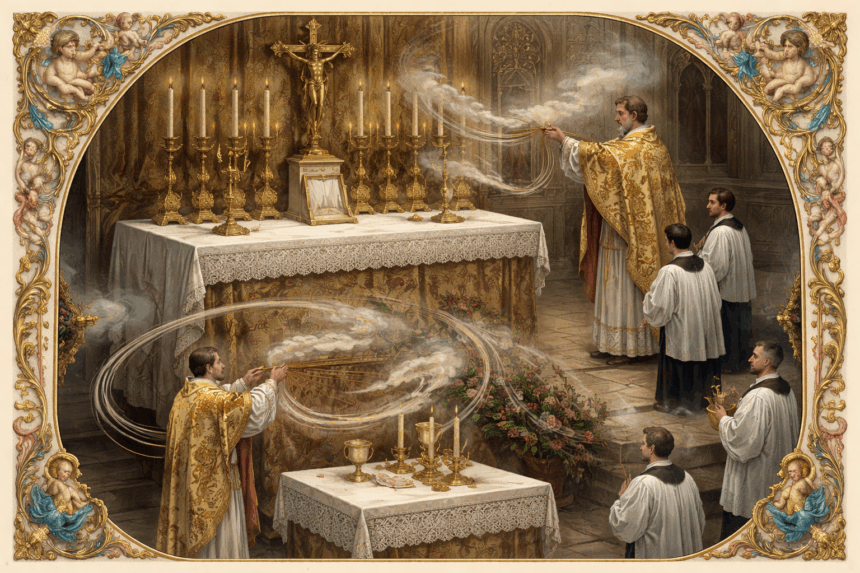
In an era where modern worship often favors simplicity, the Traditional Latin Mass, also known as the Tridentine Rite or Extraordinary Form preserves a rich tapestry of symbolism woven into every motion. Two rare diagrams from late 19th- and early 20th-century seminary manuals and rubrical handbooks offer a window into this world: the Ordo incensationis Altaris (“Order of the Incensation of the Altar”) and the Ordo incensandi Oblata (“Order of Incensing the Offerings”). These step-by-step schematics, from the rubrics of the Roman Missal (Ritus celebrandi Missam, IV, 4-5 and VII, 10), guided priests in Solemn or High Masses, preventing improvisation and ensuring reverence across the global Church.
The Altar Incensation: Honoring Christ in Stone and Flame

At the heart of the first diagram stands a central crucifix, marked 1-3, incensed first with three double swings, a direct homage to Christ, the altar’s living embodiment. Flanking it are candlesticks (4-7 left, 6-7 right), symbolizing the light of faith, followed by a numbered path across the altar mensa (top surface, 8-18) and front antependium (24-29). Side movements (11-20) trace a deliberate left-to-right progression, leaving no sacred space untouched.
A Latin note at the bottom clarifies: if no relics or images adorn the altar, their incensation is omitted, proceeding directly to the cross and numerical order. This ritual underscores theology: the altar represents Christ’s sacrifice, while rising incense evokes prayer ascending to heaven. Likely printed in clergy instructional missals like those from Mechlin (Malines), these visuals trained generations of priests, embedding precision into muscle memory.

Order of Incensing the Altar, According to the Rubrics of the Roman Missal; Private collection, Margao, Goa
Incensing the Offerings: Cross and Circle Before Consecration
The second diagram captures the Offertory moment, before bread and wine become Body and Blood. Titled “juxta Rubricas Missalis Romani (Ritus celebrandi Missam, VII, 10),” it divides into two forms: In modum crucis (in the form of a cross, 1-6) and In modum circuli (in the form of a circle, 7-9).
In the cross pattern—traced three times vertically, horizontally, and centrally, the priest invokes Christ’s impending sacrifice, whispering the prayer ribboned through the illustration: “Incensum istud a te benedictum ascendat ad te, Domine” (“May this incense, blessed by You, ascend to You, O Lord”). The circular motion encircles chalice and host, symbolizing God’s eternity, heavenly perfection, and total offering.
These steps sanctify the gifts, linking prayer, sacrifice, and anticipation of the Eucharist. Nothing is accidental; every swing teaches doctrine.
Historical Echoes and Enduring Relevance
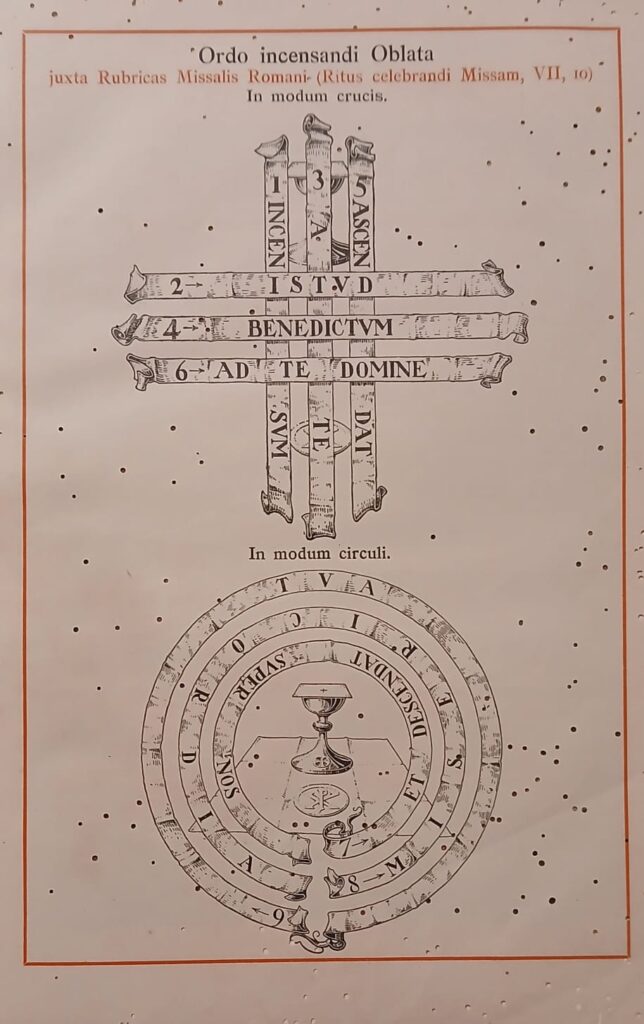
Order of Incensing the Offerings, Roman Missal Rubrics (In the Form of the Cross and Circle; Private collection, Margao, Goa
Dating to an age of ornate liturgy, these diagrams appear in seminary training tools and priestly handbooks, now cherished in Traditional Latin Mass communities, liturgical archives, and museums. They highlight why devotees call the Tridentine Rite a “silent catechism”, actions preach louder than words, fostering awe amid structured beauty.
Today, as interest in the Extraordinary Form surges, fueled by communities like the FSSP and ICKSP, these artifacts remind us of Catholicism’s depth. They invite reflection: in a hurried world, can such deliberate reverence transform worship? Priests following these paths today ensure, a bridge to centuries of faithful practice.
Sadly, this beautiful tradition of incensation has largely faded from use today. Many younger clergy are unfamiliar with the precise rubrics, or may see them as optional rather than meaningful.