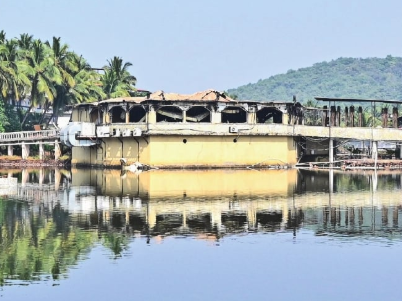
Goa Forward Party (GFP) president and Fatorda MLA Vijai Sardesai has alleged that the Goa Jan Vishwas (Laws Amendment) Bill, 2026 was enacted to protect those accused in the deadly Birch by Romeo neo Lane nightclub fire at Arpora on December 6, 2025, which claimed 25 lives and injured over 50 people.
The Bill was passed by the Goa Legislative As sembly on January 16, the final day of its brief session, amid uproar, with opposition members rushing into the Well of the House. The passage of the legislation has drawn sharp criticism from opposition parties and legal experts, who argue that it undermines accountability and public safety

Speaking during the discussion on the Bill, Sardesai accused the government of converting offences that previously attracted prosecution and imprisonment into mere payable penalties, “Crimes are being rebranded as administrative violations. Law enforcement is being replaced by a rate card. This House must understand the gravity of what has been done,” he said.
Sardesai warned that removing jail terms would destroy deterrence and erode account-ability. “When jail is removed, deterrence dies. When courts are removed, accountability col. lapses. When crimes can be settled by payment, illegality becomes a business model. This is not decriminalisation of minor offences; this is the commercialisation of crime,” he asserted. The Fatorda MLA further slammed the legislation as “Jan Avishwas” (public distrust) rather than “Jan Vishwas” (public trust), arguing that transparency is essential to building public confidence. He alleged that the opposition had been denied access to Cabinet information that could. have revealed when the Ordinance underpinning the Bill was drafted and approved.
Highlighting the broader implications, Sardesai said that in a State already grappling with illegal constructions, un-safe nightclubs, environmental degradation, land grabbing. labour exploitation, and public safety failures, the law sent a dangerous message: “Break the law, budget the penalty, and continue.” He emphasised that laws should protect lives, not violators.
Sardesai also questioned the timing and intent of the Or dinance, suggesting it was tailor-made to shield those re-sponsible for the Arpora nightclub tragedy. He noted that while the government claimed decriminalisation measures began before the incident, the Act was made effective from December 2, 2025, instead of December 9, 2025-the date the Ordinance was published in the Official Gazette-rais-ing suspicions of retroactive protection.
Aldona MLA Adv Carlos Alvares Ferreira raised similar concerns over Section 1(2) of the Bill, warning that it creat-ed the perception that the law was being applied retrospec-tively to benefit those involved in the tragedy. “Laws con-taining penal provisions cannot be applied retrospectively,” he said, adding that “although the Ordinance was promul-gated on December 2, it was published only on December 9, which should be considered the effective date.”
Architect Tahir Noronha also questioned the constitu-tionality of the move, arguing that laws cannot operate prior to their formal introduction. He said the one-week delay in publishing the Ordinance resulted in jail terms for government officers being replaced with fines and alleged that the Bill decriminalises certain actions of government officials with retrospective effect.
Responding to the allegations, Chief Minister Pramod Sawant defended the Bill, stating that the Government of India had initiated decriminalisation by converting impris-onment into fines under various laws. He added that crim-inal provisions under 10 different Acts had been decrimi-nalised and denied that the state government was seeking to protect anyone involved in the Arpora fire tragedy.
Sawant explained that the Ordinance was promulgated on December 2 and remained in force until the Bill was passed by the Assembly. “The government does not want to protect anybody found responsible for the Arpora fire tragedy,” he said.
Despite the Chief Minister’s assurances, opposition leaders and legal experts have warned that the legislation weakens deterrence, undermines accountability, and risks sending a message that illegality can be monetised rather than punished-a charge that comes at a time when public anger over the tragedy remains high.
The passage of the Bill, under circumstances of minimal debate and high political tension, has further deepened distrust among the public and reinforced perceptions that regulatory and legal safeguards in Goa can be bypassed, particularly in cases involving politically sensitive or high-profile incidents.