Dolcy D’Cruz
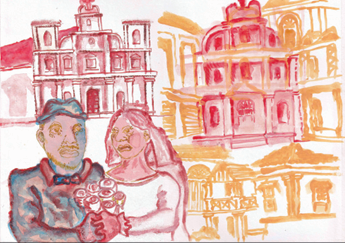
Children’s stories play an important role as both educational and reflective tools, helping young readers understand values while also encouraging families to question social norms such as beauty, identity, and self-worth. Through engaging storytelling and art, they open up meaningful conversations, shaping how children see themselves and the world around them. Maria Vanessa de Sa’s first solo exhibition, ‘The Girl Who Was the Color of Nothing’, opens on April 10 at 6 pm at Gallery Gitanjali in Panjim Pousada, Fontainhas and is curated by Dr R Benedito Ferrão. The show features artwork from the illustrated book ‘The Girl Who Was the Color of Nothing: A Children’s Story for Adults’, co-created by the artist and curator, which will also be launched that same evening. The exhibition will run from April 11 to 19 between 10 am to 6 pm. The exhibition and book ‘The Girl Who Was the Color of Nothing’ features 20 paintings that bring the story’s characters and key moments to life.

The tale explores how adult-imposed norms, including beauty standards linking lighter skin to desirability, affect children’s self-esteem, while also addressing caste, race, and gender roles. Dr R Benedito Ferrão is a professor of English and Asian & Pacific Islander American studies (APIA) at William & Mary and the focus of his research is Goan representation in fiction. “It’s nice that the book is being released in Goa because it’s a Goan story for a Goan audience although it does have universal themes as well. The book does have an adult element in it that Vanessa and I, envisioned as being something that a family could do together. Most children’s books have a message, a kind of educational tool, for children to learn morality or about the world. I knew that the focus was going to be this obsession that we have in South Asia with colorism with skin tone. I also wanted it to be entertaining but also educational and also a little bit serious. I would describe it as being tragicomic,” says Dr Benedicto.
The 60-page book published by The Uninvited, also has a reference to Our Lady of Snow in Raia. “History tells us that possibly the f irst artistic representation of the Virgin Mary to come to South Asia was the image of Our Lady of the Snows in the 16th century. It came via the European Christianizing mission. What really struck me was why they would have chosen Our Lady of the Snows for a tropical place. It’s a very jarring kind of vision of snow in the tropics. I wanted to think about the ways that our impressions of beauty are not only created by our families, but also by other institutions that we f ind ourselves relying upon,” explains Dr Ferrao. He further adds, “I had a very artistic idea of what I wanted the story to do by contrasting ideas of whiteness and colorism with also saying our standards of beauty need not be what they are for anyone else. We should not be invested only in the idea of beauty and whiteness and lightness of skin. We need to think of children as having values that go beyond just skin colour.
Our looks and the colour of our skin changes based on our age. If we get obsessed with these superficial kinds of things, then we’re losing out on developing the whole child, as psychologists would say.” Another reason Dr Ferrao wanted to create this children’s book with the beautiful artistic element that Maria Vanessa de Sa provided was because he thought that Goan children need Goan stories. “It sometimes reveals to the parents themselves how they have unwittingly been relaying ideas to their children without critiquing them themselves,” says Dr Ferrao. Initially, when Dr Ferrao read the book to Vanessa it immediately caught her attention, because it is a very Goan and unique story. “I could relate to it, as I grew up in Panjim listening to familiar stories on colorism and how in our daily life, we use beauty products. As a human being, we have so many layers and personalities to us other than the colour of our skin. Whatever colour, each of us are unique in our own ways.
So judging by the colour of the skin is, to say it’s quite a misconception,” says Vanessa. Vanessa worked on small pieces on A3 size paper with mixed media. Based on the theme of the story, she worked either with pen and ink or acrylics, washes and textures. “What was very important was, working in this team, with Benny and Vishvesh Kandolkar, who helped us to manage the project. There was a lot of open-mindedness and no judgment. In terms of artwork, there was an open-mindedness and it was not technically, but more related to the context and the culture. There were a lot of earth tones which were used. It was more to bring out the environment or the atmosphere in the local Goan homes. We’re looking at the book to open up the dialogue between parents and children,” says Vanessa, who was an architecture student, who learnt art appreciation and art exercises in the initial years. Vishvesh Kandolkar is the project coordinator for this art exhibition and book release. “Obviously, most of the hard work is done by the author and the artist. However, things were not easy for them. They faced a lot of rejections to publish the book and hosting the exhibition.
That is why, I appreciate that Gallery Gitanjali at Panjim Inn, especially Jack Sukhija, has been very gracious to host Goan artists. Previously, they hosted Angela Ferrao and even Vamona Navelcar in 2013, where I first met Dr Benedito. Moving forward, I hope more spaces open up for Goans to exhibit their work, as Serendipity and other art festivals are happy to promote “Goa-based” artists but not necessarily Goans,” says Vishvesh. Dr Ferrao and Vanessa are eagerly awaiting for the book release and the exhibition. “What’s exciting, particularly about the exhibition, is that the viewers will get to see the work as it was first created. This is going to be the only opportunity people have to see the art before it was changed for the book,” informs Dr Ferrao. Speaking about creating Goan books with illustrations, Dr Ferrao says, “There’s been a rise in this notion of illustrated books for children with a Goan theme like Vithai Zaraunker’s ‘The Story of Janakye Bai’ comes from the Velip community. Goan people are thinking about how we preserve our stories. This is supposed to be a children’s book for adults, but it’s still aimed at children. We must involve children in recognizing and preserving our stories.