The High Court of Bombay at Goa has brought to a close a four-year legal battle over the illegal cutting of a hill at Arpora, but what remains unanswered is why it took a citizen-led environmental cam paign and judicial intervention to make the authorities do what they were legally required to do in the first place. The hill behind the Park Regis Hotel, which was subjected to extensive cutting despite being marked as a No Development Slope in the Regional Plan, has now been restored to a stable condition following sustained intervention by the Goa Foun dation and directions from the High Court.
The Court, on Monday, record ed that the primary relief sought in the petition — the restoration of the hill — had been achieved and disposed of the matter. But the restoration was the culmination of more than four years of litigation, inspections and pressure on the authori ties, after the regulatory ma chinery initially failed to stop the destruction. The Goa Foundation first complained to the Arpora-Na goa Village Panchayat on March 31, 2022, after observing heavymachinery cutting into the hill and development activity at the site. The Foundation pointed out that the land was identified as a No Development Slope, where such activity could not lawfully be undertaken. Instead of stopping the work, the panchayat told the Founda tion that it could not act because the complaint did not identify the person responsibleWith the hill-cutting continu ing, the Foundation moved the High Court on April 12, 2022.

The very next day, the Court directed the Flying Squad to immediately stop the activity. A subsequent inspection by the North Goa Planning and Devel opment Authority (NGPDA) ex posed the extent of the damage. The hill had been cut vertically by around four to five me tres over a stretch of approximately 100 metres and hori zontally by about 30 metres. A road nearly six metres wide had also been excavated, involving additional cuts of two to three metres. The authorities subsequently established that the hill-cutting had been undertaken without the permission mandated under Section 17-A of the Goa Town and Coun try Planning Act, 1974. The High Court was particularly scathing about the failure of the authorities to intervene on their own. In its September 6, 2022 order, the Court described the NGPDA’s explanation for its inaction as a “highly lame and insensi tive plea” and made it clear that authorities entrusted with preventing illegal hill-cutting could not simply sit back and wait for citizens to lodge complaints.
The Court also criticised the Village Panchayat for at tempting to evade responsibility. On September 20, 2022, the NGPDA held that the hill-cut ting violated Section 17-A and ordered restoration of the hill to its original condition. The following day, the Village Panchayat revoked the construction licence and issued a similar restoration direction. When the High Court admitted the PIL on October 4, 2022, it went further, restraining any fresh application for hill-cutting permission until the site was restored and put ting further construction on hold. That, however, was far from the end of the matter. The Goa Foundation continued to monitor the restora tion over the next four years through repeated site inspec tions and discussions with the Town Planning Department, technical experts and the private party.
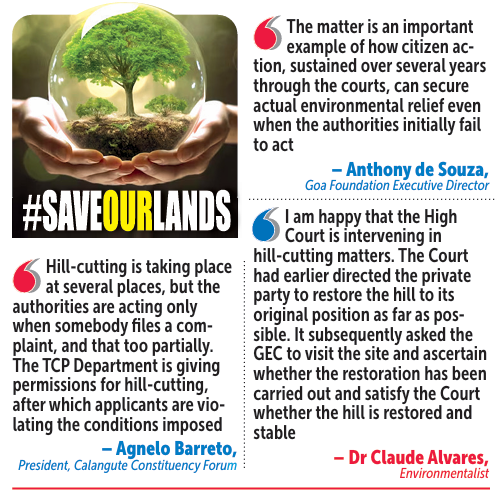
In January 2024, the Court rejected an attempt to con tend that the hill had already been restored, noting that the work had been undertaken without the involvement or technical input of the Town Planning Department. The pri vate party subsequently agreed to prepare a scientifically based restoration proposal. The Foundation continued to insist that restoration could not be reduced to cosmetic earthwork but had to be technically sound and capable of making the slope stable. It was only in October 2025 that the Town Planning Department engaged Goa Engineering College (GEC), Far magudi, to scientifically determine how the hill should be restored. GEC submitted its recommendations in January 2026, following which further restoration work was under taken in accordance with its technical recommendations. In its June 29, 2026 report, GEC found that the slope had been restored to a stable condition and that the restoration complied with its recommendations. Goa Foundation Executive Director Anthony de Souza said the case exposed the gap between environmental safe guards on paper and their enforcement on the ground. “The matter is an important example of how citizen ac tion, sustained over several years through the courts, can secure actual environmental relief even when the authori ties initially fail to act,” he said. De Souza said the hill had not been restored because the authorities responded promptly when the illegal cutting began, but because a citizen-led organisation noticed the damage, complained when it saw the violation, approached the Court when the complaint was ignored and then stayed involved until the restoration was independently verified.
The case, he said, should serve as a reminder that envi ronmental laws cannot be effectively enforced if authori ties wait for citizens to identify every violation. Environmentalist Dr Claude Alvares said the High Court’s intervention was significant, particularly because the Court insisted that restoration had to be independently assessed. “I am happy that the High Court is intervening in hill-cut ting matters. The Court had earlier directed the private party to restore the hill to its original position as far as pos sible. It subsequently asked the GEC to visit the site and ascertain whether the restoration has been carried out and satisfy the Court whether the hill is restored and stable,” he said. According to Alvares, the Arpora case is the second in stance in which the High Court has intervened in such a matter. The first, he said, concerned hill-cutting at Taleigao, where the Court directed a private party to deposit Rs 88 lakh towards restoration.
But environmentalists and local activists warn that the closure of the Arpora case should not be mistaken for an end to the larger problem. Calangute Constituency Forum president Agnelo Barreto said hill-cutting continued at several locations, while au thorities often moved only after complaints were filed. “Hill-cutting is taking place at several places, but the au thorities are acting only when somebody files a complaint, and that too partially. The TCP Department is giving per missions for hill-cutting, after which applicants are violat ing the conditions imposed,” Barreto said. He pointed to ongoing hill-cutting at Orda, Candolim, as an example of the problem. The Arpora case may therefore have ended in court, with the damaged slope finally declared stable.
But its larger lesson remains far less comfortable: a protected hill was cut illegally, the authorities failed to prevent it, and it took years of citizen vigilance and judicial pressure to put the hill back together.