SHASHWAT GUPTA RAY
Most reservoirs fall below 50% capacity; activists warn of stress on supply as rainfall deficit looms

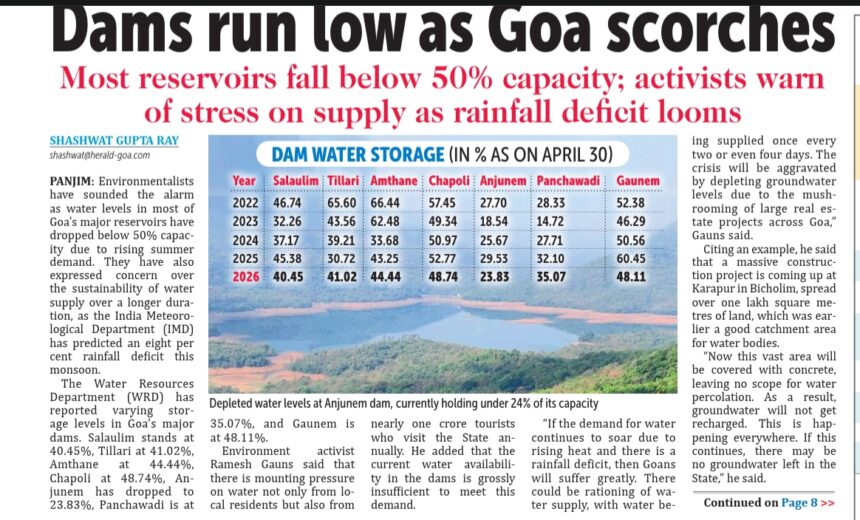
Environmentalists have sounded the alarm as water levels in most of Goa’s major reservoirs have dropped below 50% capacity due to rising summer demand, while the India Meteorological Department (IMD) has predicted an eight per cent rainfall deficit this monsoon; the Water Resources Department (WRD) reports Salaulim at 40.45%, Tillari at 41.02%, Amthane at 44.44%, Chapoli at 48.74%, Anjunem at 23.83%, Panchawadi at 35.07%, and Gaunem at 48.11%, raising concerns over long-term water sustainability; environmental activist Ramesh Gauns warned that pressure on water is increasing due to both residents and nearly one crore annual tourists, saying current dam levels are insufficient to meet demand and warning of possible rationing with supply once every two to four days if heat and rainfall deficits continue; he also highlighted falling groundwater levels caused by rapid real estate expansion, citing a large construction project in Karapur, Bicholim over one lakh square metres of former catchment land now being concretised, which he said will block water percolation and prevent groundwater recharge, warning that if such development continues unchecked, Goa may face a severe and lasting water crisis with depletion of groundwater reserves across the state.
Gauns added that these mega projects will further increase water demand, while Goa currently does not have adequate resources to meet future requirements, while environment activist Rajendra Kerkar said present water levels in dams are unsatisfactory and warned that if rains fail this year Goa could face a severe water crisis, also pointing out that insufficient steps are being taken to protect the State’s freshwater resources, stating that most streams and rivers are polluted and even in remote villages like Sattari drinking water is not potable due to pollutants, with treated water often containing impurities leading to kidney and digestive disorders among people, while former Chief Engineer WRD Sandip Nadkarni said except for Anjunem dam the rest have sufficient storage until monsoon and even with a 10% rainfall deficit between June and August there is no immediate concern though September rainfall could be critical and in the long run storage must be increased through new dams or converting mining pits into reservoirs, while Chief Engineer WRD Dnyaneshwar Salelkar said declining dam levels are a concern but assured water till June and said monsoon will replenish stocks and it is too early for alarm while Minister for Water Resources Subhash Shirodkar said dams have about two months’ supply with Salaulim and Tillari holding two months stock and Panchawadi about one-and-a-half months and added that even with 10% rainfall deficit Goa’s average 110 inches of rain would still provide around 100 inches sufficient to fill dams by November and also highlighted upcoming infrastructure projects including a 60 MLD pumping station on Kushavati River, a 250 MLD station on Chapora River and a dam at Sanguem expected to supply 100 MLD to Margao and Mormugao which he said will significantly improve water availability in future.