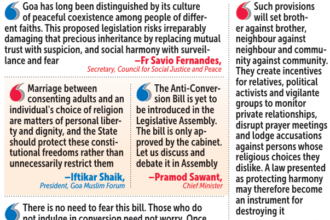
The Goa govern ment’s decision to push a stringent anti-conversion law has brought religion squarely into the electoral arena, raising the stakes of a political gamble that could either consolidate the BJP’s majority vote or hand the Opposition a potent is sue ahead of the 2027 As sembly elections. Even before the pro posed Goa Prohibition of Unlawful Conversion of Re ligion Bill, 2026 is placed before the Assembly, the political backlash is begin ning to expose the risks involved. Opposition parties, mi nority institutions and sec tions of civil society have raised concerns that the proposed law could cast suspicion over legitimate religious meetings, charita ble work and prayer gath erings, creating the possi bility of harassment in the name of preventing unlaw ful conversion. More significantly for the government, the opposition is not confined to the tradi tional political rivals of the BJP.
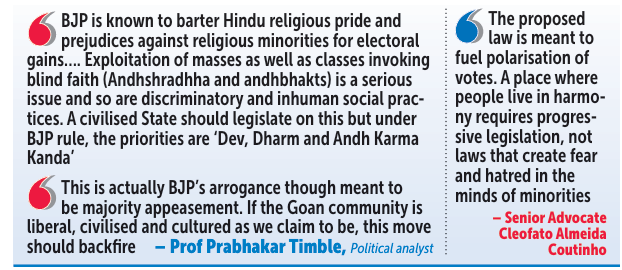
MLAs from minority communities who support the ruling dispensation have also opposed the proposed legislation and sought that it be referred to a Select Committee, sig nalling that the Bill could prove politically uncom fortable even within the ruling side. Independent Cortalim MLA Antonio Vas on Thurs day went a step further, urging Chief Minister Pra mod Sawant to withdraw the legislation rather than table it in the forthcoming Assembly session. The growing resistance has brought into question the political purpose of a law which critics argue ad dresses a problem that has not been demonstrated to be significant in Goa. Political analyst Prof Prabhakar Timble con tended that “BJP is known to barter Hindu religious pride and prejudices against religious minorities for electoral gains.” He argued that the pro posed legislation was not a response to a pressing social problem, pointing out that “conversions by force, allurement or fraud is not at all an issue in Goa” and that legal provisions already exist to deal with such acts. Timble instead said the government should focus on what he described as the more serious problem of exploitation through blind faith and discriminatory social practices.

“Exploitation of masses as well as classes invoking blind faith is a serious issue and so are discriminatory and inhuman social practic es. A civilised State should legislate on this but under BJP rule, the priorities are “Dev, Dharm and Andh Kar ma Kanda”,” he said. His criticism goes to the heart of the political debate surrounding the Bill: wheth er the government is at tempting to solve a demon strable problem or seeking to place religious identity at the centre of the political dis course before the elections. Timble described the proposed legislation as “ab solutely unnecessary and unwarranted”, warning that it could create “nurseries of fanatics and fundamen talists” and encourage self styled “rakshaks” to indulge in private policing, leaving minorities feeling insecure. “This is BJP’s arrogance though meant to be ma jority appeasement. If the Goan community is liberal, civilised and cultured as we claim to be, this move should backfire,” Prof Timble added. Senior Adv Cleofato Almei da Coutinho argued that the government was targeting the wrong problem. “Goa requires an anti-su perstition law, not an an ti-conversion law. There is no case of forced conversion in the State. Why, then, is this law needed?” he questioned.
Coutinho sees the legis lation through the prism of electoral politics, arguing that it could deepen rather than resolve social divisions. According to him, the proposed law is “meant to fuel polarisation of votes”. “A place where people live in harmony requires progres sive legislation, not laws that create fear and hatred in the minds of minorities,” he said. He put the spotlight on the political choices facing legislators who moved from the Opposition benches to the ruling BJP, saying, “I hope the MLAs who got elected on the Congress ticket and switched over to BJP will stand up and oppose this pre-election gimmick.” For the BJP, the political at traction of the Bill is evident. Religious conversion, par ticularly allegations involv ing force, fraud or induce ment, provides the party with an issue through which it can position itself as the protector of religious iden tity. The legislation can po tentially strengthen the BJP’s appeal among voters for whom protection against re ligious conversion is an im portant concern. It gives the ruling party an ideological issue around which its core support base can be mobi lised, at a time when elec toral politics is being shaped by competing narratives of identity, development and governance. But the same calculation carries a signifi cant downside in Goa. Unlike States where reli gious polarisation has been a feature of electoral politics, Goa’s political landscape has been marked by social and religious coexistence. A law perceived as intrusive or targeted at minorities could produce an unintended po litical response, particularly if legitimate religious and charitable activities are seen as coming under the shadow of criminal law. That is where the Bill could become more than a BJP mobilisation tool. The Opposition, already attempting to work towards a broader electoral under standing ahead of the 2027 polls, has an opportunity to turn the legislation into a larger argument about governance, secularism and the protection of individual religious freedom.
Instead of allowing the BJP to define the issue exclusively as a question of protecting peo ple from unlawful conver sion, the Opposition is likely to frame it as an attempt to inject religious polarisation into Goa’s electoral politics. The government’s polit ical challenge, therefore, is not merely to get the Bill through the Assembly. It is to prevent the legislation from becoming a broader symbol of communal politics that unites otherwise fragment ed Opposition forces and pushes sections of the elec torate into a defensive polit ical camp. The proposed anti-con version law thus presents the BJP with a double-edged electoral proposition. It could consolidate the party’s core support by placing religious identity at the centre of the campaign. But if large sec tions of Goa perceive the legislation as unnecessary, divisive or threatening to the State’s tradition of coexist ence, the same Bill could pro vide the Opposition with pre cisely the rallying point it has been seeking ahead of 2027.