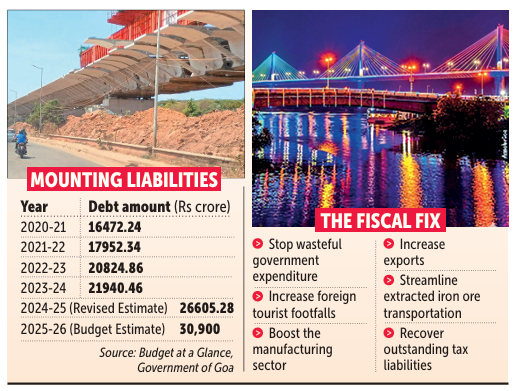
Economic experts have warned that Goa’s public debt, projected to exceed Rs 30,900 crore, risks pushing the State into a debt trap that could stifle developmental spending. With significant repay ments due, urgent action is required to prevent interest obligations from affecting public welfare and infra structure spending. According to the experts, measures such as curb ing wasteful government expenditure, increasing foreign tourist footfalls, boosting the manufac turing sector, increasing exports, and recovering outstanding tax liabilities could help raise addition al revenue to tackle the mounting debt. “While Goa remains one of India’s most prosperous small States, the rising debt levels — both in absolute terms and as a percentage of GSDP — are concerning. A significant concern is the debt-servicing burden.
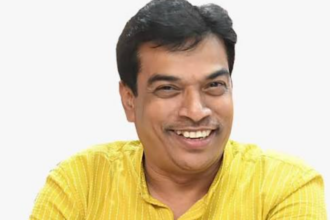
With a major repayment challenge approaching in 2026-27, the State will need to repay over Rs 11,370 crore in loans and interest over the next five years,” tax expert and financial adviser Shivanand Pandit said. He said the current strat egy of replacing existing debt with fresh borrowings, coupled with the fact that 85 per cent of public debt is due for repayment within the next decade, points to the need for more sustain able fiscal discipline. Fur thermore, the economy’s heavy reliance on tourism and services makes it vul nerable to external shocks. “To ensure long-term sta bility, the State must explore revenue diversification into sectors such as IT and sus tainable manufacturing, while improving the effi ciency of capital expenditure and enhancing transparency in the management of off budget liabilities,” he added. Veteran finance expert Binayak Dutta said there is a clear need to reduce fixed costs, which currently ac count for 65 per cent of the total budget. “This includes establish ment costs (12 per cent), salaries and staff expenses (29 per cent), debt servicing (16 per cent), contributions (5 per cent), and subsidies (3 per cent). Alternatively, we should consider paus ing the construction of non-productive assets, such as office buildings, and fo cus on increasing non-tax revenues,” Dutta said.

To strengthen the economy, he suggested prioritising initiatives in new and renewable energy, encouraging in ward remittances from NRIs, aggressively driving foreign tourist footfalls, and boosting exports from the pharma and mining sectors. Senior economics expert Prof Manoj Kamat said that absolute debt is increasing due to continued borrowings. Liabilities as a percentage of GSDP have fluctuated, but continue to show an upward trajectory under baseline projections. “Currently, Goa’s fiscal position is relatively sound, sup ported by a consistent revenue surplus and strong inter nal revenue generation. Its own tax revenue is projected at approximately 7.7 per cent of GSDP, driven largely by SGST collections and non-tax revenue from the power sector. However, this fiscal space is increasingly constrained by high committed expenditures, particularly salaries, pen sions and rising interest payments,” Kamat said. While the State typically generates enough revenue to cover its day-to-day expenses, the fiscal deficit — current ly hovering between 3.1 per cent and 3.4 per cent — ne cessitates continued borrowing to fund essential capital expenditure. “As an economy heavily reliant on tourism and servic es, Goa remains vulnerable to external shocks and global slowdowns, which can rapidly widen these deficits. Fur thermore, our high per capita income often masks under lying sectoral dependencies and economic inequalities,” he said. To maintain the State’s current growth trajectory and avoid higher borrowing costs or pressure on its credit rating, the government must prioritise revenue diversifi cation and contain off-budget liabilities.
Director General of the Goa Chamber of Commerce and Industry (GCCI) Sanjay Amonkar said current budgetary figures indicate that, to ensure long-term sustainability and achieve the projected growth, the government must explore measures such as resolving transportation bottle necks to ensure extracted ore is dispatched promptly and the associated revenues are realised. “We need to recover nearly Rs 2,000 crore in taxes that have remained stuck since the GST transition. The Rs 5,300 crore allocated for capital outlay must be fast-tracked into high-return projects, such as digital infrastructure and initiatives like the Porvorim elevated highway,” Amonkar said. He also urged the government to address the parallel economy in the tourism sector. “By strictly enforcing licensing requirements for homestays and paying guest accommodations, we can en sure compliance with safety norms while also capturing lost non-tax revenue. If we successfully implement these measures, the State’s fiscal position will remain robust,” Amonkar said.