Dolcy D’Cruz
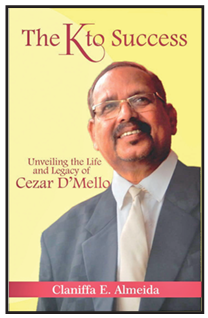
The story of one of Goa’s most respected tiatr personalities has now been captured in print through ‘The K to Success’, an autobiography on the life and legacy of dramatist, writer, singer and folk artiste Cezar D’Mello. Authored by writer and filmmaker Claniffa Almeida, the book traces Cezar’s journey from his childhood in Batim and Panjim to his rise as an award-winning tiatrist and member of the legendary Konkani trio Mil-Mel-Nel. The book offers readers a glimpse into the rich history of tiatr and the evolution of Goa’s vibrant Konkani theatre tradition. The preface has been penned by journalist and publisher Fredrick Noronha. Published by Cezar Dramatic Troupe, Panjim, and printed by Alto Typesetters, Miramar, the book features a cover designed by Willy Goes, Principal of Goa College of Art. Cezar’s fascination with tiatr began at a young age. Born and raised in Batim and Panjim, he grew up watching village performances organised during the annual feast celebrations. “Every December, the gaonkars would come together and stage performances.

Although our ancestral home was in Batim, my father worked in Panjim. During the feast season, people would return to the village for rehearsals and performances, and that is where my love for the stage began,” recalls Cezar. As a child, he eagerly looked forward to attending tiatrs. His father worked in the Post Office and supplemented the family income by working as a male nurse in the afternoons. “I would often take lunch for him and see how hard he worked. At the same time, I was fascinated by tiatr. Whenever famous Bombay artistes came to perform in Goa, I wanted to watch them. I remember standing outside Aliade Hotel near the Post Office, hoping to catch a glimpse of artistes like C Alvares, Prem Kumar and Disha. I used to cry for my parents to take me to watch tiatrs at Azad Maidan in Panjim,” he says. That fascination eventually led him to writing. As a teenager, he would spend hours drafting tiatr scripts at home, often tearing them up afterwards, never imagining they would one day launch a successful career. His breakthrough came through tiatr-writing competitions. His first script, ‘Konn Kirmidor’, won first prize at the Tiatr Competition organised by Kala Academy in 1976. The following year, he wrote ‘Vishwasi O Ghatki’, which failed to secure any recognition, not even a certificate. Undeterred, he continued writing and eventually discovered an unusual pattern. “In the third year, I wrote a tiatr whose title began with the letter ‘K’, and it won a prize. After that, many of the tiatrs I wrote with titles beginning with ‘K’ also won awards. So I continued that tradition,” he says with a smile. Today, Cezar remains active in the arts, focusing primarily on radio plays while continuing to record and perform Konkani duets that are shared online.
One of the most significant chapters of his career was his association with the renowned trio Mil-Mel-Nel, which entertained audiences for nearly four decades. The trio’s origins were rooted in a competition. Nelson Afonso, who had left his previous trio, was searching for new talent. Cezar and Milagres Fernandes applied, initially intending to perform as a duo. However, they invited Joe Mendonca to join them and formed a trio for the audition. “We wrote our own lyrics and performed before judges including Nelson Afonso, Tony and Marcelin de Betim. We were selected. Joe stayed with us for about three years before being replaced by my friend Agnel D’Costa. That was when Mil Mel-Nel was born,” says Cezar.
The trio went on to perform professionally from 1977 onwards, becoming a familiar name on the Konkani stage. While Agnel D’Costa has been living abroad for the past decade, the group occasionally reunites for special performances and musical shows. Their early repertoire consisted mainly of political songs before gradually expanding into comedy and entertainment numbers. Their first professional payment in 1977 was just Rs 15 each. Over time, as their popularity grew, so did their earnings, eventually rising to Rs 1,000 per performance. Those early years were marked by sacrifice. The trio travelled by bus because it was the cheapest option. On some occasions, they slept in Margao’s municipal garden and frequently relied on ferry boats to reach performance venues across Goa. Another turning point came when they joined John Claro’s hugely successful tiatr ‘Portuguese Kolvontt’, which went on to complete more than 100 performances. The original trio in the production had been replaced, and Cezar’s group was invited to fill the vacancy.
The opportunity opened doors to performances in Bombay and introduced them to wider audiences. “We travelled to Bombay twice with ‘Portuguese Kolvontt’,” he says. Reflecting on the evolution of tiatr, Cezar believes much has changed. Earlier generations of performers often relied on prompters because many artistes held full-time jobs in Bombay and had limited rehearsal time. Modern actors, he says, are more professionally prepared. “Today there is much more innovation in lighting, sets and stage effects. But when it comes to storytelling, the older tiatrs were stronger. Comedy was integrated into the story. Now it sometimes feels like audiences are watching two separate tiatrs, one for the story and another entirely for comedy,” he observes. The book itself is a labour of love. Cezar spent nearly three years searching through old family photographs that would complement Claniffa’s narrative. Many of the images date back to an era when cameras were rare and photographs were taken primarily in studios. As a writer deeply rooted in fiction and literature, Claniffa admits that she was initially sceptical about stepping into the realm of biography. “As I began writing about Cezar D’Mello, I quickly realized the as audiences, we only ever see the artist under the spotlight, radiant, polished, and performing. But behind the velvet curtains lies a completely different life, filled with untold struggles.
When Cezar began narrating his journey to me, I felt a profound conviction that this was a story the audience needed to know. The bitter truth of an artist’s life is that no matter how heavy your personal burdens are, the moment you step on stage, you must wear a smile and perform. That unspoken contract with the stage is the very soul of this book. I feel incredibly overwhelmed and blessed to have penned the story of a man who has made such massive waves in the Tiatr and Goan entertainment industry, especially as part of the legendary trio: Mil Mel Nel,” says Claniffa Beyond documenting his own journey, Cezar remains passionate about preserving tiatr heritage. As former Member Secretary of the Tiatr Academy of Goa, he encouraged writers to archive their works and helped organise revivals of classic tiatrs by legends such as Prem Kumar, C Alvares and Nelson Afonso during the celebrations marking 125 years of tiatr. “It is important that future generations know who these great writers were. Their works should be preserved, published and documented for posterity,” he says. ‘The K to Success’ is available at Varsha Book Stall near Café Bhonsle and Broadway Book Centre in Panjim.