PANJIM: A day after Chief Minister Pramod Sawant announced that the controversial smart meter rollout would be put on hold, protests continued across Goa on Saturday, signalling that public anger over electricity-related issues extends far beyond the installation of the devices themselves.
From Panjim to Bandora, activists and opposition parties remained on the streets, demanding relief from inflated electricity bills, withdrawal of penalties imposed on consumers, and a complete scrapping of the smart meter project. The continuing agitation has also exposed growing political discomfort within the ruling establishment, with the controversy trigger-ing criticism not only from the Opposition but also from within the government’s own ranks.
In one of the most visible demonstrations of the day, Aam Aadmi Party (AAP) leaders and volunteers organised a ‘Jan Aakrosh’ morcha to Power Minister Sudin Dhavalikar’s residence at Bandora, accusing the government of burdening ordinary consumers with excessive electricity charges.

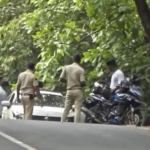
The protest took an unusual turn after police allegedly prevented the group from proceeding to Mahalaxmi Temple. The AAP delegation instead visited Shri Nagesh Temple, where they said they prayed for wisdom for the Power Minister to provide relief to consumers facing soaring electricity bills.
“BJP is so afraid of people’s anger that it stops citizens from even entering a temple. It is clear that its downfall in the 2027 Assembly polls has already begun,” alleged AAP State president Valmiki Naik.
Naik said the government must urgently provide relief to poor and middle-class families, many of whom are struggling under electricity bills that in some cases exceed their monthly income.
AAP leader Geetesh Naik said the party had intended to submit a memorandum seeking a waiver of penalties but was prevented from doing so by police. Party leaders maintained that their agitation would continue until all penalties are withdrawn and consumers receive relief from what they described as unjust and exorbitant power bills.
In Panjim, activists who have spearheaded the anti-smart meter campaign celebrated the government’s decision to pause the rollout by distributing ‘mangane’ at Azad Maidan. However, even as they welcomed the retreat, they made it clear that the battle was far from over.
Activists Gajanan Tilve and Yogesh Govekar alias Mogambo described the government’s move as a victory for sustained public pressure but insisted that merely suspending the project was insufficient. They argued that unless the scheme is permanently withdrawn, consumers would remain vulnerable to its future revival.
The controversy has also acquired a significant politi-al dimension, with opposition leaders claiming that the government’s handling of the issue has exposed fault lines within the ruling alliance itself.
Advocate Amit Palekar said the developments surrounding the smart meter controversy revealed deep contradic-tions within the BJP-led coalition despite the Power portfolio being held by an alliance partner.
“The developments surrounding the smart meter issue show that political calculations are taking precedence over public interest. Instead of focusing on resolving citizens’ concerns, the ruling establishment appears more preoccupied with managing its political equations and safeguarding its position in power,” Palekar said.
The Congress also intensified its attack on the government, arguing that the rollback exposed serious flaws in the manner in which both smart meters and penalties linked to sanctioned electricity load were implemented.
Goa Pradesh Congress Committee president Girish Chodankar questioned why consumers were penalised instead of being assisted by the Electricity Department. “The government has access to every consumer’s address, mobile number and billing records. Why were individual notices not issued? Why was the burden shifted entirely onto ordinary citizens and penalties imposed for alleged non-compliance?” Chodankar asked.
As criticism mounted, even BJP State president Damu Naik conceded that the Electricity Department had failed to create adequate awareness about penalties imposed on consumers for exceeding their sanctioned load.
Facing mounting public pressure, Power Minister Sudin Dhavalikar announced that penalties already collected from consumers would be adjusted in future electricity bills. He said the delay in scrapping the penalties was caused by the model code of conduct during the Ponda Assembly by-election and technical issues.
Dhavalikar defended the government’s actions, stating that the penalties were imposed following directions from the Joint Electricity Regulatory Commission and that advertisements had been issued informing consumers about load declarations and smart meter installations.
Responding to criticism from opposition parties and activists, he said, “I am well aware of the problems of the common man and poor people because they meet me every day. I do not need lessons from AAP or NGOs.”
At the same time, the minister appeared to acknowledge the political sensitivity of the issue. He revealed that he had earlier felt the penalties could trigger a backlash but said the financial implications required a Cabinet-level decision.
“In the beginning I had realised that levying penalty was wrong and was aware of backfire. But since there were major financial implications I could not take decision and such decisions having financial implications are taken only by Cabinet,” Dhavalikar said.
The minister also could not conceal his displeasure over public criticism from within the government, remarking that policy issues should be discussed inside the Cabinet rather than aired publicly.