Elsa Angel Rose
Himanshu Jangra, fl ippantly saying “Maine kaha yaar 370 rupaye lage hai, wasool toh karunga (I have spent 370 rupees, I am going to get my money’s worth),” has been making its rounds on social media. The clip is from the crowd work session of stand-up comedian and Big Boss 19 contestant Pranit More’s show, where he pays his crowd for sharing the funniest story. In this viral clip, Himanshu is sharing his dating experience, in which he explains how he took a girl out, bought 370 worth of biryani, and coaxed her into a physical relationship with him because he needed to make the date worth the Rs 370 he had spent. (This is just the viral part of the now-deleted clip; the entire video included the person describing graphically what was done to the girl and other details.) As soon as the clip went viral, Himanshu got sacked from his job, and an FIR was fi led against the comedian, Pranit More and Himanshu. The video clip shows Himanshu explaining what he did to the girl, where he did it in the breeziest way possible. Then there is a whole crowd of men and women who seem to fi nd his story funny and interesting, and the comedian and owner of the show, Pranit More, is constantly encouraging the already speaking Himanshu to share more, laughingly saying ‘Ha wasool toh karna hein’ and ‘peak Gurgaon content’. Now, what this clip reveals is something way too intense. The dating culture in India is dynamic, but what happens when the dating pool is full of people who associate money with consent, intimacy, a ection and more? Will a date be a date anymore or more like a deal? Some men like Himanshu think that they can purchase a ection, intimacy and connection. It also unravels a much deeper problem, one which is still buried deep in the underground; men like him are not concerned, or most probably are not aware, that women can also have their own choices and opinions. As long as he is concerned, he needs to coax the woman into a physical relationship by buying her dinner, pretending to be sad or pushing her until she says yes. Perhaps such men do not consider women as humans or more as objects and that they should have no opinion, ideas, thoughts, for that matter. It is such blatant ignorance and infl ated sense of entitlement that leads to sexual harassment, domestic rapes and other pressing issues. Both Himanshu Jangra and Pranit More have released apology statements, in which Himanshu emphasised that the story he shared was exaggerated for monetary reasons.

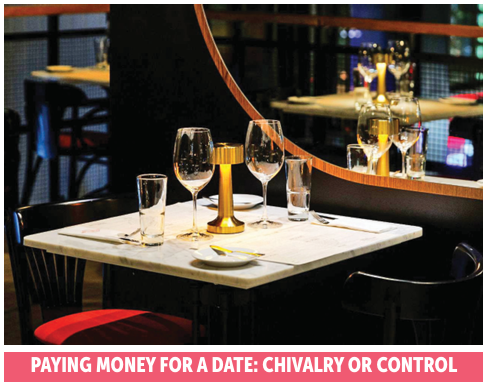
Addressing the elephant in the room: who has to pay for the date? The man or the woman? Many say the man should pay out of chivalry, while others advocate splitting the bill in the name of equality. In the end, it all boils down to personal choice. “I think it depends on how the couple sees it. If it’s an expectation that one person, usually the man, always pays, it doesn’t really promote equality. But if someone o ers to pay as a gesture, especially at the start, that’s fi ne. When both people are fi nancially independent, I don’t think men should always pay. In the early stages, splitting the bill or alternating feels more balanced. If one person invites the other and o ers to pay, that’s a kind gesture, but it shouldn’t be expected every time,” said Shane Frank Remedios, a young adult from Cumbharjua. Asking the same question to a woman, Barsa Maze, 29-year-old, makeup artist from Margao shared, “If women want to be treated equally, they can’t also expect men to always pay just because ‘that’s how it’s always been’. That’s having it both ways. Equality means sharing responsibilities, including the bill. Expecting a man to always pay just because he’s a man is a double standard, plain and simple. Real chivalry is about mutual respect, not a one-way fi nancial obligation. When both people are fi nancially independent, there’s no reason one should always pay just because of their gender. That’s not romance, that’s just an old habit. If feminism fi ghts for equal rights, equal pay, and equal respect, then that equality should apply at the dinner table too.” Dividing the bill appears to be a power move for Barsa. She said, “And honestly, splitting the bill is a power move. If you don’t vibe with the person, you walk away clean, no guilt, no unspoken expectations, and no guy saying ‘I spent money on her’. Real independence means owning your rights fully even when it costs you half the dinner bill.” But something that needs to be reiterated, however much as possible, is that just because you paid for the date, it does not entitle you to the other person’s time, energy, attention, a ection, or intimacy. It should not be made into a deal where whoever pays is entitled, and the other person is obliged. “Any entitlement in dating is questionable, whether it’s from a man or anyone else. Just because someone paid doesn’t mean they’re owed something. If that happens, it makes dating feel like a transaction. Dating should be about mutual interest and respect, not tied to money or e ort,” said Shane. Barsa commented on the same, “A man who thinks he’s ‘owed’ something just because he paid for dinner isn’t being romantic, he’s making a transaction disguised as a date. Real generosity has no strings attached. The moment it comes with expectations, it’s not chivalry, it’s manipulation.”
DOES DATING EQUAL A TRANSACTION?
“Dating these days seems to be kind of a selected way to hurt oneself. It feels like an exchange and a transaction, as people only want something from you and don’t want you for you. It’s a very di erent world compared to what it used to be a few years ago, and personally, I despise it,” said 21-year-old Bernice Mendes from Aldona. If everyone is entering the dating pool with the thought of making the most out of it in an economic sense, is it even a date? When did dating, something associated with romance, having fun, getting to know each other, become about who is spending how much? How to get the maximum out of each other? Is it worth the money and more? Won’t such thoughts or perceptions remove all the happiness of dating someone or seeing someone? Something which you do out of sheer caring or interest in someone. The commodifi cation of human beings through dating apps can be considered a reason. Subscriptions, premium features, and more on dating apps for meeting people give the idea that human connections can be bought to an extent. Then there is the wide pool of people; all you need to do is swipe right or left, and you can get yourself a date every now and then, which, in a way, removes the importance of patience and forming a connection gradually, without having access to the person’s profi le beforehand.
DATING IS DIFFERENT FOR MEN AND WOMEN
“Men in the dating pool usually want women for physical needs and barely ever date them, whereas women want the emotional connection and bond (usually). Women tend to want to be loved on various occasions and fall for the various manipulative tactics put forth by men because they’d rather have a moment’s bliss than a full grown relationship, but women are learning to deal with these things and not get into situations they know that’ll clearly hurt them,” said Bernice. Dating experiences are evidently on two ends of a pedestal for men and women. “From a woman’s perspective, I only ever choose to be intimate with someone whom I’ve known for a while and know that they’re a decent human being. Whereas, for a man, I don’t think these aspects really matter to them,” said a young girl from Margao who requested anonymity. Kresden Pimento, a Mumbai-based Goan youngster, shared, “The biggest challenge I’ve faced is a lack of understanding and poor communication. This has led to many fi ghts, which seem small initially but proceed to build up over time. There is also a doubt about how much you can actually trust the person and if it’s actually going to work out long-term.”