Tomás Amansio Rodrigues
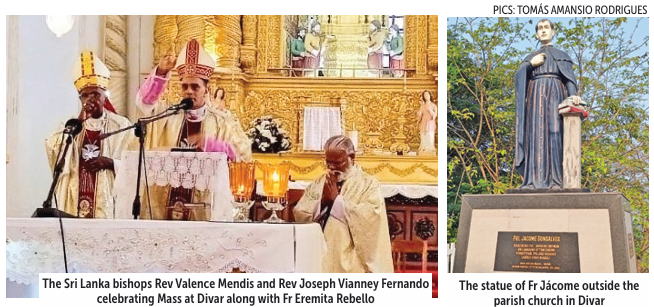
The island of Divar is known for many reasons and draws tourists from across the world but in February 2026 it brought two visitors for a very special and different reason. Bishop of Kandy, Bishop Valence Mendis and Bishop Emeritus Joseph Vianney Fernando came to Divar to visit the birth place of Catholic priest Fr Jácome Gonçalves whose 284th death anniversary is observed today, July 17. In the annals of Goa’s history, Fr Jácome remains quite forgotten, but Divar and Sri Lanka remember and revere the Oratorian priest and missionary who was a close companion to St Joseph Vaz and accompanied the latter in his mission in Sri Lanka, then known as Ceylon, and under Dutch occupation. Born on June 8, 1676, at the parish of Graça, Chorão, at his mother Mariana de Abreu’s home, Jácome’s father Tomás Gonçalves was from Piedade, Divar. They came from a Catholic family of many generations, being among the first native converts. He studied at the Jesuit College of Goa and in 1696, he began theological studies at the Academy of St Thomas Aquinas, where he possibly developed a taste for poetry, prose and music. He was ordained priest in April 1700 at the Cathedral of St Catherine and joined the first native Goan priestly congregation that of the Oratorian of St Philip Neri.

Residing at the Cruz dos Milagres, he is known to have practiced austerity, fasting on every Friday and Saturday, and seeking to be detached from all worldly attachments, he never visited his family again. Just five years after his ordination, in May 1705, he set off for Ceylon, heeding a call from the congregation founder, Fr Joseph Vaz, who would later be raised to sainthood. Fr Jácome arrived in Ceylon in August 1705, having learnt the Tamil language during his journey to the island nation. Recognising Fr Jácome’s intelligence and aptitude for languages, Fr Joseph Vaz got him to study the Sinhalese language and the customs of the people, a task that did not prove difficult for Fr Jácome. His expertise in the language is proven by the 42 books he penned in Sinhala and Tamil, composed music, motets and wrote passion plays. For this contribution, he is rightly called the Father of Catholic Literature in Sri Lanka. His was not just an academic mission in Ceylon and he converted several villages to Catholicism, and it is believed that he baptised more than 10,000 to the Catholic faith.
When he died, his mortal remains could be buried only 48 hours later as people flocked to pay their last respects to the saintly personage and miracle worker. At his funeral oration, Fr Custodio de Andrade said that while Fr Joseph Vaz planted the seed, Fr Jácome watered it and Goa made it bear fruit. The fruit that it bore is what brought the bishops of Kandy to Divar earlier this year and got them to sing Sinhala hymns composed by Fr Jacome. Along with Fr Joseph Vaz, Fr Jácome is the second Goan whose missionary zeal, cultural sensitivity, and unwavering faith in the face of persecution kept the flame of Catholicism burning bright in Sri Lanka.
In keeping with the ideals of St Joseph Vaz, he too encouraged Catholics to express their faith through their native languages and cultural forms. This helped create a distinctly Sri Lankan Catholic identity that managed to survive even after Portuguese political power had ended. For that reason, although St Joseph Vaz is recognised as the leader of the Ceylon mission, historians do view Fr Jácome as the mission’s principal intellectual and literary figure. While, St Joseph Vaz rebuilt the pastoral Church in Sri Lanka, Fr Jácome’s writings provided the texts required to sustain the Catholic communities across generations. That country hasn’t forgotten him and what he did for the faith there, and this connection serves as a bridge between Goa and Sri Lanka that unites the two in the Catholic faith, even almost three centuries after his death. Divar remembers Fr Jácome as a gifted son who answered God’s call beyond its shores. Sri Lanka honours him as a missionary, scholar and poet.
His life stands as a reminder that the richest legacies are often those shared across borders, languages and cultures. Following the canonization of St Joseph Vaz, the people approached the Archbishop of Goa seeking to start the process for the canonization of Fr Jácome. They were informed that though Fr Jácome was a Goan priest, he worked and died in Chilaw Diocese in Sri Lanka and the process has to be initiated by the bishop. The people of Divar were encouraged to make known the works of Fr Jácome in Goa. Acting on this a committee was formed to create this awareness. The school hall was re-named as Fr Jácome Gonçalves, the road from Our Lady of Divar High School (Fr Jácome’s ancestral house), passing in front of the Chapel of Lord Redeemer, Maddant, Navelim and leading to the Divar-Sao Pedro ferry point, has been named after him.
Simultaneously, there are also efforts in Sri Lanka and, interestingly, the two Sri Lankan bishop’s who came to Goa earlier this year, not only prayed at the Church of Our Lady of Piety, Divar, along with Fr Eremita Rebello, but while one of them played on the church organ, the other sang a Sinhala hymn composed by Fr Jácome, which brought about an emotional feeling among the parishioners present. Today, the Church in Goa and Sri Lanka is preparing for the cause of Fr Jácome’s beatification and eventual canonization where he will join St Joseph Vaz at the altar. It is wish of every islander to see him declared a Saint and they pray that it will happen soon. (Tomás Amansio Rodrigues is an independent researcher interested in Goan history and has been actively involved in promoting the cause of Fr Jácome Gonçalves.)