Dolcy D’Cruz
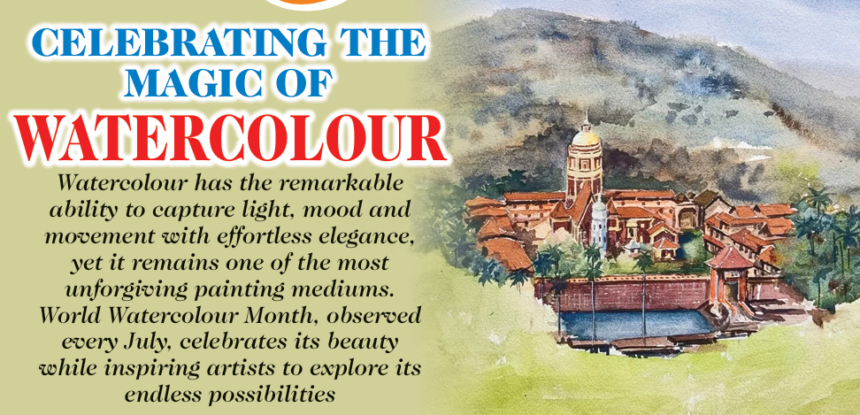
Watercolour may appear to be one of the gentlest painting mediums, but behind its soft washes and luminous colours lies one of the greatest challenges an artist can face. Transparent, fluid and often unpredictable, watercolour demands confidence, precision and an understanding of how water and pigment behave on paper. Unlike acrylics or oils, where mistakes can be painted over, watercolour offers little room for error. Every brushstroke matters, making planning and control essential. Once water touches the paper, the pigment begins to flow freely, often creating unexpected textures and blends that artists must learn to embrace rather than resist. Every July, artists around the world come together to celebrate this remarkable art form through World Watercolour Month, a global initiative observed from July 1 to 31. Established in 2016 by artist and author Charlie O’Shields, founder of Doodlewash, the celebration aims to inspire people of all ages and skill levels to explore watercolour while supporting art education worldwide. Over the years, World Watercolor Month has grown into an international movement, with thousands of artists from more than 100 countries participating. Throughout July, artists create and share watercolour paintings, join online challenges, attend workshops and demonstrations, participate in exhibitions and connect with fellow artists through social media using hashtags such as #WorldWatercolorMonth. Renowned photographer Prasad Pankar began his watercolour journey only in May this year, but says his passion for learning something new every year led him to the medium. “Every January, I set myself a goal to learn a new skill. This year, I chose painting because I had always wanted to learn it. Painting and photography go hand in hand—they are both visual mediums. I started with sketching and gradually moved to painting. Watercolour has always fascinated me. Whenever I see a beautiful watercolour painting, it touches the core of my heart and soul. So, it wasn’t surprising that I chose this medium,” says Mapusa-based Prasad. “Watercolour is both beautiful and challenging. You never know exactly how a painting will turn out, and that’s what makes it exciting. At the same time, it is an unforgiving medium. Once a brushstroke is made, it’s permanent. Unlike oils or other opaque mediums, you can’t simply paint over a mistake. Watercolours are transparent, and everything depends on controlling the amount of water.

A little too much or too little water can completely change the outcome.” Talking about World Watercolor Month, Prasad is enjoying approaching the daily prompts from an unconventional perspective. “I’ve been conceptualising photographs for over two decades, so thinking creatively comes naturally to me. Rather than taking the obvious route, I enjoy interpreting the prompts differently. For example, one of the prompts was ‘Pickle’. Most people would probably paint a jar of pickles. I painted the side profile of a person with darkness inside the head and wrote, ‘When you’re in a pickle, look within. We already have all the answers inside us.’ Since I’m philosophical by nature, my ideas often take this direction. I’m enjoying the challenge immensely,” explains Prasad. Watercolour remains one of the world’s oldest and most accessible painting mediums. Its portability makes it ideal for plein-air painting, while its transparency and luminosity allow artists to create soft, fluid effects that bring landscapes, botanical studies, wildlife and urban sketches to life. These qualities continue to make it a favourite among artists seeking to capture the ever-changing beauty of nature and everyday life. Mrs India – Queen of Substance 2023 winner Yogita Walke loves painting with watercolours because of their transparency and the unique textures they create. She says every watercolour painting is different, making it the most surprising medium to work with. She began painting with watercolours in 2021 and enjoys creating landscapes, sunrises and sunsets. “I have my website, paperpainthaus.com, where I share my art in the form of stickers, art prints and postcards.
I also have a monthly mail club. Being a former science professor, I teach watercolours in a structured way. I have designed three levels, beginner, intermediate and advanced, to guide aspiring artists who want to learn watercolours. This course is where my profession as an educator meets my passion for painting,” says Yogita. Sachin Revankar, an engineer by profession, started a series called ‘Goenchi Osmitai’, where he capture Goa’s traditional festivals through live painting. “So far, I have documented more than 40 festivals, painting them live as the celebrations unfold. These works are all done in acrylic. I began my artistic journey with watercolours, especially painting landscapes and still life. I consider myself a travel artist and have painted in several countries, including Germany, where I painted the Cologne Cathedral, besides creating many Goan landscapes in watercolour,” says Margao-based Sachin. Sachin describes watercolour as one of the most demanding mediums. “Watercolour is unpredictable, especially in Goa’s humid climate. The way the paint behaves depends on the weather, the temperature, the amount of water and even the time of day. The same colours can produce completely different results on different days. Everything depends on the very first brushstroke. Once you begin, you have to work with confidence because there is very little room for correction.
The sketch has to be accurate, and every application of colour must be carefully planned. Painting with watercolour has a rhythm of its own, and mastering it is not easy. I enjoyed working in watercolour and completed many paintings, but there were times when the afternoon heat would dry the paper almost instantly. You would apply water and it would evaporate before the paint had a chance to flow properly. That made it difficult to execute the ideas I had in mind,” he explains. For artist and art educator Chaitali Morajkar, watercolour has been a constant companion since childhood and remains her favourite medium even after 25 years as a freelance artist. “Watercolour has always been my favourite medium. I have been working as a freelance artist for the last 25 years and teaching for the past 15 years. My journey with watercolours began in childhood, and I have always loved painting landscapes.” Explaining what makes the medium so special, she says, “I love the very naïve quality of watercolour. It is a transparent medium with its own softness and a very fragile character. I especially enjoy teaching the wash technique because it beautifully showcases the medium’s unique qualities. Watercolour itself is a very meditative medium compared to all others.
At the same time, it is probably the most difficult medium to master. People often think oil painting is the hardest, but I always say watercolour is more challenging because there is very little control. It is spontaneous, and once you make a mistake, you can’t simply correct it.” She further adds, “It is a hard medium, but it is also a very lovable one because of its unique qualities. Watercolour teaches patience and helps you learn how to deal with situations as they arise. As a teacher, I always tell my students that if they learn watercolour well, handling other mediums becomes much easier. The discipline, observation and confidence you develop through watercolour can be applied to every other medium.” For many artists, World Watercolour Month is an opportunity to experiment, learn new techniques, challenge themselves creatively and become part of a vibrant global community united by a shared love for watercolour.