Vivek Menezes
For the first time in many years, an artist from Goa and Goa College of Art is taking centerstage in one of the most important and influential Mumbai galleries. After four solos at Experimenter in Kolkata in 2017 (Ground Zero), 2020 (Monuments, Mausoleums, Memorials, Modernism) and 2023 (Spectres, Specimens, and Ships in Doubt), the thoughtful and highly skilled 34-year old Sahil Naik of Ponda will inaugurate Sour Stars and Breadfruit Monsoons on July 31 at Experimenter’s lovely Mumbai exhibition space in an old heritage building behind the Taj Mahal Hotel. I was lucky to get a preview walkthrough with the artist earlier this week, and loved every bit of what he’s managed to achieve.

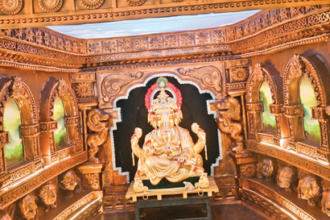
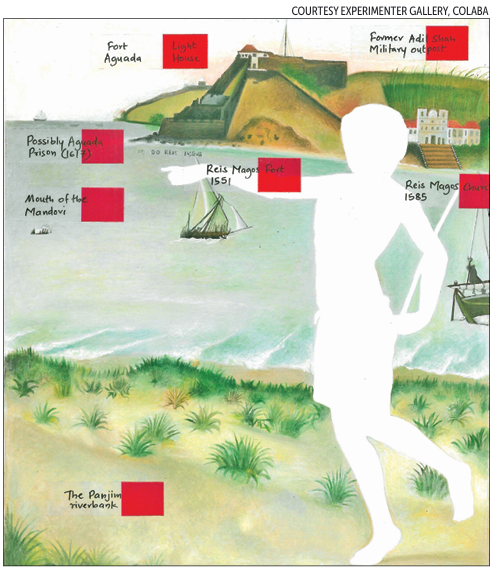
There is tremendous historic synchronicity here, between the artist, subject and location, in a remarkable rekindling of the long trajectory of cultural connections interlinking Old Bombay and the erstwhile Estado da Índia. The showstopper in this regard is Naik’s spectacular 2025 cement, wood, lime plaster and emulsion artwork Distant Whispers and Lucid Dreams: Garcia da Orta, which was shown in Panjim at the Serendipity Arts Festival last year, but shines infinitely more brightly in this Apollo Bunder location, just down the waterfront from Bombay Castle, the original dwelling of the great 16th century physician who wrote the 1563 classic Colóquios dos simples e drogas da India. We remember him for that book, but less known is that his Bombay estate was the effective foundation
stone for the modern megalopolis, and the bulk of what was transferred to England from Portugal in the 1661 dowry of Catharine of Braganza. Now, with great panache, amcho Sahil has brought Orta home. “It is particularly meaningful for this work to be seen here and in its right context,” said Naik to me via email the day after we met, “especially given Mumbai’s own history and role in the larger colonial story. Bombay links to Goa and Gujarat amongst other ports along the Afro-Asian seas, and I have been looking at some of the stories located here, like epidemics, and the story of St John the Baptist church in SEEPZ for example.” These are perennial preoccupations: “I am a Goan artist and my work examines global-Southern histories from our perspective and location. I am interested in the stories, objects and spirits that passed through our land, but also to discover direct, indirect and affinitive/similar contexts. Goa is both a site and link in my work, and over the years I have drawn connections from Nagasaki in Japan to Salvador do Bahia in Brazil.
I am also interested in “minor histories” or what I also like to call peoples histories – those that were preserved in story, song, rumours, legends and rituals. I seek these, and they mostly stay front and center in my work. It is so important to reclaim our histories in our own voice and words, more so today when they are being compromised.” On the day Naik and I were talking in Colaba, thousands of young people were on the roads at Dadar, in solidarity with the ongoing protests in New Delhi. The young artist told me he intended to join them: “Art is political. It cannot be disconnected from the social and political context it is made in, otherwise what is the point? My exhibition is up, but it is more important right now to be in solidarity with our students. I will be at the protests because it is the right thing to do, and I hope we will all do the same, and bring our families and friends along. Art is not tied to its exhibition alone, it has a life beyond, but to register our protest is urgent. Our constitutional freedoms must be defended, and accountability must be sought. We should all be finding our way to support the students.” Far too long – indeed across generations – the Mumbai art world has overlooked contemporary Goan artists, despite the obvious fact that exemplars from Goa powered the rise of modern art in this city in the first place: Antonio Xavier Trindade (1870-1935) the “Rembrandt of the East” at Sir JJ School of Art, and Angelo da Fonseca (1902-1967) who abandoned JJ for Shantiniketan in 1930, also Francis Newton Souza (1924-2002) the ebullient founder of the all-important Progressive Artists Group, along with his lifelong friend pioneer abstractionist Vasudeo Santu Gaitonde (1924-2001). Later, it is impossible to overstate the impact of Mario de Miranda (1926-2011).
It is good to see this inexplicable long standing anomaly seems on the verge of being resolved in 2026, as Sour Stars and Breadfruit Monsoons opens just after A Disquiet Tide closes at Fulcrum just up the road in Kala Ghoda, where Satyam Malhar, Wenceslaus Mendes, Pradeep Naik and Ashish Phaldesai have looked at “the mangrove ecologies of Goa not as objects of study, but as lived environments shaped by tides, labour, memory, and time.” Given the talent pool in India’s smallest state, there should be much more of the same, and Naik says “as artists we must always find community and move beyond the self. No artistic practice can survive or grow in isolation. I had the privilege of growing with peers from Goa, Baroda and now artists from the Experimenter programme, and each day has been a learning curve. My recommendation is for artists to apply for residencies, and find peer groups where work and politics can be discussed. These are very important.