ANIL KUMAR MISHRA
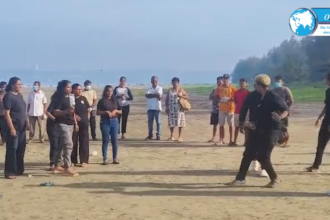
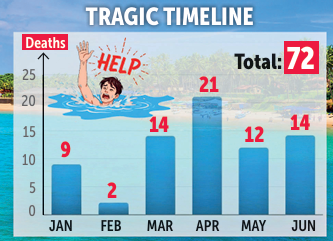
Behind Goa’s post card image of sun, sand and surf lies an alarming public safety crisis. 72 people lost their lives by drowning dur ing the first six months of 2026, exposing the deadly risks lurking not only along the State’s beaches but also in its rivers, waterfalls and other inland water bodies. Official data shows that April alone accounted for 21 deaths, making it the cruellest month of the year. The figures also reveal that drowning fatalities be gan climbing sharply from March — well before the on set of the monsoon—under scoring that Goa’s drowning crisis is no longer confined to rough seas during the rainy season but has become a year-round concern. The alarming numbers have triggered calls for stronger enforcement, bet ter public awareness, im proved rescue infrastruc ture and a coordinated strategy involving multiple government agencies before the next tourism season. Even as authorities in tensified monsoon safety measures, close calls con tinued to unfold across the State. State-appointed lifesaving agency Drishti Marine responded to 495 incidents during July alone, rescuing 246 people from potentially fatal situations. Forty-four lost children were reunited with their families, while four drown ing deaths were neverthe less recorded despite exten sive rescue efforts. North Goa accounted for 246 incidents, while South Goa reported 249. Lifesav ers carried out 159 res cues in North Goa and 87 in South Goa, with Morjim recording the highest num ber of rescues in North Goa and Benaulim leading in South Goa.

Several operations also involved fishermen caught in rough seas. The agency attributed the successful rescues to the rap id deployment of trained lifesavers, jet skis and coordinated emergency response teams stationed along Goa’s coastline. During the monsoon, more than 450 trained lifesavers and beach marshals have been deployed across beaches, water falls and inland water bodies, with the strength increasing to over 480 personnel during peak weeks. Despite the expanded deployment, rescue agencies ac knowledge that critical gaps remain. “We are dependent on Navy divers whenever an emer gency occurs. If we get at least five well-trained divers, we can function more efficiently,” a senior Fire and Emergency Services (FES) official said, highlighting a shortage that con tinues to hamper emergency response. Officials say drowning deaths stem from multiple causes, many of them preventable. “There are different reasons. Some die by suicide, some drown accidentally while fishing, and some fall into the water accidentally. The majority of the cases are found to be accidents. Recently, I was involved in a rescue that was necessitated by an accidental fall while fishing. Some bodies that we recover remain unidentified. However, we also face challenges as we have to retrieve bodies wearing only hand gloves.
It poses a health risk,” another FES official said. Safety activists argue that reckless behaviour continues to be one of the biggest contributors to fatalities, particularly among visitors who ignore repeated warnings. John Lobo, General Secretary of SOWS-G, said, “The tour ists coming to Goa, especially men, consume too much al cohol and act rashly. They venture into the sea for a swim. The lifeguards warn them because they do not know the sea conditions. They however start fighting with the lifeguards. I have seen this with my own eyes. How much can the poor lifeguards bear the inhuman treatment they receive from these rowdy tourists?” His remarks echo the repeated appeals made by lifesav ers, who continue to warn visitors against entering the sea during the monsoon, when powerful currents and rapidly changing weather make swimming and water sports ex tremely dangerous. The mounting death toll has also prompted civil socie ty groups to demand a broader strategy that goes beyond beach safety.
In a representation to North Goa Collector Ankit Yadav, GOA-CAN urged the administration to prepare a compre hensive drowning prevention action plan covering all five talukas of the district. “There have been drowning deaths in North Goa district this year, 2026, and in previous years as well. Besides water falls and rivers, there have been drowning cases in the five talukas of Tiswadi, Bardez, Pernem, Bicholim and Sattari, occurring in rivulets, ponds, lakes, wells, quarries, tanks and swimming pools,” GOA-CAN stated. The organisation has sought a joint meeting involving the Fire and Emergency Services, Goa Police, the Water Resources Department, the Tourism Department, the Fisheries Depart ment, the Directorate of Health Services, the Public Works De partment, the Education Department, Drishti Lifesavers and other agencies to prepare a coordinated response. “Therefore, we now urge your office to convene a joint meeting of the concerned agencies to draw up an action plan for 2026-27 to curb drowning cases in all five talukas of the district,” GOA-CAN coordinator Roland Martins said. The group has proposed installing warning signboards, displaying emergency contact numbers, increasing police patrolling, banning alcohol consumption near rivers, placing lifesaving equipment at vulnerable locations, issuing advi sories for educational institutions, conducting stakeholder training and launching sustained public awareness cam paigns before the tourism season begins on September 27.
The State Government, meanwhile, has begun strengthen ing its long-term response. The Chief Secretary on Wednes day chaired a high-level review meeting on the Goa State Action Plan for Prevention of Drowning Incidents, where senior officials discussed expanding public awareness cam paigns, improving swimming pool safety, promoting swim ming as a life-saving skill, strengthening safety in schools, enhancing protection around rivers and coastal areas, im proving boat safety and encouraging the use of appropriate safety equipment. Authorities have also intensified public advisories, urg ing residents and tourists to avoid entering beaches, rivers, waterfalls and other water bodies during adverse weather, obey warning signs and red flags, supervise children closely and avoid consuming alcohol before venturing near water. Yet the figures suggest that advisories alone are proving insufficient.