The staple food of Goa is rice, fish, and curry. Rice cultivation begins in June, the crop reaches maturity by mid-August, and it is ready for harvesting in September and October. Every year, in the last week of July, the elders in the house would often be heard reminding the younger generation to check whether there was enough jaggery and parboiled rice to prepare something sweet at the beginning of August.
It has always been customary to prepare something sweet at home on the first day of August. However, whenever the sweet was made, the children only enjoyed the process of making it and swallowing it down; they never really asked why we did it. Late Mrs. Geneviev Andrade from Ambagim said that the month of August is known for celebrating newness. But what is truly new in August? It is the paddy crop, which is on its way to maturity and gradually nearing harvest. The new harvest often began only after the paddy sheeve was cut off by the landlord. Hence, August is known for celebrating newness, or ‘novidade’.

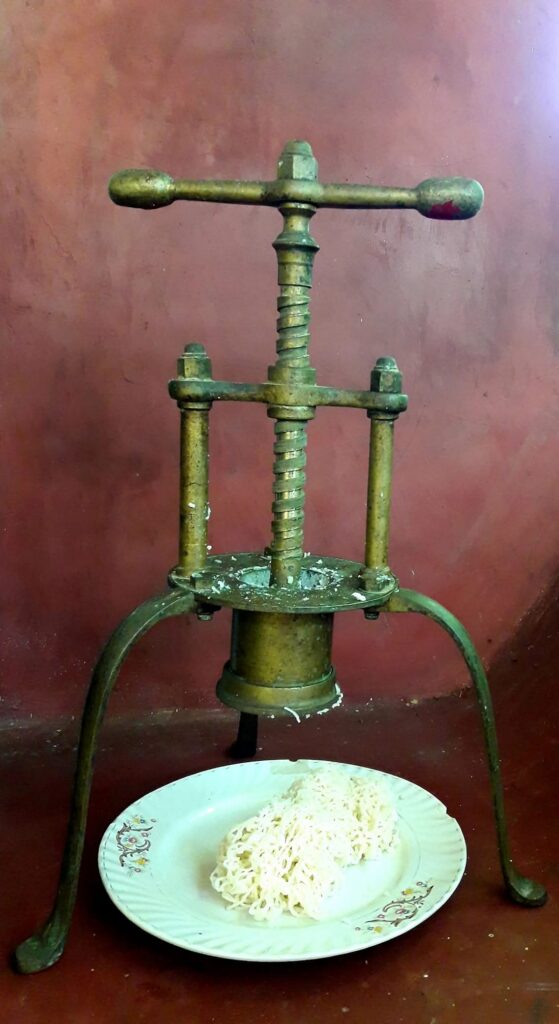
In fact, it is traditional to enter the month of August with something sweet to eat. Traditionally, on the first day of August, every Goan family would prepare ‘Shevyo’. These are rice vermicelli mixed with grated coconut and coconut jaggery. ‘Shevyo’ are made by placing steamed rice cakes into a vermicelli maker called a ‘Shevgo’, which may be made of wood, iron, or brass. Mind you, not every family owned a ‘Shevgo’. If someone did not have one, they had to borrow it from a neighbor or sometimes even rent it for a day. Families that did not prepare ‘Shevyo’ still ensured that they did not deprive their taste buds of something sweet on the first day of August by at least biting into a piece of jaggery.
Different parishes in Goa celebrate ‘novidade’ on different dates in August. Every Catholic family prepares ‘Patolleo’, a flat rice dumpling stuffed with grated coconut and jaggery, generally wrapped in a turmeric/champa leaf. A local myth about making ‘Patolleo’ says that if the droplets of steam from the copper or terracotta steamer (‘Copro’) used to steam the ‘Patolleo’ fall on the skin of the person steaming them, that person would get ‘Chamkil’ (warts). If a family was mourning someone in the house, the family members were not allowed to use the ‘Copro’ for steaming any food item. In such cases, the mourning family would be offered something sweet by their close neighbors.
Other sweets prepared in August include ‘Folle’, which are cone-shaped rice dumplings prepared in cones woven from jackfruit leaves, and ‘Aatol’, a semisolid cake made of palm jaggery, grated coconut, split chickpea, and wheat. ‘Aatol’ was prepared especially on the day of harvesting the crop. Apart from being made when one’s field was harvested, it was also prepared on several other occasions, such as on the day of laying the foundation stone of a new house and on the day of raising the first beam of the house (‘paati’) onto the roof. The proverb ‘Agosto, bom gosto ou Agosto desgraça (disgroso?)’ is one many may have heard often from the elderly, and it likely means that August is a month full of delicious tastes, especially sweets, but also a month of utter disgrace for families that ran out of food, particularly paddy, before the new crop was ready to harvest.
Mr. Pankaj Kamble, from Navelim, Goa, shared something interesting. On the occasion of ‘Naag Panchami’, Patolleos are prepared by every Hindu Konkani family. ‘Naag Panchammi’ is tentatively celebrated during the second week of the month of Shravan, according to the Indian calendar. Besides Naag Panchami, Patolleo are also made for Hartalika and Ganesh Chaturti, he said.
He further mentioned that on Naag Pancham, some Hindu families follow a unique tradition of offering the sweet to snakes in their cultivated fields and the surroundings of their houses. Patolleo are placed in the four corners of the field for the snakes to eat, with the hope that the field owners and those working in the field will not be harmed by the snakes around.
Salt-free patolleo are offered to Goddess Parvati on Hartalika because it is strongly believed among the Hindu community along the Konkan belt that the Goddess craved this sweet during her pregnancy.
A variation of the Patolli is also prepared in Kerala during Onam and is known as ‘Ely Ada’.
Mr. Kamble also spoke about ‘Modaks’ prepared by the Hindu community during Ganesh Chaturthi and every month on Sankashti. Modaks are onion-shaped dumplings made with rice flour dough and a sweet coconut-jaggery filling, similar to the filling used in Patolleo. The Sanskrit word ‘sankashti’ means deliverance from any form of trouble or difficult times. Therefore, worshiping Lord Ganesha on this day ensures that the person is blessed with peace and prosperity in the times ahead. The faithful usually fast so they can be free of obstacles on this auspicious day. The only difference between Modaks made on Sankashti and those made during Ganesh Chaturthi is that Sankashti Modaks are made using wheat flour instead of rice flour and are fried rather than steamed.