BY INVITATION | Vivek Menezes
The decades following the Amin explosion left deep wounds. There was the memory of parents whose longing for their homes in Uganda was one of the saddest things I’ve ever been confronted with.

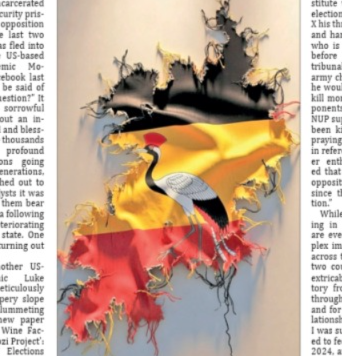
If the longest standing opposition leader is incarcerated in a maximum-security prison and the main opposition challenger in the last two election cycles has fled into exile,” asked the US-based Ugandan academic Moses Khisa on Facebook last week, “what’s to be said of the country in question? It was a sobering, sorrowful reality check about an incredibly beautiful and blessed country where thousands of Goans have profound family connections going back over five generations. And when I reached out to other expert analysts it was shocking to hear them bear witness to Uganda following Rwanda by deteriorating to full-on police state. One even said it was turning out like North Korea!
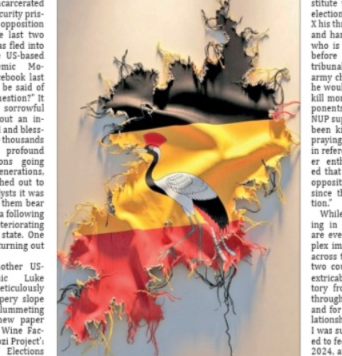
Khisa and another US-based academic Luke Melchiorre meticulously laid out the slippery slope Uganda is plummeting down in their new paper From The ‘Bobi Wine Factor’ to the ‘Muhoozi Project’: Uganda’s 2026 Elections and the Politics of Presidential Succession, published a couple of days ago in African Affairs. They argue “the 2026 elections and their immediate aftermath marked a historic turning point in Uganda’s politics of presidential succession, revealing a profound and ongoing reconfiguration of the country’s ruling order in which political power began to shift decisively toward President Museveni’s son and Chief of Defence Forces (CDF), General Muhoozi Kainerugaba.
It could be this was always on the cards — although it certainly did not seem inevitable when I visited Uganda in 2024 — as Khisa and Melchiorre write: “In February 2016, just days after securing a fifth consecutive term, Museveni stridently declared that within 5 years the country would have no opposition left. This prediction initially appeared to be hollow bluster. By the 2021 election, far from being on its deathbed, the opposition was resurgent, led by the 38-year-old, popular-musician-turned-presidential candidate, Robert Kyagulanyi (aka Bobi Wine). Museveni’s NRM lost significant electoral ground in long-standing strongholds in Buganda (central) and Busoga (east) to Kyagulanyi’s National Unity Platform (NUP). Gripped by ‘serious panic’ over Kyagulanyi’s political ascendence, the regime intensified its repression of the NUP leader and his supporters, further undermining its domestic legitimacy and attracting widespread international condemnation. Yet, following the disputed 2026 elections, Museveni’s decade-old prediction has come to seem increasingly prophetic.
Here’s how it has played out over the past few months: “According to the official results, the incumbent won an incredible 71.65 percent, his largest share of the popular vote since his first electoral triumph in 1996, while Kyagulanyi’s support apparently cratered from 35.08 percent in 2021 to just 24.52 percent. As in 2021, the latter man found himself under siege after the election, his home surrounded by military personnel; General Muhoozi publicly issued threats against his life; his wife was hospitalized after allegedly being assaulted by state security agents, and senior members of his own party were detained. Fearing for his safety, Kyagulanyi went into hiding, later announcing that although he regarded the electoral results as ‘fabricated’, he would not challenge them in court. In 2026, post-electoral Uganda, therefore, was not characterized by the high levels of mass anti-regime mobilization—or the widespread state repression that met them—following similarly dubious recent elections in Mozambique in 2024 and Tanzania in 2025, or indeed in Uganda itself in 2011 and 2021. Instead, harkening back to Museveni’s 2016 prognostication, the country witnessed a bruised and exhausted opposition, bereft of its leadership, and increasingly in disarray.
There are unfortunate echoes of the self-proclaimed “President for Life, Field Marshal Al Hadji Doctor Idi Amin Dada, VC, DSO, MC, CBE, Lord of All the Beasts of the Earth and Fishes of the Seas and Conqueror of the British Empire in Africa in General and Uganda in Particular in General Muhoozi’s flamboyantly errant career, including his vainglorious pledge to defend Israel with 100,000 troops earlier this year. According to Ray Hartley and Greg Mills of the Johannesburg-based Brenthurst Foundation, writing on the Royal United Services Institute website, “before the election, Muhoozi blasted on X his threats to behead Wine and hang Dr Kizza Besigye, who is on trial for treason before a farcical ‘military tribunal’. The 51-year-old army chief has boasted that he would castrate Wine and kill more of his father’s opponents. Claiming that 90 NUP supporters had already been killed, he added, ‘I’m praying the 23rd is Kabobi,’ in reference to Wine. He later enthusiastically reported that 90 members of the opposition had been killed since the January 15 election.
While tensions keep soaring in Uganda, the stakes are even higher, with complex implications extending across to India as well. Our two countries share an inextricably interlinked history from the colonial era through the present day, and for many Goans the relationship is just like family. I was surprised and delighted to feel that in Kampala in 2024, and was fascinated to see how the outstanding Entebbe-based writer/scholar A.K. Kaiza concurred after visiting Goa a few months later: “There is a fine line between Uganda and the diaspora,” he wrote on the invaluable Africa Is A Country website earlier this year. The perceived one can here be traced to the emergent nationalism of the 1930s, when the awakening consciousness movement of Marcus Garvey coined the phrase, Africa for Africans. Did this easily but misleadingly slide into the cutting-off of the African identity to blackness? What is ‘Uganda’? Or ‘Kenya’, for that matter? This is a question that can hit you hard in places you did not know about, as happened to me when I visited Goa. There, nearly everyone I spoke to was the progeny of, or related to, someone who had lived in East Africa, or been born there. The decades following the Amin explosion left deep wounds. There was the memory of parents whose longing for their homes in Uganda was one of the saddest things I’ve ever been confronted with. In those moments, I am split between loyalty to my pre-colonial Bunyoro-Kitara heritage and a desire to see how much I may have taken ‘Uganda’ for granted. India gave me Uganda!
(Vivek Menezes is a writer and co-founder of the Goa Arts and Literary Festival)