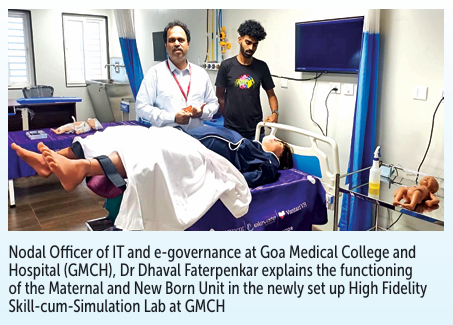
For a doctor facing a patient in cardiac arrest, a child in convulsions or a woman with a complicated delivery, there is little room for hesitation. Yet many of the skills needed to respond to such emergencies can only be perfected through repeated practice. At the Goa Medical Col lege and Hospital (GMCH), an AI-driven High Fidelity Skill-cum-Simulation Lab is seeking to change that equa tion — by allowing doctors and students to make mis takes, learn from them and re peat procedures before a real patient’s life is at stake. Equipped with high-fideli ty mannequins, virtual reali ty systems and advanced 3D imaging, the facility recreates critical-care and emergency situations with a degree of re alism designed to replicate the pressure and complexity of ac tual clinical settings.
“The lab is designed to de velop the clinical skills of our undergraduate, postgraduate, and super-specialty doctors. In alignment with the Compe tency-Based Medical Educa tion (CBME) guidelines, this training is a mandatory re quirement established by the National Medical Commission (NMC),” Nodal Officer of IT and E-governance at Goa Medical College and Hospital (GMCH), Dr Dhaval Faterpenkar said. In addition to medical stu dents, we intend to utilise this high-fidelity skill simulation lab to train nursing staff, nurs ing students, and allied health sciences students at Goa Med ical College. “The lab features advanced capabilities, such as recon structing a patient’s anatomy from CT scans and MRI re ports to assist neurosurgeons in planning complex brain sur geries before entering the op erating theatre. Additionally, it includes specialised stations for intensive care, paediatrics, and obstetrics, utilising inter active models that simulate real-time scenarios—such as breech deliveries or patient convulsions — to provide im mediate feedback based on the actions and dosages admin istered by trainees,” Medical Superintendent of GMCH, Dr Rajesh Patil said.

“It allows individuals to practice both advanced sur geries and simple procedures, such as ultrasound-guided intravenous line placements, in a safe environment that does not endanger patient lives. This simulation lab complements our long-standing skill lab, which continues to provide essential training in CPR and trauma care,” he said. This technology is positioned to be a definitive game-changer in medical education. “By utilising 3D imaging that provides a complete view of internal structures along with tactile feedback, it offers a level of preparation that may eventually supplement or replace traditional cadaveric dissections,” Dr Patil said.