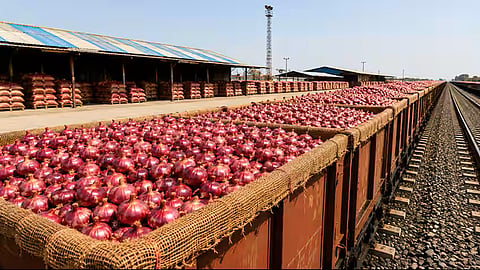
Onion prices have climbed sharply in recent weeks, prompting the Centre to intensify market intervention by releasing supplies from its buffer stock and transporting onions by rail to major consumption centres.
Under the government’s ‘Kanda Express’ initiative, onions are being moved from Nashik in Maharashtra to five major cities — Delhi, Chennai, Kochi, Madurai and Guwahati — with the aim of increasing supplies and easing wholesale prices.

As part of the latest intervention, more than 800 tonnes of buffer-stock onions are being dispatched from Lasalgaon in Nashik to Delhi. The shipment is aimed at ensuring larger quantities reach major wholesale markets, where increased availability could help bring down prices.
What is Kanda Express?
The Kanda Express is a special rail-based initiative designed to transport bulk quantities of onions from one of India’s major production centres to large consumption markets.
Nashik, particularly the Lasalgaon market, is a key hub for onion trading. By using rail transport, the government aims to move large consignments efficiently to cities where prices have come under pressure.
The rail shipments will cover five destinations: Delhi, Chennai, Kochi, Madurai and Guwahati.
The first major dispatch involves 840 tonnes of buffer-stock onions being transported from Lasalgaon to Delhi.
The government’s immediate objective is to increase onion availability in major mandis and put downward pressure on wholesale rates. A sustained fall in wholesale prices could eventually translate into lower retail prices for consumers.
Onion prices rise 59%
The government’s intervention comes after onion prices increased by 59% in recent weeks.
Seasonal fluctuations can cause significant changes in onion prices as supplies from different crop cycles enter the market. These changes can affect both wholesale markets and household budgets, particularly when prices remain elevated for an extended period.
Despite the sharp increase, the Centre has maintained that overall onion availability remains comfortable and that there is no shortage in the country.
Centre says production remains stable
According to government estimates, onion production is expected to be around 307 lakh tonnes in 2025-26.
The estimate is broadly comparable with the previous year’s production of around 308 lakh tonnes, indicating that overall output has remained relatively stable.
The government also maintains a buffer stock of onions that can be released into the market when prices rise sharply.
This stock is intended to act as a supply cushion, allowing authorities to intervene during periods of price pressure rather than relying only on fresh market arrivals.
How Kanda Express could affect consumers
The immediate impact of the rail initiative is expected to be felt at the wholesale level. By releasing large quantities of onions into major mandis, the government hopes to improve availability and moderate wholesale prices.
However, lower wholesale prices do not automatically translate into an immediate reduction in retail prices. The benefit to consumers will depend on how quickly changes in wholesale rates move through the supply chain.
Delhi-NCR is expected to be one of the key markets to watch following the latest shipment from Lasalgaon.
The government’s broader strategy is therefore to use its buffer stock in a calibrated manner while ensuring that adequate supplies remain available in the market.
With onion production estimated to remain close to last year’s levels, the Centre is banking on increased market supply and targeted interventions to contain the recent price rise.
For consumers, the success of Kanda Express will ultimately be measured by whether increased wholesale availability leads to a sustained decline in retail onion prices in the coming weeks.