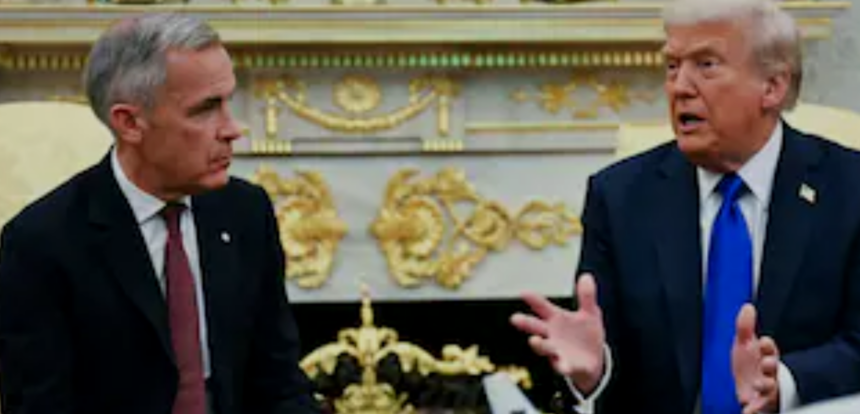
Canada is set to announce retaliatory tariffs against the United States as tensions between the two countries escalate, with Prime Minister Mark Carney accusing Washington of seeking to undermine key Canadian industries and US President Donald Trump threatening further tariffs.
Canadian Finance Minister François-Philippe Champagne and three other cabinet ministers are expected to unveil Ottawa’s response on Tuesday. Carney has indicated that Canada could move away from matching US tariffs dollar-for-dollar and instead introduce targeted measures aimed at protecting Canadian workers and businesses.

The latest escalation followed Trump’s warning that Canada must “fall in line” or face consequences that could be worse than the tariffs already imposed. Trump also threatened a 50% tariff on Canadian vehicles, auto parts and steel.
Carney rejected the US approach, saying Canada would not accept being treated as a subordinate in trade negotiations.
“An attitude at the negotiation table that Canada is a subsidiary of the United States” is “not something we’re going to accept,” Carney said.
Speaking in French, Carney accused the US of attempting to damage some of Canada’s most important industries, including the automotive, steel and aluminium sectors.
The latest confrontation comes after Carney withdrew from trade negotiations with the Trump administration late Friday. The move was followed by Trump’s threat to impose additional tariffs on around $20 billion worth of Canadian goods.
The dispute has raised concerns because Canada and the US have one of the world’s most deeply integrated trading relationships. Their economies are closely connected through automotive manufacturing, energy, agriculture and other industries, meaning a prolonged tariff battle could affect businesses and workers on both sides of the border.
Carney also questioned Washington’s reliability as a trading partner, saying Canada was increasingly looking for dependable economic partners elsewhere in the world.
Trump, meanwhile, accused Canada of taking advantage of the US for years and criticised what he described as high Canadian tariffs on American agricultural products.
The US president has also targeted Canada’s automotive industry, warning that new tariffs could be imposed on vehicles and parts from next year. Carney said the proposed measures could gradually weaken and dismantle Canada’s domestic auto production.
Ontario Premier Doug Ford has also backed a tougher Canadian response, saying Canadians are prepared to accept economic hardship rather than surrender to US pressure.
“We’re all in,” Ford said, warning that an escalating trade conflict could require Canadians to make sacrifices.
Ford said Canada could consider further measures if Trump continues targeting Canadian industries, including restrictions involving electricity and critical minerals. Ontario has previously used electricity exports to the US as leverage during the dispute.
The premier also accused Trump of seeking to weaken Canadian industries and shift production south of the border, particularly in the automotive sector.
Ontario is at the centre of Canada’s vehicle manufacturing industry, with major plants operated by Ford, General Motors and Stellantis. The province’s auto supply chain is closely connected to manufacturing facilities in Michigan and other US states, with components frequently crossing the border several times during production.
Trump’s proposed 50% tariffs on Canadian vehicles and auto parts could therefore have significant consequences for the integrated North American automotive industry.
US Trade Representative Jamieson Greer defended Washington’s position, arguing that Canada’s automotive production was initially encouraged by the 1960s Auto Pact.
The dispute has also raised concerns over Canadian sovereignty. According to Ford, Washington sought language that would have limited Canada’s ability to negotiate trade agreements with other countries without US approval. Carney has rejected such demands as unacceptable.
The Canadian prime minister has also pointed to differences over language and cultural protections, saying measures that Washington views as trade barriers are considered fundamental rights in Canada.
With Ottawa preparing its retaliatory measures, the increasingly hostile rhetoric from both governments has raised fears that the trade dispute could develop into a prolonged economic confrontation between two of the world’s closest trading partners.
(This story is published from a syndicated feed)