AUGUSTO RODRIGUES
With four cases of alleged re ligious conversion regis tered in Goa since 2012, the proposed Goa Prohi bition of Unlawful Con version of Religion Bill, 2026, raises a fundamental question – what problem is the government seeking to solve with a law carry ing exceptionally severe penalties? The government’s own figures appear to offer little evidence of a widespread conversion problem in the State. The legislative record is particularly revealing. In reply to LAQ Nos 017A and 132 tabled by Cuncolim MLA Yuri Alemao, Chief Minister Pramod Sawant indicated that two cases had been registered up to June 30, 2023. In LAQ 132, Alemao asked, “whether the gov ernment has issued any or ders directing the mamlat dars and other concerned government officials to act in matters of religious con version/forced religious conversions; if so, the rele vant details.” The government’s re sponse referred to a De cember 1, 2022, report from the Superintendent of Police, North, alleging that Joan Mascarenhas e D’Sou za and Dominic D’Souza were conducting religious practices and public gath erings involving prayer and healing. The police appre hended that such activities could lead to religious con versions through ‘allure ment or fraud’ and request ed the District Magistrate, North Goa, to issue or ders under Section 144 of the CrPC. But the subsequent ju dicial record weakens the case for presenting such incidents as evidence of a serious and persistent con version crisis.

The FIRs registered against Dominic and Joan Mascarenhas were quashed by the Goa Bench of the Bombay High Court, with Justice Amit S Jamsandekar observing: “After registering the FIR, investigation was carried out. Upon comple tion of the investigation, Po lice Sub Inspector of Mapusa Police Station has filed ‘A fi nal summary’ report before the learned Judicial Magis trate First Class at Mapusa, Goa.” The order further states: “The relevant portion of the summary report is re produced below: From the investigation conducted so far, statements on record and after all hectic efforts it is transpired that complaint is true, but there is no specif ic evidence come on record against the accused persons Dominic D’Souza and Joan Mascarenhas E D’Souza w/o Dominic D’Souza, thus the investigation on this case is shelved at present and there are fewer chances to detect the case.” The government’s more recent figures do little to al ter that picture. In reply to unstarred LAQ No 026 ta bled by Aldona MLA Carlos Ferreira on March 9, 2026, Sawant stated that two cases were registered in 2022 and another two in 2023. Taken together, the gov ernment’s own responses point to a strikingly limited number of cases over a pe riod spanning more than a decade.
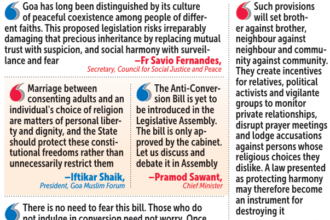
Two FIRs also ended with the High Court inter vening after the police inves tigation failed to establish specific evidence against the accused. “I think the government should demonstrate a clear, evidence-based need for a new and exceptionally strin gent law, especially in a State where religious harmony has generally been a valued part of society,” stated Sister Margaret Rodrigues, Prin cipal of Perpetual Succour Convent High School, Na velim. Despite the draft not yet being in the public domain, people from the clergy have been taken aback by the punishments proposed in the Bill. “I am yet to read a copy of the draft, but from whatever little I have seen, I think the punishments are savage. There is a punishment of im prisonment up to the end of their life,” said an astounded Fr Mousinho Joao de Ataide. “There are existing laws that deal with religious con versions and, therefore, the need to introduce a new law is astonishing. It would have been different if there were no laws in place to deal with conversions,” said Fr Ataide. People from the major ity community who have married into the minority community are also finding it difficult to understand the reasoning behind the pro posed Bill. “Apart from marrying a Catholic, both my children have got married to Catho lics. I am unable to under stand the reason why such a Bill is being introduced. I could have understood if we were living in UP or some other State of India,” stated Goa’s famous restaurateur Satish Prabhu, whose wife was a Catholic and whose son and daughter have both married Catholics. Prabhu brings to mind the words of Tehrene Mafi, who once wrote: “And the stitches in my heart begin to pop, one by one.”