LUIS DIAS
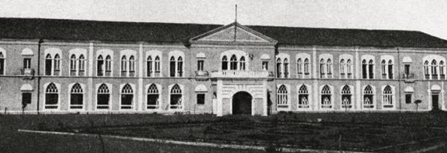
Panjim’s beautiful, price less public heritage build ings are being deliberately neglected by its civic guardians. It seems to be a systematic plan to let them languish, and then claim they are ‘dilapidated’, ‘un inhabitable’, ‘a danger to public safety’, and this then becomes the excuse for their demolition and ‘redevelopment’, benefiting vested interests in the hotel, casino and real-estate industry rather than fulfilling the needs of taxpaying residents. Last month, I focused on the old Secretariat. Let me put the spotlight now on the old ‘Liceu’ (Lyceum) complex of buildings. Hopefully, if we learn what marvels we have and their his tory, we will not take a wreck ing ball, proverbial or literal to them. My sources are the material sent to me by Cristo Prazers da Costa, ex-alumnus of the Liceu Afonso de Albuquerque, the writings of Vasco Pinho and of Portuguese academician Alice Santiago Faria. The building process of the group of five pavilions (build ings) ran from 1908 (with interruptions for various rea sons) to the mid-1940s, over seen in large part by contractor Agostinho Velho, great-grand uncle of current noted architect Fernando Velho. All the pavilions apart from the third have “neo-Gothic arches, bay frames with the same design, full-length win dows on both floors” (Faria). The third pavilion is the only one with a central corridor, and has rounded arches along the entire main façade. Pavilions two and four have galleries on one of the façades.

The edifice of the first pa vilion built by the Santa Casa de Misericórdia (Holy House of Compassion) charity and purchased in 1923 by the erstwhile government for the Liceu was “the first structure in Goa which adopted a plan with running galleries and rooms in the middle, to ensure cross-ventilation and shelter from rain and sun. This solu tion is perfectly suited to the climate, with influences from the neighbouring territory”, and was later used elsewhere e.g. the Escola Médica Panjim (today called ‘old’ GMC, Goa Medical College) and the hos pital of Nossa Senhora dos Mi lagres (Our Lady of Miracles), Mapusa. Faria termed the pavilion complex “one of Goa’s excep tional buildings,” in both its language and typology. A 1947 description is still valid: “The buildings are lo cated in one of Panjim’s most pleasant sites, offering mar vellous panoramas of the city, bathed in greenery and sun, an almost ethereal light and fresh ness in a country where Nature itself is a monument to Art.” In the early years, access to the Liceu was via the elegant zigzag staircase starting from the Corte de Oiteiro (Cortin). Indeed, some oral accounts indicate it was also used as a conduit for building materials during the construction phase of the pavilions when the Altin ho slope gradient was too steep for loaded bullock-carts.
There were at least three stepped pathways from Fon tainhas to the Liceu. Another road, the hair-pin turn at the present Portuguese Consulate building, midway from pres ent-day Fr. Agnelo road (for merly Avenida Sagrada Coração de Jesús, then Rua Almirante Reis) was built around 1930, as was another road descending toward Fontainhas. The Liceu as an intuition functioned in the pavilion buildings until a year or two af ter 1961. Vasco Pinho, ex-alum nus of the 1961 batch, the last under Portuguese rule, writes in a 2011 booklet that subse quently “the sprawling facilities were made available concur rently to different institutions such as Dhempe College of Arts and Sciences, a private Teach ers’ Training college, a Govern ment Higher Secondary School, a Bal Bhavan, a Law College, and in the later years to Dempo College of Commerce.” In 2011, Pinho celebrat ed the fact that the pavilions would be made available to the Goa Bench of the Bombay High Court. “Thus, the impressive structures have been spared from falling into ruin.” As recently as January 2026, former alumni of the Liceu had an emotional reunion at the site, covered by the local press. If Pinho had been alive to day to see how these majestic buildings have been literally abandoned to the elements ever since the Goa Bench of the Bombay High Court moved to its new premises in Porvorim, it would have broken his heart. It broke my own heart (even though I am not one of the tens of thousands who studied in those hallowed precincts, but my father was) to watch the reel made by a news outlet: the eerie stillness, beer-cans discarded by vagrants obvious ly now making it their haunt, windows left wide open to the wind and rain, furniture and swivel-chairs covered in mould, lights literally left on but “no body home.” The callous, un conscionable, brazen wastage of taxpayers’ money and the wanton neglect of our common public heritage by those who ought to be safeguarding it for the future makes one so de pressed and so angry. We cannot stand idly by and watch these beautiful edifices crumble.
A stitch in time saves nine. The existing decay can be mended and reversed. The quantum increases in the neglect and erasure of heritage, built or natural, in Panjim and indeed elsewhere, has ironical ly and tragically coincided with organised heritage activism and “action” at its weakest and most fragmented. A self-styled “heritage documentarian” smugly posted a reel recently, announcing that rather than be angered and stirred into action (“shout, scream, file a court case, donate to a cause”), she chooses to write poetry (as if the two were mutually exclu sive), making one wonder how much genuine concern for her itage there ever was. Righteous anger is construc tive: Jesus used it to banish the den of thieves from the Temple in Jerusalem, and we should channel it too to drive out the modern-day den of thieves that plague and corrupt our beloved capital city and our State.
The truly great ancient Ro man poet Ovid (43BC-AD 17/18) wrote: ‘Factum abiit; monumenta manent’, which loosely translated means ‘The past is gone; the monuments remain.’ Today not only is our past being erased and rewritten, but our buildings are being mur dered, “death by a thousand cuts” of deliberate neglect. We cannot allow this to continue. (Dr. Luis Dias is a physician, musician, writer and founder of Child’s Play India Foundation. He blogs at luisdias.wordpress.com)