SHASHWAT GUPTA RAY
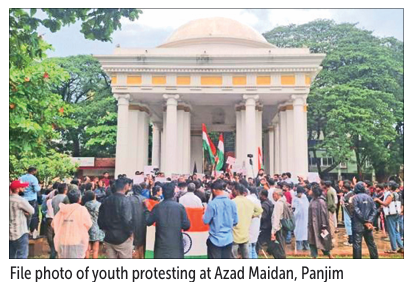
The recent stu dent-led protests over ir regularities in the NEET ex aminations have exposed a contradiction among Goa’s Gen Z — young people are increasingly politically conscious, better informed about their legal rights and more willing to challenge those in power, yet many remain reluctant to make politics a full-time career. For a generation often dismissed as politically apathetic, the growing will ingness of young people to take to the streets tells a very different story. From the NEET protests to ear lier mobilisation against double-tracking and Sec tion 39A of the Goa Town and Country Planning Act, young Goans have demon strated that they are will ing to organise, protest and confront authority when an issue directly affects them. But that political awak ening has not necessarily translated into an appe tite for electoral or party politics. Prachi Kerkar, an MA Political Science student at Goa University, said Gen Z today is exceptionally well-informed about the political landscape, from local developments in Goa and national issues to international politics.

“The heightened awareness is primarily driven by the immediate availabil ity of information and technology at their fingertips. Unlike earlier occasions, the recent youth protests were driven by the pent-up frustrations regarding the prevailing socio-economic situations, which affected them directly,” Kerkar said. According to her, economic insecurity is one of the major drivers behind this mobilisation. Competitive examinations such as NEET, NET and UPSC are viewed by many young people as crucial routes to financial security and upward social mobility. “When these opportunities are compromised due to administrative failures, the accumulated frustration inevitably leads to public protests,” she said. Kerkar also pointed to the growing interest of political parties in young voters and activists, saying there has been an increase in youth participation in the student and youth wings of major political parties. “Political parties are increasingly recognising the strategic importance of Gen Z. Individuals currently affected by the recent examination discrepancies will become first-time voters in the 2029 general elections. Given that this demo graphic is highly vocal, digitally connected, and capable of generating significant online discourse, political leaders are actively attempting to engage them,” she said. Adv Sakshi Naik Gaonkar, a lawyer and lecturer who participated in protests following the RG Kar Medical College and Hospital rape case in 2025, said the recent NEET protests point to a growing political consciousness among Goan youth, including adolescents. “Seeing the impact of the recent youth movement across India, student politi cal wings (such as NSUI and ABVP) are gaining traction in Goa University by pro viding a platform for youth voice and leadership, which serves as an alternative for a demographic that cannot yet vote,” she said.
Yet, growing political awareness does not automatically mean a willingness to join a political party. Muskan Bepari, an MA Psychology student at Goa University, said young peo ple were previously less aware of what was happening around them. That is changing as access to information has expanded. “However, as awareness grows, the youth are becoming more aware of the issues affecting them and their legal rights,” Bepari said. She said political participation increasingly takes forms outside formal party structures. “Many young individuals, including several of my peers, choose not to join a formal party but remain actively engaged through protests and various political programs. While some enter politics to exercise power, the field is often per ceived negatively,” she said. For Bepari, however, the problem is not politics itself but how power is exer cised. “My own interest in this field was significantly influenced by my grandfather, who, despite not being a politician, possesses a deep passion for politics. This interest led me to join the NSUI well before the recent protests,” she said. She believes young people should consider politics as a career if they are pre pared to withstand the pressure that comes with challenging those in power. “While having a supportive family background and a strong personal interest are beneficial, joining a political party is not a prerequisite for making a mean ingful difference. Significant change can still be achieved from outside the for mal political structure,” the budding psychologist said. That distinction — between being politically active and becoming a politician — is increasingly evident in the way young people organise. Steven Fernandes, a law student, said there is a significant political awakening among youth globally and regionally. “Similar to recent Gen Z-led movements that prompted governmental change in countries like Nepal, the youth in India, and particularly in Goa, are increas ingly mobilising around regional issues. A defining characteristic of these move ments is their independence from established political parties, such as the NSUI or ABVP. While political entities may offer subsequent support, these initiatives begin and remain collectively driven by citizens focused solely on the issues at hand,” Fernandes said. He said recent protests in Goa demonstrate the effectiveness of this independ ent approach. “During recent demonstrations in Goa—including the NEET protests, the dou ble-tracking opposition, and the protests against Section 39A of the Goa Town and Country Planning (TCP) Act—the collective voice of the youth compelled the government to listen and respond with formal action, such as issuing orders through the collector,” the budding lawyer said. Adv Zaid Shaikh, a lawyer, also sees a growing willingness among young peo ple to engage with politics, but said their participation is increasingly detached from conventional party loyalties. “There is a clear indication that the younger generation possesses a strong in terest in politics, particularly concerning issues that directly impact them.
This was evident during the NEET protests on July 21 and 22,” he said. “Notably, this engagement moves away from traditional party lines, such as the BJP or Congress. Instead, there appears to be a preference for neutral alter natives, like the CJP, allowing youth to voice their concerns without aligning with established political factions,” he said. According to Shaikh, student leaders and their peers on the Goa University campus are becoming increasingly proactive in raising issues independently. “Unlike previous generations, today’s youth demonstrate a more analytical approach to political narratives, critically evaluating information rather than accepting it at face value,” he said. But fear remains a powerful deterrent to sustained political participation. Kumar Arjun Gauli, State General Secretary of NSUI, said that although young people are highly politically aware and well-informed about current affairs, many remain reluctant to express their views publicly. “There is a growing concern among the youth regarding potential conse quences from authorities or government representatives if they speak out on political matters. Many students face significant pressure from their families to avoid political involvement due to the perceived risks to their future and safety,” Gauli said. He also argued that the political system itself does little to encourage young people to enter it, with legislative and political structures continuing to favour older leadership and leaving those aged between 25 and 35 with limited rep resentation. “Consequently, on-ground student engagement and protest participation have noticeably decreased over the past decade.
It is estimated that only 30% to 40% of the youth population actively engages with politics. The remaining majority, even those who are neutral, prefer to remain silent. When approached, they are hesitant to share their opinions and choose not to publicly advocate for their own interests, preferring instead that others raise these issues on their behalf,” he said. The contradiction is therefore clear. Goa’s young people may no longer be po litically apathetic, but neither are they necessarily ready to become politicians. They are willing to march, question government decisions, challenge institu tions, understand their legal rights and mobilise online and on the streets. What many remain unwilling to do is cross the final line — from protesting against the political system to becoming part of it. For Goa’s political establishment, that may be the more uncomfortable devel opment.
A generation that does not necessarily want to join a party, but knows how to organise, mobilise and demand answers, could prove far harder to ig nore than one that simply stays away from politics.