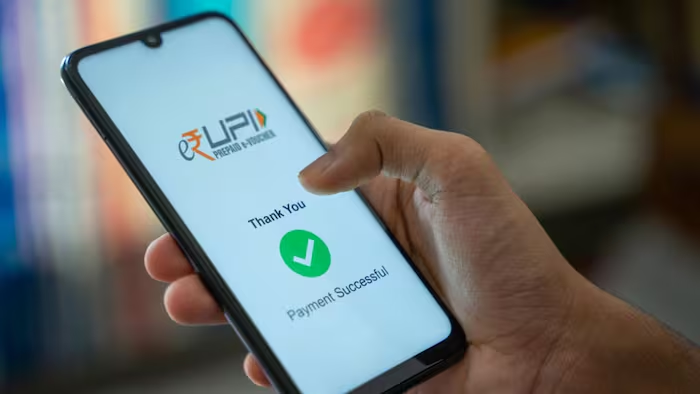
The Indian government has clarified the rules governing higher-value digital transactions, announcing that a fractional charge will apply to Unified Payments Interface (UPI) merchant payments exceeding ₹2,000 starting October 15, 2026. However, authorities reiterated that person-to-person (P2P) transfers and low-value purchases will remain completely free for consumers.
Under the new Merchant Discount Rate (MDR) framework issued by the National Payments Corporation of India (NPCI), a 0.4% fee will be levied on merchant transactions over ₹2,000, capped at ₹300 per transaction. For specific essential categories—including Indian Railways, telecom services, insurance, and fuel stations—a flat charge of ₹5 will apply instead. The Finance Ministry has advised banks to ensure merchants absorb this fee rather than passing it on to customers.

The NPCI assured the public that the revised rules keep 95% of all UPI transactions completely unaffected. Everyday transfers between individuals (P2P) and small-value merchant transactions (P2M) under ₹2,000 will incur no fees. For example, sending money to a friend will remain free regardless of the amount, while a ₹2,001 transaction at a large retailer would incur a minimum merchant fee of ₹8.
According to the NPCI, the incoming framework establishes lower fees than standard credit card, debit card, or e-wallet processing rates. The revenue generated from MDR is not a government tax; instead, it is distributed among banks and payment service providers to fund system infrastructure, enhance resiliency, strengthen cybersecurity, and drive digital payment innovation—including a dedicated fund to expand payment access in Tier 3 cities and rural markets.