MARCOS GONSALVES
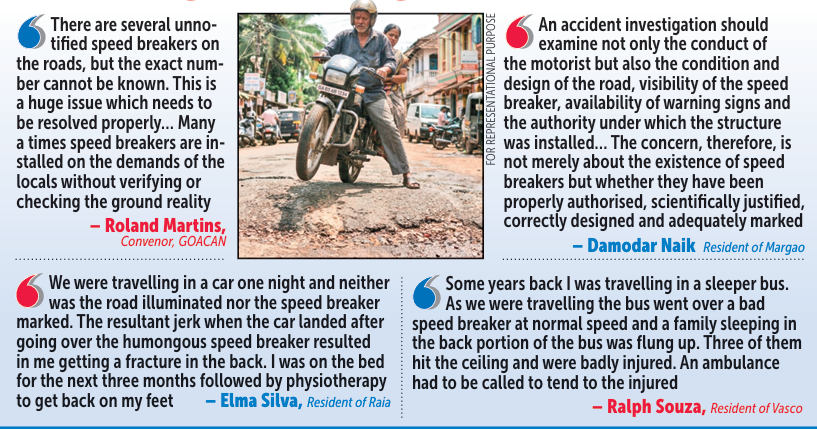
The back-to back accidents on the newly opened elevated corridor at Porvorim have put road en gineering and safety under scrutiny. Across Goa, how ever, another road hazard is drawing concern — speed breakers that motorists say appear without adequate warning, markings or evi dence of proper engineer ing assessment. Citizens point to another problem – the speed break ers are far from uniform. Some are difficult to detect at night, while others are al legedly excessively high or poorly marked, posing par ticular risks to two-wheel er riders, motorists un familiar with a road and vehicles travelling in poor visibility. The issue is not mere ly the presence of speed breakers, but who author ised them, whether they were scientifically justified, whether they conform to prescribed standards and why allegedly illegal or un notified structures contin ue to remain on roads. “There are several unno tified speed breakers on the roads, but the exact number cannot be known. This is a huge issue which needs to be resolved properly,” said GOACAN convenor Roland Martins. According to Martins, many structures are in stalled following demands from local residents or groups without adequately verifying the ground situa tion. “Many a times speed breakers are installed on the demands of the locals without verifying or check ing the ground reality,” he said. The consequences, citi zens say, can extend beyond an uncomfortable ride. Ralph Souza of Vasco recalled an incident while travelling in a sleeper bus when a badly designed hump caused passengers sleeping at the rear to be thrown into the air. “Some years back I was travelling in a sleeper bus. As we were travelling the bus went over a bad speed breaker at normal speed and a family sleeping in the back portion of the bus was flung up. Three of them hit the ceiling and were badly injured. An ambulance had to be called to tend to the injured,” said Souza. Elma Silva of Raia said she suffered a back frac ture after a vehicle she was travelling in went over an unmarked hump at night.

“We were travelling in a car one night and neither was the road illuminated nor the speed breaker marked. The resultant jerk when the car landed after going over the hu mongous speed breaker resulted in me getting a fracture in the back. I was on the bed for the next three months fol lowed by physiotherapy to get back on my feet,” said Silva. Martins said speed breakers are required to have proper warning and display boards and adequate markings to en sure visibility. “Speed breakers need to have proper display boards as per the norms. This is not seen at many places,” he said. Poor visibility becomes particularly dangerous after dark, during rain and on roads with inadequate street lighting, when a raised structure may be spotted only after it is too late to slow down safely. The problem also exposes a gap between procedure and enforcement.
Martins said a committee under the Public Works Department (PWD) has been tasked with regular ly reviewing speed-breaker-related issues and that the department has been instructed to remove illegal speed breakers. Goa’s notifications require speed breakers to be formally notified and constructed according to prescribed stand ards, with District Magistrates issuing notifications spec ifying locations and applicable requirements, including Indian Roads Congress specifications. A demand from residents should therefore trigger a site inspection and traffic assessment, rather than automatical ly result in the construction of a hump. Peter Dias, a senior citizen from Raia, said he had encoun tered speed breakers that were difficult to detect from a distance, particularly at night because of inadequate mark ings or a lack of warning signs.
Such unexpected humps, he said, could be especially dangerous for two-wheeler riders and motorists unfamiliar with the road. Leenoy Fernandes questioned the practice of installing speed breakers merely on the basis of local demands. Au thorities, he said, should first establish whether speeding is actually the problem and whether a raised hump is the appropriate solution. The concern is particularly relevant on National High ways, where the Ministry of Road Transport and Highways (MoRTH) and the National Highways Authority of India (NHAI) have advised against conventional speed breakers and called for appropriate traffic-engineering measures, including properly designed rumble strips where speed re duction is required, along with adequate signage and road markings. Damodar Naik of Margao said accident investigations should examine the road infrastructure as well as the mo torist involved. “An accident investigation should examine not only the conduct of the motorist but also the condition and design of the road, visibility of the speed breaker, availability of warning signs and the authority under which the structure was installed,” he said. “The concern, therefore, is not merely about the exist ence of speed breakers but whether they have been prop erly authorised, scientifically justified, correctly designed and adequately marked,” said Naik.
This also raises the question of accountability when a crash occurs near a speed breaker that is allegedly unno tified or improperly constructed. If the structure does not comply with prescribed procedures, the circumstances surrounding its installation should form part of the inves tigation. Citizens are now calling for a statewide audit of speed breakers across National Highways, State and district roads, municipal roads and village roads.
The audit should establish which structures are author ised, who approved them, which agency constructed them, whether the road-owning authority was consulted and whether prescribed warning signs, markings and visibility measures are in place. It should also identify humps that are excessively high, damaged, poorly marked or no longer necessary, with such structures rectified or removed.