AMAN VERMA
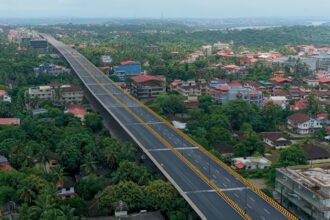
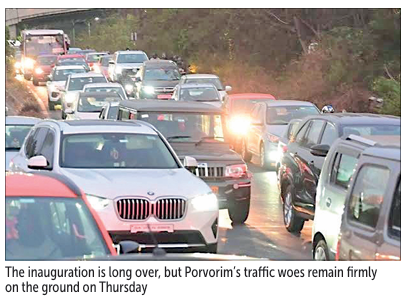
For years, Porvorim absorbed the cost of its own future convenience. Residents rerouted their days around construction barricades, breathed the dust, lived with the noise, and told themselves it was temporary — that a finished corridor would make the years of disruption worth it. Kapil, who lives in the area, remembers the bargain in those terms: “We bore the pain of traf fic snarls and diversions through the years it took to build the el evated corridor in the hope for better connectivity ahead. We thought probably this bridge would be a game changer and that the traffic snarls would go away. But alas we have been left out of the corridor.” That sense of exclusion is now at the heart of the public anger. “If anyone wants to proceed from Porvorim to Panjim, they have no access to the elevated corridor. The road is blocked,” said resident Yadnesh Sanzgiry. “So, for whom have you built the bridge? That is the problem.” For M Belekar, the frustration is more personal. “We Porvorkars feel absolutely cheated after en during the dust, noise, traffic snarls and putting our health at risk during the construction of the flyover. Now we cannot even use Atal Setu.” Veena Borkar believes the prob lem lies in the way the project was rolled out. “Absolutely knee-jerk reaction from the government.

Designing the correct entry and exit points with adequate sign boards would fix the mess.” The irony is that the corridor was supposed to address the very congestion that continues to trouble Porvorim. “In the old bridge, there was a traffic jam. And it wouldn’t get fixed. That’s all,” Sanzgiry said. For residents, the question is therefore not merely whether the elevated corridor exists, but whether it has solved the prob lem it was intended to solve. And then came the safety con cerns. At the Bastora end, residents and activists have flagged a blind turn where they say motorists are given little warning of the change in road alignment. Activ ist Francis Coelho said the loca tion lacked basic safety aids. “At a blind turn, you’re sup posed to have mirrors and you’re supposed to have a lot of signag es to say, slow down, there is a turnover, you have oncoming traffic,” he said. “But in this case there are zero signages and the blind turn is just left blind.”
Within days of the corridor opening, a fatal crash brought those concerns sharply into focus. The immediate government response was a restriction on two-wheelers. For critics, the sequence was revealing: instead of iden tifying and correcting the underlying safety deficiencies, restrictions followed an accident. Congress leader Vikas Prabhudesai has questioned whether the project was adequately planned even before it opened. Addressing a press conference with the Por vorim Block Congress, which described the rollout as a “fi asco” and said residents had been given a “lollipop” in the name of development, he questioned whether authorities had sufficiently studied traffic patterns. “If you ask them, they don’t know how much traffic was actually from Mapusa to Margao, how many commuters were from Porvorim or to Porvorim, they don’t have the figures,” he said. “So, when they decide on an elevated corridor… what is the percentage of the traffic which will use that? They have no numbers. So, that is where the design flaw came.” Prabhudesai also questioned the project’s signage and traffic-management arrangements. “There were not enough signages to give clarity to the users, whether they have to exit, where they enter, where they exit,” he said. He argued that the subsequent two-wheeler restriction had compounded the problem. “The two-wheeler ban came after the accident.
Blocking the traffic entirely has, in fact, worsened the corridor’s traffic.” Kapil is more cautious about passing judgment on the technical aspects of the project. “I’m not an expert on that because the design and re lated aspects are technical features,” he said. But from a commuter’s standpoint, his expectation is simple. “From a common man’s perspective, the bridge should simply be convenient and traffic-free. I can speak only about that aspect of the infrastructure.” He does not believe that expectation has been met. “I don’t see that happening, which is very disappoint ing.” The controversy has also exposed an uncomfortable po litical question over who was responsible for the project and its shortcomings. At the inauguration, the Porvorim MLA had described the flyover as his “dream project” and praised the quality of its construction. After the problems emerged, however, he said he had not been consulted on decisions concern ing the flyover. “While decisions regarding the flyover were being tak en, I was not taken into confidence,” he said, while prom ising to convene an urgent meeting with PWD Minister Digambar Kamat. “Porvorkars have suffered during the construction of the flyover, and they should now benefit from it,” he said.
That explanation has done little to quiet the criticism. “Same guy took full credit at the inaugural. Now he was not taken into consideration,” a prominent singer quipped on Facebook. Another questioned the distinction between claiming credit and distancing oneself from responsibility: “Then why did you organise dance festival on the bridge? You were ready to take the credit but not ready to accept your share of the blame? Every MLA should demand to see the plans of major projects undertaken in his/her constituen cy.
Later saying they were not taken into confidence is not a valid reason.” For some, the Porvorim controversy has become a wid er commentary on the State’s infrastructure push. A Naik, a Goan-origin NRI, said his perception of the government’s development agenda had changed. “The more I see the touted ‘development’ by this gov ernment, the more convinced I am that the ‘development’ was not meant for the people of Goa at all,” he said. “The way I see it, all the road, rail and sea connectivity Goa is getting points to coal movement.” Coelho, meanwhile, sees a familiar pattern in the way major infrastructure projects are handled — celebration first, scrutiny later. “They (politicians) just come in, when something like this is announced, they do an inauguration, they’ll do the rituals and after that… nobody bothers to check while it is being implemented,” he said. “And then once it (a fiasco) happens, then passing the buck starts.” Residents are now calling for something that should ar guably have preceded the inauguration: an independent technical examination of the corridor. “If you build the bridge, you have to first check the bridge,” Sanzgiry said, calling for scrutiny by institutions such as NITs, IITs or international agencies. “Put NIT, put IIT, put international agencies to resolve this. Simply blocking is not the solution.” He also called for stricter enforcement against speeding, including a Rs 5,000 fine. “You have to regulate it,” he said. Kapil supports an independent review. “That’s a good idea because when experts get involved, they can provide better inputs from a technical perspective.” For now, however, the corridor remains caught between its promise and its performance.