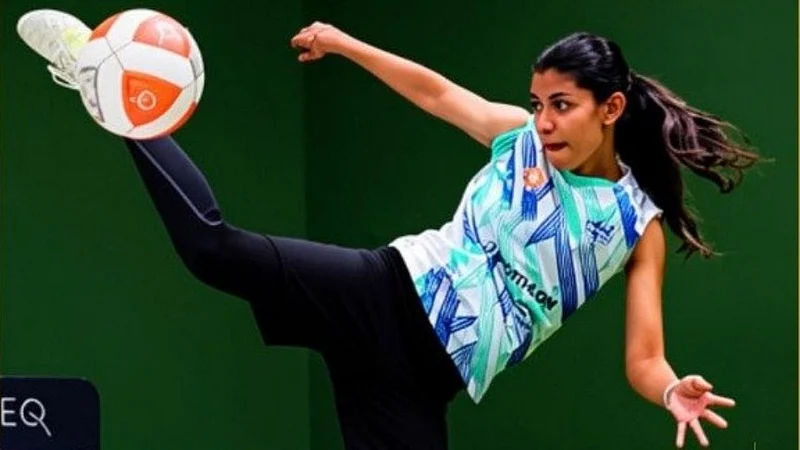
Teqball, a sport that combines elements of football and table tennis, is making its debut as an official medal sport at the 2026 Asian Games in Aichi-Nagoya, Japan.
The fast-growing sport has attracted attention for its unusual combination of football techniques, table play and quick reflexes. India is represented in teqball by Mohamed Anas Imran Beg, Declan Marshall Gonsalves and Quimcy Dsouza, who have competed across men’s doubles, women’s singles and mixed doubles.

Quimcy Dsouza has emerged as India’s leading medal contender in the sport. The Indian player reached the women’s singles semi-finals after winning both her Group A matches.
She defeated Japan’s world No. 7 Yuina Sakamoto 2-1 before beating Cambodia’s DY Koemyean 2-0 to advance to the knockout stage. She received a bye in the quarter-finals before facing Indonesia’s Sumaya in the semi-final.
Dsouza won the opening set 12-7, but Sumaya fought back to take the next two sets 12-9 and 12-7, winning the match 2-1.
The defeat ended Dsouza’s hopes of reaching the final, but she remains in contention for a bronze medal. She is scheduled to face DY Koemyean in the bronze-medal match.
What is teqball?
Teqball was developed in Hungary by a group of football enthusiasts who wanted to create a new way of playing with a ball on a table. The first teqball table was developed in 2014, while the sport was introduced internationally in 2016.
Brazilian football legend Ronaldinho became one of the sport’s prominent supporters as teqball expanded internationally.
The sport is played on a specially designed curved table with a net separating the two sides. Players use a football and are not allowed to touch it with their hands or arms.
Instead, they can use their feet, thighs, knees, chest and head to control and return the ball.
How is teqball played?
The curved table gives the ball a distinctive bounce, meaning players have to anticipate its trajectory while maintaining balance, control and accuracy.
Teqball can be played in singles and doubles. Its five recognised disciplines are men’s singles, women’s singles, men’s doubles, women’s doubles and mixed doubles.
A match can consist of up to three sets, with the first player or team to reach 12 points winning a set. If the score reaches 11-11, a player or team must establish a two-point advantage.
Each rally begins with a serve, while service changes after every four points. In singles, players can use a maximum of three touches to return the ball. In doubles, teams also have three touches but players must alternate their touches.
Players cannot use the same body part for two consecutive touches. In doubles, teammates must also alternate their touches.
A point can be conceded for an illegal return, allowing the ball to bounce more than once or sending the ball outside the permitted playing area.
With its combination of football technique, table play and rapid exchanges, teqball is bringing a different sporting spectacle to the Asian Games. India’s Dsouza now has an opportunity to become one of the first Indian athletes to win an Asian Games medal in the newly introduced discipline.