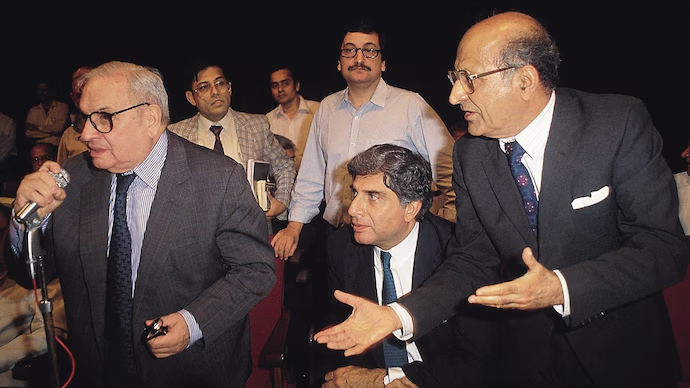
The Tata Group has faced several high-stakes leadership battles over the decades, but few were as consequential as the confrontation that unfolded at Bombay House in the early 1990s, when Ratan Tata sought to assert greater control over the sprawling conglomerate.
The episode offers a historical backdrop to the latest dispute involving Tata Sons Chairman N Chandrasekaran and Tata Trusts Chairman Noel Tata, who are now divided over questions of leadership, control and the future structure of the group.

When Ratan Tata took charge of the Tata Group in 1991, the conglomerate was a collection of powerful companies led by influential executives. Many of these leaders had built considerable authority within their respective businesses, while the group itself operated with a relatively decentralised structure.
Ratan Tata, then a relatively young chairman, sought to change that arrangement. His objective was to bring the companies under a more coordinated structure and strengthen the authority of the group chairman.
The effort brought him into conflict with some of the most powerful executives in the Tata empire. Among them was Russi Mody, the influential chairman of Tata Steel, who had built a formidable reputation and considerable influence within the group.
The confrontation became one of the most closely watched episodes in Tata’s corporate history. Ratan Tata pushed for changes in the way group companies were governed, including stronger adherence to central principles and greater coordination between businesses.
The struggle was not simply a disagreement between two executives. It reflected a broader question about who ultimately exercised authority across the Tata Group.
Ratan Tata eventually prevailed in his effort to reshape the group’s governance. The changes helped establish a more centralised leadership structure, with the Tata Sons chairman playing a stronger coordinating role across the conglomerate.
The transformation also became an important part of Ratan Tata’s tenure. Over the following years, the group expanded internationally and built a portfolio that included major acquisitions and global brands.
More than three decades later, Bombay House is again at the centre of a major Tata Group dispute. The personalities and circumstances are different, but the underlying question of authority has returned.
Chandrasekaran, who has led Tata Sons for nearly a decade, recently faced uncertainty over his future at the holding company. He had indicated that he would not seek another term after failing to secure unanimous support for his reappointment.
However, Tata Sons directors subsequently voted to extend his tenure by another five years. Noel Tata opposed the move and has also challenged the company’s approach towards a potential public listing of Tata Sons.
The latest disagreement therefore involves both leadership and the ownership structure of the holding company. Tata Trusts, which control about 66% of Tata Sons, have argued for exploring alternatives to a listing, while the company is moving towards compliance with regulatory requirements following the Reserve Bank of India’s decision concerning its listing status.
The current dispute is unfolding under very different institutional and regulatory circumstances from the 1990s. Yet the history of the Tata Group shows that disagreements over authority at the top can have consequences far beyond a single boardroom.
Ratan Tata’s battle helped redefine how the sprawling conglomerate was managed. The present confrontation will similarly shape questions about governance, leadership and control at one of India’s most prominent business groups.