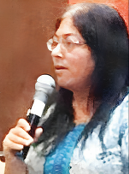
Her family’s financial background is weak – her father, a farmer, is unemployed due to the uncertain cycle of changing weather, and the mother is a daily wage worker. While her goal is to get into civil services after completing her higher education, she said that she can afford to have only one meal per day. When her mother calls to ask if she ate, “I just did,” she responds. The girl breaks down while narrating her story on live television.
There are thousands of such cases where despite possessing the ability, students have to give up on their big dreams due to lack of financial assistance. Thousands of students residing in Mumbai and Pune work in their spare time to pay for their expenses as they do not wish to burden their already stressed parents. The root cause of all this is generational poverty. How poor is our country, which is intending to become the third biggest economic superpower in 2024? Union Minister Rao Inderjit Singh presented some crucial numbers regarding poverty in India during the recently concluded Winter session of Parliament. As per the government’s survey, there are 27 crore people below poverty line (BPL) in the country. Sadly, this data is from the survey which was conducted in 2011-12. Lakhs of people lost their jobs in the meantime, especially during the pandemic.

A Niti Ayog report from 2023 states that 15% of the Indian population lives in ‘multidimensional poverty’. Multidimensional poverty is a modern way of measuring overall poverty which takes into consideration educational facilities, health services and clean water supply to people in the region, and does not rely solely on the family’s annual income. Using these factors, Niti Ayog has come up with the conclusion that only 15% of people in the country live below the poverty line.
There are several parameters to measure poverty. As per one of the government criteria, if a person living in a rural area cannot spend 26 rupees a day, then he/she shall be considered as poor. The limit is 32 rupees a day for the person living in cities. If there is a family of four where one person earns 110 rupees a day, then that family will not fall under the BPL category. For, as per the government criteria, Rs 110 divided by 4 will be 27.50 rupees per person, which is more than 26 rupees. What can one get today in just 26 rupees? Only economists would know how to come up with such criteria.
As India marches forward to become the third biggest economic superpower in the world, the increase in the country’s GDP and per capita income are consistently highlighted. India’s per capita income in 2023 stands at Rs 2 lakh. To make it simpler, if all the wealth in the country is divided equally to all its citizens, then everyone would receive Rs 2 lakh. Therefore, there is no direct connection between per capita income and poverty. A recently held caste-based survey by the Bihar government reveals a shocking picture of poverty in the State.
Generational poverty must be eradicated as it prevents every able generation is not to give their best and fulfil their dreams. This in turn adversely affects the country’s overall progress. Chattisgarh bears the tag of being the poorest State in the country. The Prime Minister during one of his campaign speeches extended the free food grains scheme in the State for another five years. In all, 12 lakh crore rupees will be spent just for this. These numbers are enough to get an idea about how deep rooted generational poverty in our country is. When compared to the rest of the States, and if the data is to be believed, there is not much poverty in Goa. However, after Chattisgarh, poverty is a huge concern in Jharkhand, Manipur, Bihar, Arunachal Pradesh and Assam. Extensive efforts should be made to eradicate this poverty. As per Niti Aayog’s report, 24.85% of the Indian population was multidimensionally poor in 2015-16, which dropped to 14.96% in 2019-21. Nevertheless, it cannot be ignored that 15% of the country’s population still lives in poverty. The government needs to take concrete steps to lift such a large population out of poverty. The Niti Aayog report states that around 31.52% of the population of the country does not get nutritious food. To some consolation, however, the number has dropped from 37% to 31%. In this report, the important index of nutrition has been used in determining multidimensional poverty in India. In determining the Multidimensional Poverty Index, years of absence from schooling (16.65 per cent), inadequate maternal health care (9.10 per cent), lack of access to cooking fuel (8.82 percent), sanitation services (6.63 percent), lack of wealth ownership (3.39 percent) has been helped by the indices. All these figures will definitely be useful for planning. But if anyone in this country is still going hungry or going to bed with their stomachs half empty, the planning is definitely going wrong somewhere.