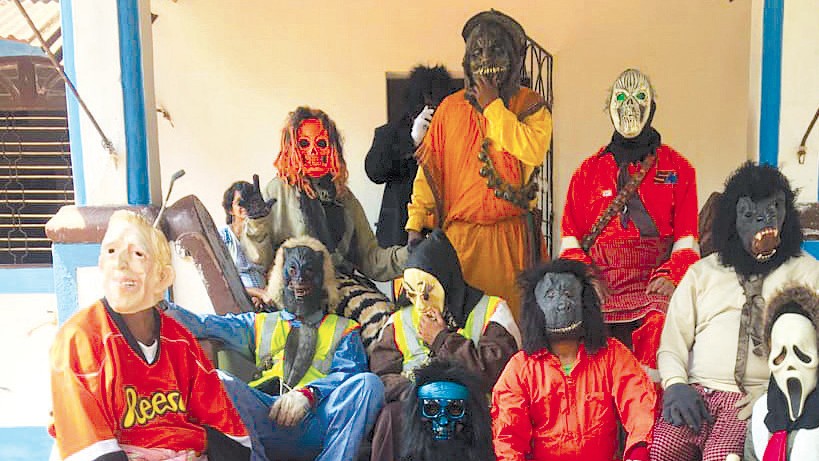
The word ‘Potekar’ comes from the ‘Potem’ meaning someone carrying a sack. In the olden days, three days prior to Lent, the elders of the village of Divar would move around the village wearing rags, covered their face with a mask so as to conceal their identity as they became ‘Potekars’ for fun during the Carnival celebrations. They would carry their ‘Potem’, a jute bag on their shoulders and roam in disguise. Not forgetting the string of brass bells tied around their waist usually meant for cattle. The very sound of the bells would keep the children on their toes. The parents then would take the advantage of the ‘Potekars’ to instil fear in the minds of their children who played mischief, made fuss to eat their food, etc. that the ‘Potekar’ would come and put them in his sack and carry them away. Hearing this, the children would behave themselves out of fear. Some others would climb up the loft of the house and stay put until sunset.
Preparation to dress as a ‘Potekar’

Preparation to dress as a ‘Potekar’ would begin at least a month in advance. The teenagers would influence the local Church sacristan to part with the wooden heads of the statue of Christ/Saints/Angels that were used to enact scenes of passion of Christ on Sundays during the Lenten season in absence of present day masks. Masks were then cast using pages of discarded old exercise books with boiled rice or wheat flour paste which would serve as glue. The masks were
then dried in the sun and later painted using water colours from the drawing
kit used in school as per each
one’s imagination. Needless to mention that there is no link with
the Church and the ‘Potekars’ it being a Pagan feast.
The ‘Potekars’ would only enter the houses of their friends and acquaintances for taking a break where they would be treated with sweet potatoes, home-made sweets, fruits, etc. and continue their onward journey and return home before sunset. Those who could afford would spent the afternoon at a local chai shop for a bhaji-pao and cold drinks in the absence of alternate eating outlets then.
Modern ‘Potekars’
The modern day ‘Potekars’ are a different lot. The younger generation does not know the significance of ‘Potekars’ and their consequences. Yet, they try to promote ‘Potekars’ by inviting their friends and make them take part in the festivities. In recent years, the festival has taken a new trend. The ‘Potekars’ assembled at the main square of the island which only resulted in just a show thereby, losing the very essence of ‘Potekars’. People from outside the island also participated dressed
as ‘Potekars’.
In the bargain, the merriment of the ‘Potekars’ of the yesteryears with the participation of the locals is losing ground. The locals should discourage outsiders taking part. It is high time the youngsters realize where they are heading for. Outsiders behind the mask can invite trouble and could be disastrous in future. If corrective measures are not taken in right earnest, the ‘Potekars’ of Divar will be forced to go into oblivion.