‘Senhora, tomai pepino, dai me menino’ (lady, take this cucumber and give me a child’); ‘Senhora, tomai colher, dai me mulher’ (Take this spoon, give me a wife) or ‘Senhora, tomai urido, dai me marido’ (Take this ‘lentil’, give me a husband) – These are Portuguese lines fervently whispered by people of all faiths who pray to St Anne to bless them with a child, wife or a husband, respectively.
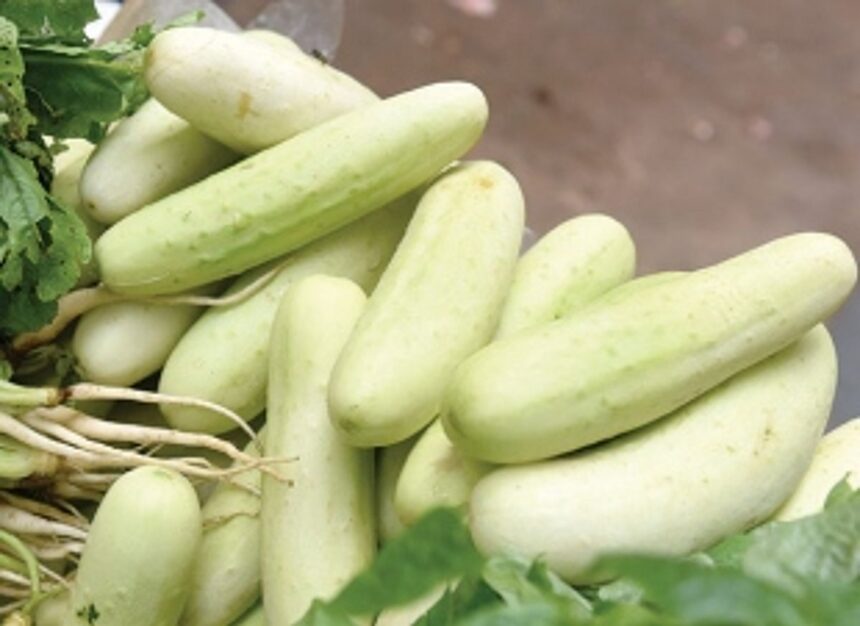
The couples praying for a child usually offer the Goan cucumber (Touxem) as an offering, a tradition being carried on from Portuguese times. To get hold of the Goan cucumber, one had to travel far and wide across Goa.
Miguel Braganza, a member of the Agriculture Committee of the Goa Chambers of Commerce and Industries (GCCI) and a former agricultural officer said, “The popularity of the St Anne Church at Santan -Talaulim has increased after its crumbling, weather-beaten structure was restored in the last decade with funds from the World Monuments Foundation. The local cucumber producers do not have a collective to lobby for exclusive rights and at the same time do not have an agreement on common price. They are getting elbowed out of the race.”
Braganza further added, “The Paramparagat Krishi Yojana that has been finally launched in Goa by the Directorate of Agriculture, has a window of opportunity to create two or more clusters of traditional farmers in Thana-Dongurlim, Farmagudi-Ponda, Curca-Bambolim, Colomb-Rivona, Gaondongrem-Tudov and elsewhere to perpetuate this ‘xeti parampara’ of ‘kumeri’ type cultivation of cucumber and hilly vegetables that are also in demand for mattolli at Ganesh Chaturthi. We can replicate NEPED of Nagaland that has been documented, and adapt it for Goa.”
Director of Agriculture, Madhav B Kelkar was candid enough to say that to collect a data on the production of the local Goan cucumber is a difficult task as it is scattered and there are no cooperative systems. “Also, the farmers sell their produce directly by the roadside after harvesting it. On my recent visit to Canacona, I could not see those cucumbers by the roadside. It may be because the monsoon in the State was delayed by 10-15 days,” said Kelkar.
The managing director of Goa State Horticulture Corporation Limited, Sandeep Fal Dessai who also was unable to get the production data said, “We have a very promising local variety of cucumber which was originally grown in the hilly areas of the State, mostly during the rainy seasons. This variety can even be preserved for one year which can be used as a vegetable and some sweet dishes or cakes. The fresh ones are relished as a salad and it is very tasty.”
Dessai said, “About 1000 families in Goa would be engaged in growing this crop along with other produce. Many of them now grow seedling in poly-bags and then transplant it on the slopes of the hill as soon as the monsoon hits the State. This saves time. Goa government has taken a proactive role by preserving the seeds of these crops and we are multiplying it so that we can give it to more farmers. Secondly, since we have many outlets throughout Goa, we will be arranging and helping to market their products. It is a three month crop and within this period a farmer earns as much as Rs 1 lakh. During Ganesh Chaturthi, the sale is at its peak.”
Chairman of the Agriculture Committee of the GCCI and former Director of Agriculture in the State, Satish Tendulkar informed that the Goan cucumbers are a variety which is only for a short duration and is only cultivated in Goa.
“They are cultivated on the hill slopes because retention of water can damage the crop. The produce is ready only after 15 days of rains. It naturally becomes organic because of the slope as no chemical fertilizer can withstand the flow of water. This crop approximately is grown in 1000 hectares in the State. Also, it is a very good cash crop as it is sold on per piece and not in kilograms and the farmer gets a good price for it as they sell directly to the consumers on the roadside. This is a very traditional variety and we have seen these from the pre-liberation days in Goa, said Tendulkar.”
Octogenarian Dr Hemant Y Karapurkar who is also Goa’s former Director of Agriculture had his higher education in Germany and is active in Sattari farm at Valpoi. He said, “The raw and fresh varieties of this cucumber are eaten as salad and the ripe ones are either used to make vegetable or even sweet dishes. This is an age-old thing and is being cultivated for years together. We do produce it in our farm along with brinjal, ladyfinger etc which is organic.”