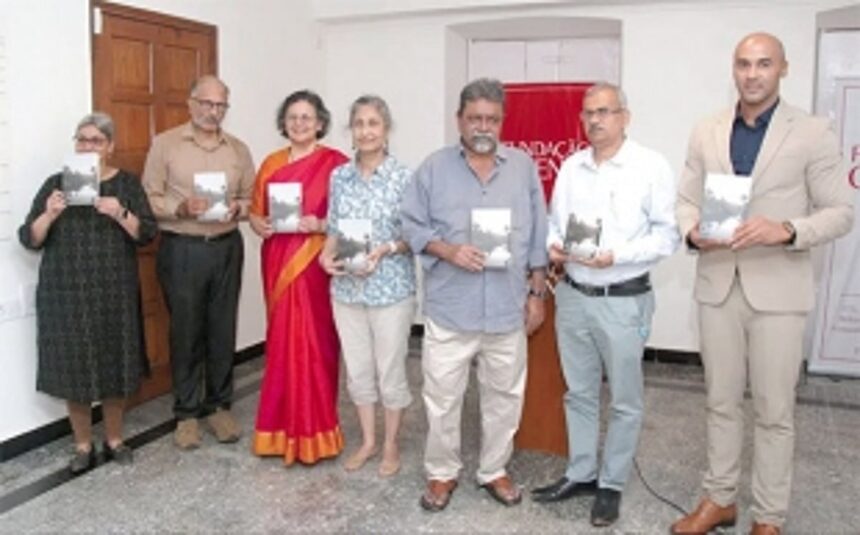
To cap off the year 2022, Fundação Oriente recently launched
their anthology ‘Still Waters’. The anthology is comprised of shortlisted and
prize winning stories from the sixth edition of the Fundação Oriente Short
Story Competition (FOSSC) that was held in 2021. While participants were
allowed to submit their entries in Konkani, Marathi, Portuguese or English, all
the stories selected for publication were translated to English before being
included in the anthology.
The Fundação Oriente Short Story
Competition is a prestigious competition that has been organised by the
institution in Goa since 2011. The competition seeks to revitalise traditional
storytelling through encouraging creative writing and promoting the cultural
and linguistic variety of Goa. The sixth edition of the competition took place
after the pandemic in 2021, and 25 short stories were shortlisted for
publication in the form of the ‘Still Waters’ anthology. The jury selected the
three prize winning stories from the shortlist.

Andrew John De Sousa was awarded the first prize for his story
‘A letter from Ms Miranda’, and secured the Alban Couto prize. The second place
was secured by Akhil Sawant for his story ‘Paani’ while Ermelinda Makkimane won
the third prize for her story ‘Pascoal Returns’. Fundação Oriente also
organised a short story writing workshop in April 2021 as part of FOSSC 2021.
Andrew De Sousa is well known for his proficiency in multiple
languages and has already published workbooks in French. His story ‘A letter
from Ms Miranda’ is centered on a teacher and student but focuses on
relationships rather than the school setting. “I saw the contest on Instagram
and decided to enter it. It was a competition that required an author to have a
connection to Goa, its people and their languages. Being published was a nice
incentive and the prize was an added bonus, but those were not my main
motivations behind writing this story. The themes of the story are people’s
relationships with other people, with Goa and with the languages spoken in Goa.
Though the story was written in English, I incorporated words from other
languages spoken in Goa like Konkani and Portuguese that are commonly used
while speaking. They served to give the story some flair while creating a sense
of authenticity. I wanted a Goan reading the work to be able to feel a sense of
connection through the words I’ve used,” says Andrew.
For Akhil Sawant, taking part in FOSSC 2021 presented him with
an opportunity to re-establish his connect with the Marathi language. “Since
graduation, I have been working with English language newspapers. I initially
completed my schooling in Marathi, but after enrolling in college, I had to
speak mostly in English as the majority of students would converse in English.
The competition allowed me to connect with Marathi again. I have always been
interested in languages and how stories were conceived in different languages.
I had taken part in a few story writing competitions organised in college, but
the last time I wrote a story was in 2018. The fact that the contest was open
to authors who wrote in multiple languages was a chance for me to interact with
and understand how stories are conceived in different languages like Konkani
and Portuguese.”
Winning the second prize was a surreal moment for Akhil. “I
heard about the competition from a friend and only completed my story ‘Paani’
on the day of the deadline. I did not expect to win anything as there were over
60 authors participating. I was later tagged in the shortlist and attended the
award ceremony. There were Marathi authors present whose stories I had been
reading since I was a child. All of the authors that attended the ceremony were
so experienced and established, so winning the prize was a surreal moment for
me. The story ‘Paani’ itself deals with inter caste and inter religious issues.
It explores how a boy of one religion witnesses children of a certain caste and
different religion playing in a water body near a temple that only they are
permitted access to, and his actions and the resulting consequences. The story
was originally written in Marathi and the published version has been included
as part of the ‘Still Waters’ anthology,” says Akhil.
Ermelinda Makkimane’s story ‘Pascoal Returns’ secured the third
place at the competition and was published in the anthology. “My story was set
on Divar Island itself. The events occur in the 1950’s, when Divar was
undeveloped and didn’t have proper roads or electricity. The main theme of
‘Pascoal Returns’ was that of yearning, of a character who wanted to pursue
farming but was forced to become a pig butcher due to his mother’s aspirations.
That profession was viewed as one that had greater scope in those days. It deals
with his yearning and courage to return to his roots and work on his own drive
to become a farmer after his mother’s passing. I work shopped the story quite a
bit before submitting it, using critical analysis, moving around elements of
the story and using a few post modern techniques like shifting the point of
view from one character to the next, until the story finally took on the form
that I wanted it to have,” says Ermelinda.
Talking
about her feelings after securing the prize, Ermelinda says, “Prior to this
competition, I had no experience related to writing short stories. I attended a
short story workshop in 2019 and read a lot which helped me develop my short
story writing skills. The FOSSC prizes are prestigious awards that backed by
Fundação Oriente. There were several experienced authors who submitted their
entries. In comparison, I was a complete newcomer and felt like a nobody, so
winning the third prize made me feel like believing in myself. The most
important gain from the competition was my sense of self belief.”