
AI addiction is when one prefers Al conversations over human interactions, and when Al use affects one’s A everyday life, including work, studies, relationships, or physical health. Al becomes a coping partner to deal with anxiety, trauma, loneliness, and more. “The term Al addiction is still relatively new. Due to the limited scientific evidence available, it is still too early to understand how widespread Al addiction really is. However, growing dependence on Al is becoming an emerging concern, particularly among younger generations,” said Mih Amanullah Arakkal, a Psychology Researcher.
“I used to spend time playing video games or watching movies. Lately, I’m spending ~20 hours a week chatting with Al. Lately, more and more, I’m spending hours every day discussing things like the nature of reality, how Al works, scientific theory, and other topics with Claude Sonnet and Gemini Pro. It’s a huge time suck, but it’s also fascinating! I learn so much from our conversations. I’ll often have two or three going on consecutively,” a Reddit user shared his experience with Al use.
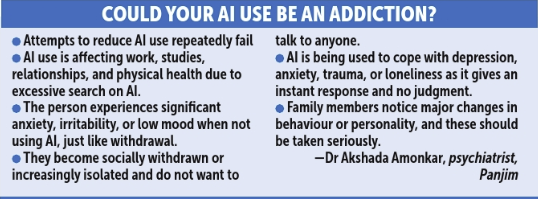
Al addiction can be considered a subset of internet addiction, which is not yet recognised as a clinical diagnosis. “Al addiction is more specific compared to Internet addiction as it gives instant responses, never judges, and can provide emotional validation or personalised assistance, explained Dr Akshada Amonkar, a consultant psychiatrist from Panjim. Note that several high-profile wrongful death and product liability lawsuits have been filed by families and legal representatives against Al companies, including OpenAl (the creator of ChatGPT), Google (the creator of Gemini), and Character.Al.

HAS AI BECOME THE BE-ALL AND END-ALL ALREADY?
A 2026 study (Presented at ACM – CHI Conference on Human Factors in Computing Systems) examined 334 Reddit posts from users who either described themselves as being “addicted” to Al chatbots or expressed concerns that they might be.
The researchers identified three recurring patterns: becoming immersed in role-playing and fantasy worlds, developing emotional attachments by treating chatbots as close friends or romantic partners, and engaging in compulsive information-seeking through endless question-and-answer interactions. “Al is addictive because it taps into something very natural in us. We, humans, are wired to seek immediate rewards with the least possible effort. And Al promotes this by providing instant answers, personalised responses, and human-like conversations, making it an easy escape from intellectual challenges, emotional distress, boredom, or loneliness. Unlike people, Al is available 24/7 never gets impatient, and is always ready to follow our preferences. Its widespread use increased during the COVID-19 pandemic, when isolation and stress led us to rely more heavily on digital technologies for work, learning, and emotional support,” explained Mih Amanullah.
IS ANY CATEGORY OF PEOPLE INCREASINGLY AT RISK?
“Some people are more at risk than others. Those dealing with depression, anxiety, relationship problems, and social withdrawal may be more vulnerable, not because Al causes these problems, but because it becomes an easy coping mechanism. Loneliness, in particular, appears to be a common thread,” shared Mih Amanullah. When it comes to loneliness, it is a loop.
According to the researcher, one relies on Al to feel less lonely, which gradually reduces opportunities for genuine human connection, which eventually leads to an even greater loneliness and makes Al feel more comforting. “For individuals who are stressed, lonely, or facing academic or work-related pressure, Al gradually becomes a preferred coping mechanism. The commercial success of these tools depends entirely on their ability to keep users engaged, making themselves increasingly indispensable day by day,” said George K Thangsing, Counselling Psychologist at Manipal Hospital.
REPERCUSSIONS OF BEING ADDICTED TΟ ΑΙ

Being addicted to Al does not refer to merely spending prolonged hours using Al. “The seriousness of Al addiction depends on its impact. If Al use leads to social isolation, poor academic or work performance, sleep problems, worsening anxiety or depression, or an inability to function without it, it deserves attention,” explained Dr Akshada. Psychology researcher Mih Amanullah explained, “Overreliance on Al for thinking, problem-solving, and decision-making may gradually reduce independent thinking. This can affect critical thinking, productivity, sleep, relationships, and overall quality of life. The concern is not that Al can think for us, but that over time we may stop exercising the mental abilities that make us think independently.
ARTIFICIAL INTELLIGENCE ADDICTS ANONYMOUS (AIAA)
AIAA is a fellowship for people suffering from Al addiction, Al psychosis, and compulsive Al chatbot use who are ready to reclaim their lives (Definition taken from the AIAA website). The group appears to be present/active abroad. According to their website, these support groups organise in-person meetings as well as online meetings.
On such support groups, someone who previously struggled with hypochondria and internet addiction, and who requested anonymity, shared, “I feel we are more comfortable sharing things with the internet rather than speaking to a person, as they can get provoked or might judge you. I feel these groups provide comfort, and as I said, they don’t make you feel judged. Also, some people don’t want to visit a doctor now and then for each and every symptom, so, for their satisfaction, they just Google it. I think that instead of googling your symptoms, one must get diagnosed, get to the root cause, and treat it.”
Originally developed for Alcoholics Anonymous and later adapted for behavioural addictions, a 12-step model (recovery supporter) focuses on accepting the problem, developing self-awareness, taking responsibility, rebuilding relationships, and maintaining recovery. “At present, there is no evidence to conclude that it is effective specifically for Al addiction. However, its emphasis on insight, social support, and healthier coping strategies may still benefit many individuals struggling with problematic Al use,” said Mih Amanullah. According to George K Thangsing, “Implementing psychoeducation at the grassroots level will be effective; it is a good starting point to teach people how Al is designed to keep them hooked, engage unconsciously and diminish independent decision making.”