Elsa Angel Rose
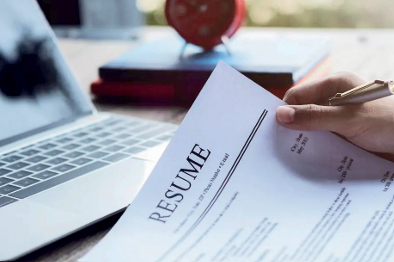
AI has managed to create identical CVs, or more precisely, the ‘GPT CVs. Employees and job seekers are not holding back; they are going all i Il in on ‘tailoring, structuring, and formatting’ impeccable ‘GPT-generated CVs, not in collaboration with Al, but entirely through Al. This has created an inevitable hurdle for recruiters to overcome: identifying the best candidate from a bunch of look-alike CVs. “There has been a noticeable increase in Al-generated CVs, especially as employers are also using Al-based filters and screening tools for shortlisting profiles. Al-generated CVs can often be more fictional than reflective, making it difficult to assess the candidate’s true capabilities and individuality,” observed Shantel Cybil Braganza, Human Resource Executive from Margao. As mentioned by Shantel, many times, it becomes absolutely essential for job seekers to use Al, as their recruiters also increasingly depend on Al to shortlist and select candidates. “Some companies use Al tools to reduce the time spent filtering profiles.

However, their usage and effectiveness vary across industries and functionalities hired,” said Shantel
In current times, you applying to one place or a maximum of 10 places and then getting into one of those jobs does not happen. The real-life version of this includes applying to 300+ places and then getting 4-5 interview callbacks. This is also a byproduct of online platforms (LinkedIn, Naukri, Indeed, and more) making (or trying to make) hiring wide and offering hiring managers optionality. When hiring managers have a huge pool of potential employees, job seekers who are part of these pools automatically end up having a huge pool of potential employers. Applying manually to each one of those is not pragmatic. Hence, mass-applying using Al-generated CVs appears to be the most efficient rescue option for this dilemma. And for recruiters, using Al keyword filters and other tools seems to be the most practical option. In simple terms, “Candidates can’t stop applying to the slew of jobs because they might not get interviews. Recruiters can’t stop using keyword filters because there are too many applications to review”.
“The employer. By a distance. A candidate gaming a CV affects one hire. An employer running all applications through an AI filter affects every hire they make, and they don’t even know what they’re missing because rejected candidates are invisible to them. At least when a human screens CVs, there’s judgment, context, and the occasional gut call that turns out to be right. When AI screens, you get pattern matching. And patterns can be gamed. The risk isn’t on the candidate side; it’s on the side that decided to remove humans from a fundamentally human process,” explained Juned Khan, Founder & CEO-91HR, Panjim. When an employer uses AI tools and other software to locate the right candidate, he/she ends up mapping out the best optimised candidate, not the best candidate. “You end up with people in rooms who are great at getting into rooms and not much else,” said Juned. Not all human resource companies rely only on software to shortlist and find the right one. “Honestly, I don’t think any tool does this reliably enough to trust. What we do is talk to candidates. A 20-minute conversation tells you more than any detection software. If someone has stuffed their CV with keywords they don’t understand, it falls apart the moment you ask them to explain their own experience. That’s the filter,” said Juned. role and contributions there. When asked about whether the percentage of fake or entirely fabricated CVs has exponentially risen with the coming of AI, he replied, “Fully fabricated CVs are actually a small percentage, maybe 5-8% in my experience. The bigger problem isn’t outright fake CVs, it’s the inflated ones. People exaggerating designations, stretching tenure by a few months, and taking credit for teamwork as individual achievement. That’s far more common and far harder to catch without proper due diligence.” The problem is not fake CVs exactly, but fake work histories, and these cannot be attributed to AI use fully. AI has just made fake work history presentations cleaner. “Fake work histories have existed long before AI. People have been listing companies that shut down, or roles that can’t be verified, for years. Earlier, a fabricated CV often had inconsistencies in language or formatting that gave it away. Now those CVs read well. The fraud isn’t new, it’s just better dressed,” shared Juned.
Submitting a generic AI resume or an exaggerated AI CV could be associated with resigning even before joining. Of course, putting all the keywords in the CV will give you visibility, but it won’t get you the job. Hence, a collaboration between humans and AI can get you a job, given that many other factors also align. “I strongly believe that candidates should create their own CVs and use AI as a supporting tool rather than relying on fully AI-generated resumes. A CV should reflect a candidate’s actual experience, achievements, and skills, while AI can help improve the structure, language, formatting, and correct grammar or spelling errors,” said Praniksha Premanand Karapurkar, HR Executive at Growth Gravy, Panjim. Following this approach will offer authenticity to the CV and confidence during the interview to candidate. “I have often come across candidates who submit entirely AI-generated resumes but struggle to explain the content during interviews, as they are not fully aware of what has been included. AI should enhance a candidate’s profile, not replace their personal input and effort,” said Praniksha. This brings back the question of whether elaborate CV’s are now making a comeback. Since every recruiter likes to know in depth information about each company the candidate has worked with, their role and contributions there. “Personally, I appreciate CVs that provide sufficient detail about a candidate’s experience, responsibilities, projects, and achievements in each organisation they have worked with. This information helps us assess not only their technical capabilities but also their level of confidence and expertise in specific areas,” said Praniksha. However, it is significant to keep in mind the difference between being detailed or elaborate and repetitive. “An authentic CV that clearly showcases relevant experience will always have a stronger impact than a lengthy document filled with generic information,” the HR professional shared.
Beyond AI help, one thing that can truly help one land the dream job is personality, human skills and alignment with the company culture and ethics. “While AI can certainly assist with technical tasks and help streamline the recruitment process, human skills and personality remain irreplaceable. Technical competencies can be taught and developed over time, but qualities such as passion, commitment, emotional intelligence, and the right attitude are often what determine long-term success in a role,” said Praniksha. Through one’s conversation, body language, and overall interaction experienced hiring managers understand a person’s suitability to the role and the organisation. While AI can support hiring decisions, the final decision should always be made by a human.