Karsten Miranda
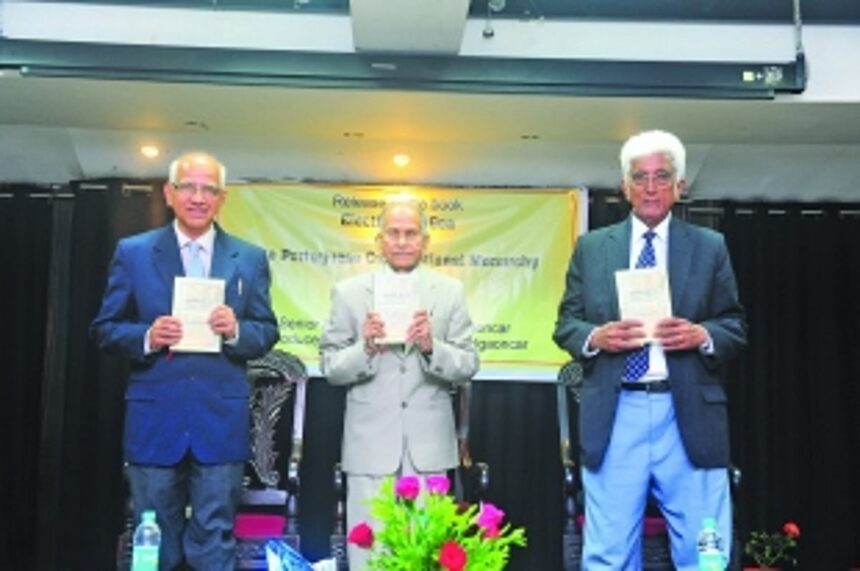
Senior Advocate and former Advocate General of Goa, Mario
Bruto da Costa recently released the book ‘Elections in Goa during the
Portuguese Constitutional Monarchy’.

It may be recalled that the senior advocate had earlier
published another book, that one in Portuguese, titled, ‘A Terceira Corrente’,
containing an interesting and very relevant selection of letters, speeches and
articles of his late father, Adv Antonio Anastasio Bruto da Costa, a fearless
Goan, who valiantly opposed many of the policies and decisions of the Salazar
regime, particularly during the last fifteen years of his dictatorial and
controversial rule in Goa.
This new book gives a
fair representation of a narrative of events and facts that occurred during the
Portuguese rule, the time of the first elections that were held in Goa and what
that meant at that time. This, the system of representations at various levels
of administration was one of the major reforms conceded to Goa and other
overseas colonies of Portugual during the constitutional period as consequence
of the liberal changes in 1820 in Portugal.
The system of election and representation of people during
the nineteenth and twentieth centuries constitute unique features in the
administration of colonial Goa. The book examines the nature of enfranchisement
and election that prevailed in Goa against the background of the political
system in Portugal and the Portuguese legislations in Goa. While the system of
election followed in Goa reflects the political trends in Portugal and Europe,
it also shows the colonial character of the Portuguese rule in Goa.
“One of the strengths of this book is it is replete with
quotations. I feel the quotations lends strength to the narrative in this book.
We get to hear the voices from the primary sources and through that we learn
that these were the men of considerable talent, fine parliamentarians, men of
courage who did not mince their words when they sat in parliament and asserted
the rights of the people of Goa,” says senior advocate Jayant Mulgaonkar, who
provided an introduction to the book at its release function.
After Constitutional Monarchy was established in Portugal in
the early nineteenth century , a charter was granted to Goa under which Goans
elected their representatives or ‘deputados’ to the Portugues parliament.
Among the first of these, were Bernado Peres Da Silva and
Constancio Roque da Costa who were followed over the years by number of others
and included such famous names as Francisco Luis Gomes, Bernardo Francisco Da
Costa among others.
When António de Oliveira Salazar became the Prime Minister
of Portugal, he was the architect of the Colonial Act, which affected
Portuguese India, differentiating Goans from the metropolitan Portuguese
people.
“Now interestingly in the 1820s the provisional junta of the
government in Portugal proclaimed to the people of Portugal that there shall be
no more colonies but overseas provinces and fellow citizens of the same
motherland. Almost a century there after Salazaar changed gears. And
unfortunately Salazaar’s gear shift or gear stick was stuck in the reverse
gear. He enacted a piece of legislation which was the Colonial Act which laid
down that it was of the organic sense of Portuguese nation to discharge the
function of possession and colonising overseas dominions and civilizing the
people residing therein. Now the results of his policies are well known today,”
says author Mario Bruto Da Costa.
“What I would like to emphasize is that the period after
1820 had certain events that are worth noting. One is that Goa had, for the
first time, a Goan as a governor, with the title of Prefect. Secondly, Goans
fought elections fearlessly against candidates fielded by the central
government in Goa. Thirdly, Goans enjoyed complete freedom of speech and
expression and they exercised this right with dignity and without fear,” adds
the senior advocate.
While the author spent a lot of time researching and
examining old documents and newspaper articles, his book has been praised for
its accurate depiction and portrayal of the high civic sense, integrity of
character and outstanding cultural strengths that were displayed by a
generation of Goan intelligentsia of that era.