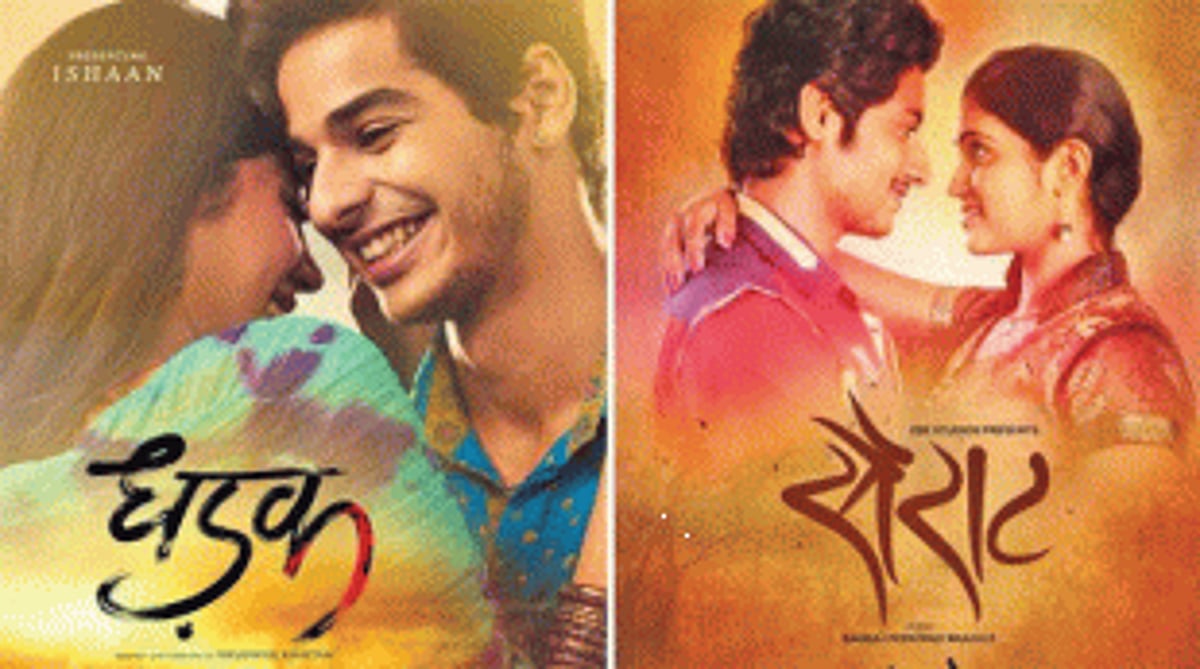
Whenever a film, or for that matter, a
book or even a play, is remade, it is confronted with a horde of fans waiting
to measure the remake to the perceived higher standards of the original. Fans
can take an almost masochistic pleasure in spotting and analysing every change
the director has made to their beloved piece of art – a world they have
inhabited, lived through and already claimed as their own.
This has been the
case with ‘Dhadak’, which took on the gargantuan task of remaking ‘Sairat’, a
small Marathi film that broke box-office records in 2016 and turned into a pop
culture phenomenon all across Maharashtra. As soon as the trailer for the Hindi
version dropped, social media boiled over with seething responses from
Marathi-speaking audiences, panning the remake.

As one of those
who had seen and loved the Marathi film, I was intrigued, though not surprised,
by this response. Having studied film adaptation and by profession a
translator, I am intimately familiar with the challenges in transposing a work
from one language or medium to another. As such, my training has taught me not
to be dogmatic: the Harry Potter movies work fantastically well on screen even
though they do not adhere ‘faithfully’ to the original books, and the number of
books we read in translation is testament to the fact that crossing barriers is
a worthwhile, if somewhat arduous, task.
From this
standpoint, I shared none of the objections of purists to the fact that Dharma
Productions and Shashank Khaitan chose to remake a Marathi film, reset it in
Rajasthan, and basically did a copy-paste with better clothes and fancier
locales.
Translators know
that the nature of their work is not linguistic but rather semantic or
literary; our job is not to transcribe words from one language to another,
rather to convey the meaning, spirit, style and tone of the original through
the translation. This is true of film adaptation as well – each film has its
own unique language. In form, content and spirit, the writer and director leave
their mark through the choices they make in retelling a story. In this light,
the problems with the remake are apparent in the choices of its makers.
Firstly, ‘Dhadak’ deliberately makes
explicit what was left to the surprise and horror of the denouement in ‘Sairat’
– Madhu’s father makes his son swear that he will not “follow that upper-caste
girl”, Ratan Singh says early in the film that any daughter of his who strays
off the honourable path will meet a violent end and a number of supporting
characters spout lines like “you will never be safe now”. The makers might
argue that this underlining of the stakes is important to drive the point home
for a mass audience but the resounding success of ‘Sairat’ – especially in
rural areas – disproves the notion that people need to be spoon-fed like this.
Without a hint of artifice or any overt dialogue, every supporting character in
‘Sairat’ is subtly defined by their caste and place in society, a world that
Manjule takes great pains to paint in raw detail. In ‘Dhadak’, we get this one
line from the father and no mention or depiction of caste divides otherwise.
Secondly, ‘Dhadak’ waters down, if not
reverses, the inherently feminist narrative of the Marathi original which was
driven by the character of Archie. Here was a girl who stood up for her love
and was completely defiant in the face of an authority whose violence she was
intimately familiar with. Archie’s arrogance is rooted in the comfort of her
upper caste, but is not defined by it. She smirks and laughs at Parshya, but she
never derides him by making her love into a prize bestowed upon her lower caste
lover from an ivory castle as Parthavi’s character does by making Madhu jump
through a number of hoops in an open dare to win her love. Neither does Archie
simper and whimper or refuse to question her father like Parthavi does in the
remake. One of the most stunning scenes of ‘Sairat’ is when Archie, on hearing
that the police has got her man, runs to her lover’s rescue, gun in hand. In
‘Dhadak’, Parthavi pulls out a gun only as a last resort, making her into both
a passive victim and sole culprit of the life of misery the couple has to live
thereafter.
This rewrite paves way for Madhu to
suspect Parthavi of infidelity later on in the film, and for the makers to turn
an ordinary lovers’ tiff in the original into a moment of physical violence in
the remake. This slap glorifies and plays up to the very patriarchy that the
film is purporting to warn us against and is not the only instance of mixed
messaging in ‘Dhadak’. How can one have sympathy for a girl who spouts trite
lines like “I won’t cook, you will, but please use less ghee because I want to
remain slim”? Archie’s bravado in the original is shown to be rooted in a sense
of somewhat naive pride and immense self-esteem, and to turn that character
into essentially a spoilt, controlling nag is not only a great shame but a
betrayal of Manjule’s reversal of the damsel-in-distress stereotype.
Moreover, in the choice to use sweeping
cinematography, horse-riding, sunset scenes and operatic music, the makers of
‘Sairat’ were making an ironic nod to the genre of Bollywood, whose escapist
fantasies the young protagonists unconsciously imitate in a desperate attempt
to run away from their harsh reality. The tension created by walking the fine
line between Bollywood-like and realistic cinematography is precisely one of
the Marathi film’s great strengths, one that Manjule wielded carefully to
suspend the audience between comfort and discomfort before throwing them
completely off the edge with the last scene. Stripped of this tension and
devoid of realism, what we get in ‘Dhadak’ is an aesthetically pleasing but
flat remake that has no room for the deep irony and thwarted hopefulness of the
original. As a result, the film is a fairly straightforward take on a doomed
love story set against a vague backdrop of caste and class. This is something
we have seen umpteen iterations of already in Bollywood – think ‘Dil’, ‘Maine
Pyar Kiya’, ‘Raja Hindustani’ – and so what is originally a damning statement
on caste ends up becoming a dull public service message against honour
killings.
’Sairat’ deliberately drew the audience
in with the promise of an entertaining love story but left them instead with a
lasting sense of how caste is not just political, but deeply personal, with
damaging and often lethal consequences for young people who are just trying to
go about living ordinary lives. ‘Dhadak’ leaves no such lasting impact, with
the crucial rewrite of the climax going for a conventional ending instead of the
damning scene of a baby’s footsteps in the blood of its slaughtered parents – a
metaphor for the far-reaching and vicious cycle of caste violence.
The true genius of ‘Sairat’ lay in using the age-old
story of star-crossed lovers to make a deep and scathing indictment of the
caste system. It employed the very tropes of the Bollywood genre to undermine
the dangerous fantasies it sells us. Without this spirit of allegory or
subversion, ‘Dhadak’ is to ‘Sairat’ what Google translate is to a
flesh-and-blood translator; it does a fair transposition of the original but
fails utterly to read or convey its damning subtext.