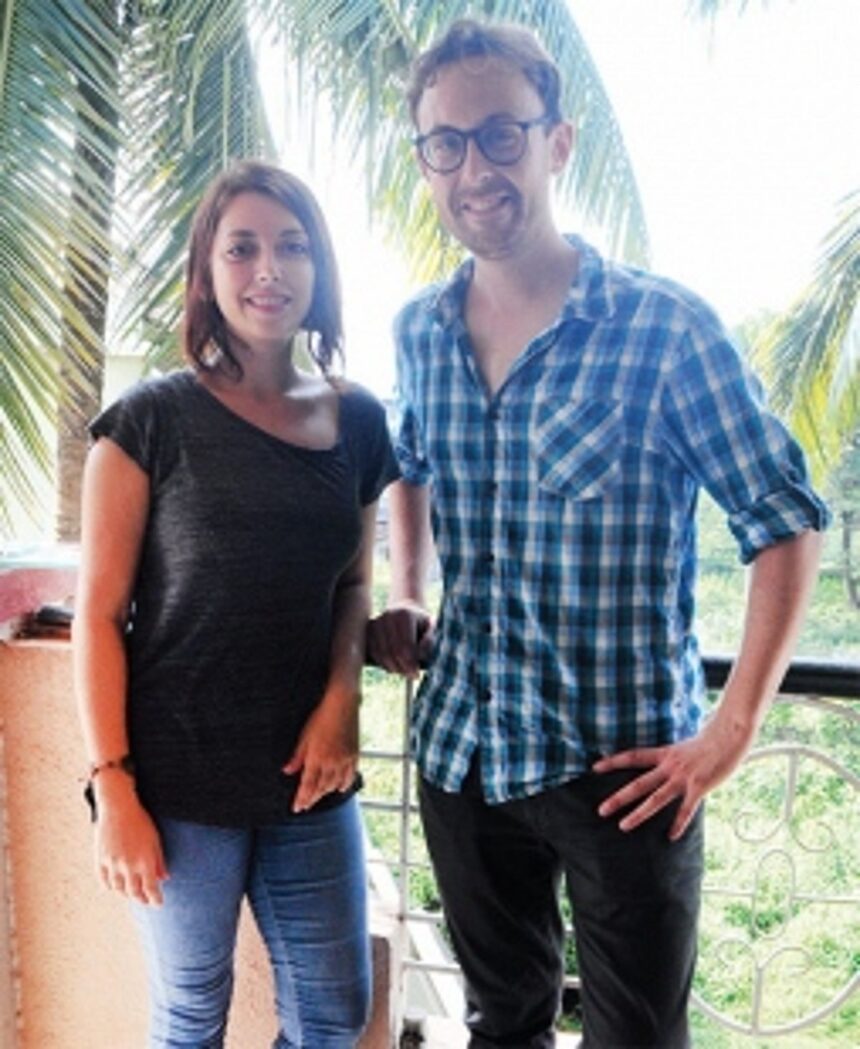
The Asian Mycological Congress is a biennial event that brings together mycologists from all over Asia and covers advances in all aspects of mycology, the scientific study of fungi. The conference encourages learning, dissemination and promotion of mycology. This year, the congress was held under the aegis of the Asian Mycological Association and the Mycological Society of India and organized by the Goa University. Though, the congress is called Asian Mycological Congress, it is open to citizens of any country who are interested in researching about fungi. Two research students who were attracted to the event were Antoni Gandia from Spain and Ceyda Zazoglu from Turkey.
Antoni has a masters in Molecular and Cellular Biotechnology of Plants from Instituto de Biología Molecular y Celular de Plantas (IBMCP) in Valencia, Spain. His fascination with mushrooms grew as a teenager living in a hostel. “I noticed that my friend had a small tray under his bed and he had grown mushrooms on it. I was surprised to know that it was possible to grow mushrooms in such a small place and that too under the bed. Being a science student, I wanted to know more about it specially on the molecular level,” says Antoni, who did his fellowship with Tyroler Glückspilze, Austria.

On his first visit to Goa, Antoni was overwhelmed with the sessions he attended at the Asian Mycological Congress. “The four day sessions had speakers from different parts of the world, giving us insight into the advancements and recent studies related to mycology. We could choose the sessions we want to attend. My interests are primarily scientific research and assistance, I can provide support to biologists and other scientists in the lab and the field. My work focuses on the study of living organisms. Through experiments and research, I can help to discover new approaches to heal people and ecosystems, improve agricultural productivity, as well as develop new bioprocesses and technologies” he adds. Antoni has also written a book in Catalan, ‘Fungicultura, el cultiv dels bolets’ which he intends to translate into English.
Ceyda Zazoglu from Turkey has a masters in Environmental Sciences and Engineering from the Istanbul Technical University. She was a student volunteer for the Art and Science of Mycorenewal at California and later a research
volunteer at the Amazon Mycorenewal Project in Ecuador. Being a Fungal Remediation Researcher, she has the opportunity to see how the fungi reacts to different conditions especially contamination. “Goa has different types of mushrooms that are wildly grown. There are three widely consumed mushrooms in the world, Agaricus bisporus also known as Button mushrooms, Pleurotus also called oyster mushrooms and Shiitake mushrooms. On our visits to some places in Goa, we noticed that the Reishi mushrooms were wildly grown on the barks of the trees. In East Asia, there is great value for this mushrooms as it is known for its medicinal qualities including curing of cancer and diabetes,” says Ceyda.
“The weather in Goa is ideal for cultivating mushrooms and it doesn’t require a large patch of land. They are naturally grown, cost effective and also helps in bioremediation. As I have worked on the Amazon Mycorenewal Project, bioremediation is a waste management technique that involves the use of organisms to remove or neutralize pollutants from a contaminated site. With the contamination of petroleum in the Amazon river, it was affecting the water and the organisms and plants living in that region. We are still studying the mushrooms that grow and absorb these harmful chemicals,” says Ceyda.
Though both are research students, they emphasis on recognize the mushrooms well before cultivation and consumption. “Mushrooms can be grown even on industrial waste such as straw and wood chips. They have various uses for producing medicines, food products, dyes and they even break down plastic which is carbon fibre,” concludes Antonio.