Statistics
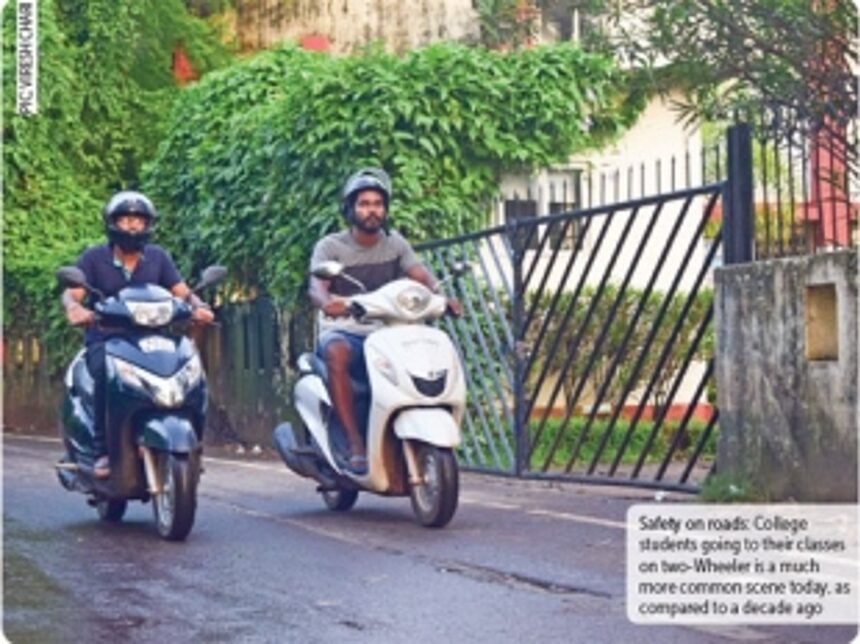
say that around 80% of the accidents that take place on our roads involve youngsters.
It’s not only heart-wrenching, but also disappointing to see our young and
energetic population fall prey to the heat of the moment, which is the reason
for most of the road accidents. Speeding up, not wearing helmets/seatbelts,
using phones
while riding or driving, are all very common amongst youngsters today, despite
knowing how dangerous these acts can be. There most certainly is a
need to
reinforce awareness about road safety measures among the Goan youth. This feat
can certainly be achieved by the colleges in our state. And there are a few
colleges that are trying their best to help their students be safe on
roads.
Dr
Elvis Gonsalves, Principal of St Xavier’s Higher Secondary School, Mapusa,
states that at their institution, they have taken special measures to emphasise on the
importance of road safety measures among students. “We have students who are
barely 16 or 17 years old. I think they are too young to ride, and that’s why
we have a rule here that no student will ride or drive to college. Earlier, we
have had cases where students coming to classes on their bikes have met with
accidents. But since we started the practice of not allowing anybody in uniform
to ride or drive, the number of such instances has reduced drastically. Even
the parents support us in this matter,” explains Dr Gonsalves. Apart from this
rule, Dr Gonsalves also informs about the various talks that are arranged
by the institution to inculcate safe road habits.
“Road safety awareness talks, either by the professors or by some resource
person from the Directorate of Transport, are a common ritual in our college.
Here, we try to teach simple basic road safety rules to our students, and also
make them aware that discipline on road is a must for both riders as well as
pedestrians,” he adds.

“There
is a dire need for awareness
about road safety amongst people of all age-groups! The young,
old and middle aged, all need to be re-taught road discipline,” feels Prof
Andrew Barreto of Parvatibai Chowgule College, Margao, who finds the lack
of civility on roads very disturbing. As he talks about the need of these
awareness activities to be taken up by educational institutions, he opines, “I
don’t know if many colleges are actively promoting road
safety. Chowgule College has put up signs requesting students to wear helmets.
I feel that if the students are shown the consequences of their actions through
videos or interaction with someone who has been in an accident, it would
motivate them to take road safety more seriously.” Sharing a similar opinion,
Prof Lata Rajeev of Don Bosco College, Panjim thinks that colleges indeed can
do a lot as far as creating awareness among students is concerned. She states,
“Colleges can caution students about the perils of rash driving by passing a
positive message through talks and programs held on campus.”
According
to Bhushan Bhave, a professor at PES’s SRSN College of Arts and Science, though
colleges have to do their bit in creating awareness about road safety, it’s
also upon parents as well as state authorities to impart these lessons to the
youngsters. “In Goa, due to the availability of good public transport facility
and special buses for schools/colleges, a bike to go to the college is not a
necessity for most of the students. The parents should make it a point not to
provide their children with this facility unless it is absolutely necessary.
Also, the authorities need to be more strict about the penalty they charge for
breaking the road safety rules. Youngsters should have the fear that will make
them abide by the laws, and should not feel that they can get away with
anything. Only then will they start taking the laws seriously,” he maintains.
While he also believes that workshops, talks conducted by the colleges in
collaboration with the traffic cell will surely help create awareness among
youth, Prof Bhave insists that these programmes shouldn’t be organised just for
the sake of it. “Maximum participation of the students has to be ensured by the
colleges, and a strict check needs to be kept over the results,” he concludes.