There are few contemporary parallels to the worldwide excitement after Zohran Mamdani’s victory in the New York mayoral race earlier this week: Maybe there are some comparisons to be made with Barack Obama’s initial ascent to the White House, or that electrifying 1989 moment when the Berlin Wall was breached. Just like then, it seems like the whole world has tuned in to watch history in the making and has now joined together for an unrestrained global celebration. Over the last few days, it has been amazing to observe just how personal this victory turned out to be for so many people, in so many different parts of the world, all of whom became emotionally invested in his idealistic campaign.
Social media surely amplified the interest – and Mamdani has certainly raised the bar with his clever videos, messaging and merchandise – but there can be no doubt it is the substance of his campaign that won this famous victory. He ran on the exact opposite of the divisive politics of exclusion that dominate our times, shrugging off vitriolic hateful attacks, and conveyed a message of hope instead of fear, bringing people together instead of pitting them against each other. In fact, while his victory speech quoted Nehru, the young politician’s effect on those around him was positively Gandhian. He won by inspiring young New Yorkers to get up and out, and head together to the polls in record numbers. In the process, he has fired up his entire generation.
Mamdani is only 34, with some of the most powerful enemies in the world, starting with the US president and his MAGA cohort. To some people, his victory is being treated as an existential threat, which must be combated by almost any means necessary. That means huge pressure, and the inevitability of constant sabotage, which makes it impossible to predict he can wind up being successful in any substantial measure. Nonetheless, we also clearly see his rise is hopeful indication there might be ways out of our highly exhausting age of oligarchs and militaristic might-makes-right, and that is precisely what has galvanised the youth.
I loved the perceptive take from the distinguished diplomat and former foreign secretary Nirupama Rao, who wrote on social media that “Zohran stands at the confluence, a sangam, of worlds. Hindu and Muslim, Indian and Ugandan, New Yorker and Delhi-ite in equal measure, he carries within him the contradictions that define both his lineage and his politics. There is something unmistakably Indian about the way he moves through New York boroughs— eating biryani and aloo dum with his hands, speaking Hindi with a fluency that surprises even the jaded cosmopolitan, quoting Nehru on democracy, and imbibing Bollywood beats on his victory lap. Yet there is nothing performative or with artifice, about it. He does not wear his Indianness draped across his shoulders like a flag; it is woven quietly into his being. In that unforced way, he embodies a kind of living soft power — not the state-sponsored kind, but the gentler persuasion that comes from his youthful exuberance.”
In her view, says Rao, “Mamdani’s presence in American politics…is an act of synthesis. From India, he carries the conviction that pluralism is a civilisational inheritance — that faiths, languages, and histories can overlap without erasing one another. From America, he absorbs the restless belief that democracy is an unfinished experiment, renewed each time someone insists on belonging. Between these two traditions, he stands as a bridge — a reminder that both nations, in their most generous moments, have imagined freedom not as uniformity but as coexistence. His lineage is an evocative expression of all this. Mira Nair projected India’s emotional landscape through cinema; her son now projects its plural spirit through civic life; both do it by being unmistakably themselves. In them, India’s soft power is less a strategy than an inheritance — the quiet confidence that culture, when lived fully, persuades naturally.”
It is a persuasive angle, and equally fascinating, of course is how this New York victory is being seen in Uganda, the African country with even more of an authentic claim on the young Mayor of New York than India, as he was born in Kampala and lived there for several childhood years, besides retaining his Ugandan passport and citizenship. In addition, his father Mahmood Mamdani’s latest book is an epic reckoning with the country that once kicked him out for not belonging, Slow Poison: Idi Amin, Yoweri Museveni, and the Making of the Ugandan State).
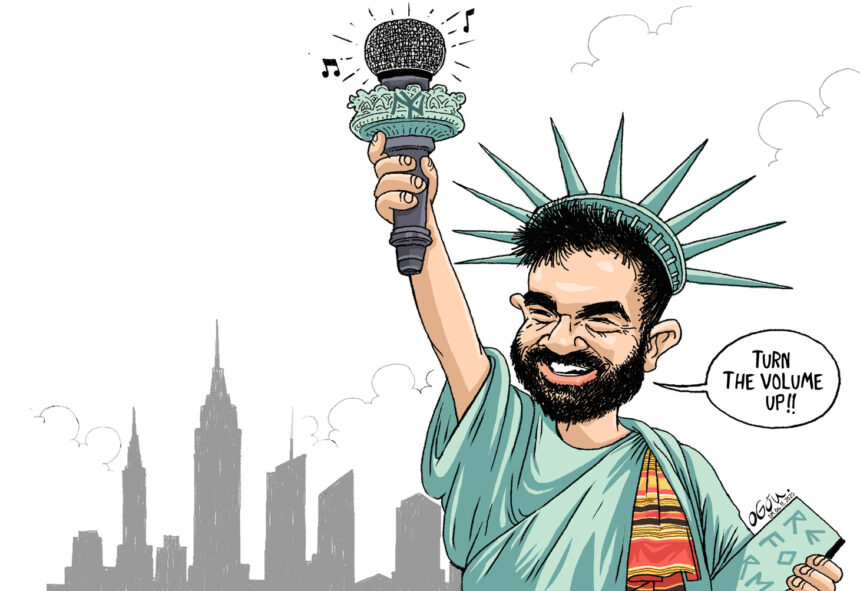
What we can see is, for the most part, Ugandans are jubilant, as apparent in the editorial cartoon on this page, reproduced with permission from Daily Monitor, the Kampala-based independent newspaper where Mamdani – “just a boy with a clean face” – once worked as a teenaged intern almost two decades ago.“The reaction to his win is electric’ says David Kaiza, the outstanding Ugandan writer who attended the Goa Arts + Literature Festival in February earlier this year.
When I texted Kaize for his reaction from his home in Entebbe, he messaged back “I think people are still trying to digest what it means. Many, many people have formed close personal relationships with the Mamdani family. His father, Prof Mahmood is the most consequential scholar in Uganda for decades. His mother, Mira Nair has had an equally large impact on East Africa with the film school she founded, Maisha – Kiswahili for life. We who knew the father and the mother see both of them in him; his mother’s energy and commitment to the underprivileged, and his father’s unimpeachable intellectual integrity. All three of them have won a following in Uganda for their undeniable commitment to the country. Mamdani’s success at a time of the youth-led uprising against tyranny has not gone unnoticed in the presidential palaces of East Africa, and they fully understand that young East Africans have just been given an additional leader.”
(Vivek Menezes is a writer and co-founder of the Goa Arts and Literature Festival)