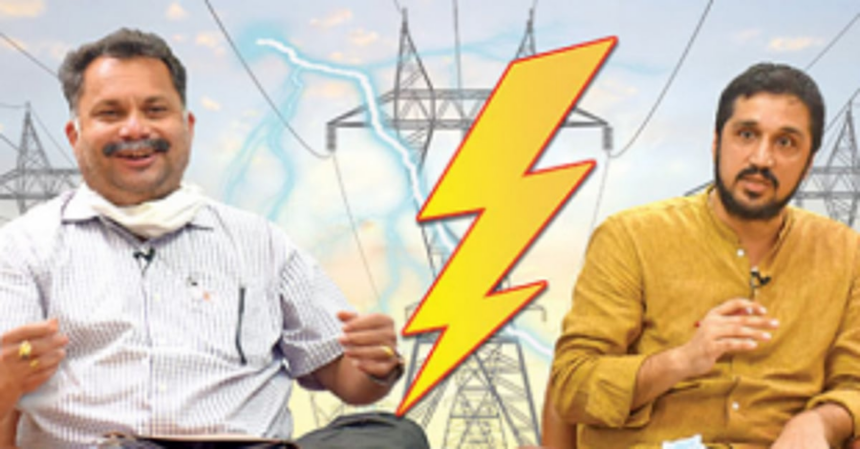
At the end of the debate on the power situation in Goa and Delhi, what emerged is that Goa will not get any dole or scheme that will lead to the supply of free electricity in the State. Power Minister Nilesh Cabral was very clear that this will not happen. He pointed out that the Aam Aadmi Party (AAP) claim that they were giving free electricity to the people of Delhi was a scheme and that the expenses were borne out by the exchequer. The AAP representative at the debate, Valmiki Naik, one of the senior-most leaders of the party in Goa, countered why the State government couldn’t introduce a similar scheme in Goa.
There was no winner or loser in the debate that never rose to any great heights. On the other hand, in the absence of any sparks, there were definite shifts in the discussions, much like the voltage fluctuations we have learnt to live with, that saw the panelists get the better of each other in turn, before the subject changed to corruption in the government.

In the build-up to the debate, the AAP contention is that in Delhi their party government has around Rs 30,000 to spend per resident per year from its an annual budget of Rs 60,000 crore, which is for a population of about two crore people who are resident in the Delhi. They compared this to the annual budget of Goa which is of Rs 21,000 crore in a State that has a population of approximately 15 lakh, and so worked out that the State had an amount of Rs 1.40 lakh that it could spend on each resident annually. From the Rs 30,000 that Delhi had to spend on each person, they pointed out that the government gives its residents electricity and water free, and provides state-of-the-art schools and the best hospitals. Their question is where does this money go, and why can’t Goa give its people benefits of a similar nature.
It is no doubt that it was the relentless pressure by AAP the led to Cabral accepting the challenge of a debate. It has to be stressed that Cabral never did throw a challenge for an open debate, but AAP jumped at his offer for anybody to study the Goa model and converted it into a debate and even flew in a Delhi MLA who is chairman of the Delhi Jal Board for the debate that never occurred. Cabral, at that time, had said he was ready for a debate with the Delhi Power Minister, but then agreed to discuss with AAP’s Naik on the subject. With the debate now out of the way, can the Electricity Department get back to its task of providing an efficient service to the people?
There are many deficiencies in the power supply system leading not just to transmission and distribution losses, as pointed out during the debate by the AAP representative, but also to erratic supply to the consumer, whether domestic, commercial or industrial. This month there was another marginal hike in the power charges, but the quality of supply does not rise appreciably, and there is where the government fails. Any hike in the power charges, however minimal, should be accompanied by better service. This has not been the feature in Goa in the past, nor is it now. Goans have not protested the hikes in the charges, but they demand proper supply of power that can come about with proper infrastructure in the State. The government should work towards fulfilling that, while also looking at reducing dependency on fossil fuels and opting for green fuel.