LUIS DIAS
At the rate Panjim’s price less public heritage buildings are “vanish ing” before our eyes (the Cam pal lighthouse is the latest in furiating example) or sinister plans seem afoot to hand them over to the casino industry or to the real estate mafia for ‘beautification’, ‘redevelop ment’ or similar euphemisms for erasure, I felt it necessary to highlight our existing her itage and fervently hope we don’t ever have to mention them in the past tense. This is the first of a series on Panjim’s precious public heritage buildings. It’s tragic how little we were taught in school about our heritage, and this problem of collec tive ignorance and apathy has gotten worse over time. It is this endemic ignorance that is partly responsible (apart from corruption and greed, of course) in illogical bureau cratic decisions adversely affecting Panjim’s heritage. What we know little or noth ing about, we do not val ue. The writings of Percival Noronha, Vasco Pinho and Celsa Pinto are invaluable in addressing this lacuna.

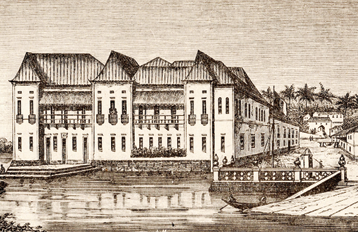
The old Secretariat is prob ably (after the Panjim church) our capital city’s most iconic landmark edifice, so it felt ap propriate to begin with it. In a different shape and form, it was already standing in 1510 when the Portuguese first arrived in Goa, the ‘al ca zar mourisco’ or fort used by Yusuf Adil Shah as his summer residence (the Portuguese called it ‘Palácio de Idalcão’), surrounded by a moat. To gether with the fortification across the mouth of the river Mandovi (that we know as Reis Magos), it provided cru cial defence against naval at tack. It was reconstructed and completely remodelled in the Pombaline style (which had developed in Lisbon during the rebuilding following the massive earthquake of 1755) in 1759 when the then Vice roy Dom Manuel de Saldanha de Albuquerque, Conde de Ega shifted his residence from Panelim to Panjim. The moat was filled and converted into a road. A chapel on the ground floor was dedicated to Nossa Sen hora de Imaculada Conceição (Our Lady of Immaculate Con ception), the Patroness of Por tugal and Panjim. A statue of the crucified Christ with glass eyes from this chapel is now at the chapel of São Sebastião (St. Sebastian), Fontainhas. The meticulous engravings (one pictured here) by cartog rapher and illustrator António Lopes Mendes (1835-1894) furnish vital information on how the edifice looked when he visited Goa (1862-1871). The river Mandovi lapped its exterior patio, as can be seen.
The high scissor roofs (‘tec tos em tesoura’) similar to those found in Portugal were replaced in 1887 by the ones we see today, with the major works carried out by Rear Admiral Cardoso de Carvalho. The building remained a resi dence until 1918, when it was transferred to public adminis tration offices. Work on the verandah we see today facing the Mando vi and the Abade Faria statue was begun during the tenure of Governor Joaquim José Machado (1897-1900) and completed by his successor General Eduardo Augusto Rodrigues Galhardo (1900 1905). Most of the footpaths were laid around 1903-1904. Post-Liberation, the build ing was extended along its eastern side soon after the inauguration of the adminis tration of Goa’s first elected Chief Minister Dayanand B Bandodkar. In the words of Vasco Pin ho, the Adil Shah Palace as it is also known to us today “was and is undoubtedly Pan jim’s most important Portu guese-era landmark.” He also adds, “It was Jawa harlal Nehru, the architect of modern India, who right ly pointed out that the Idal cão’ established a link with Goa’s pre-Portuguese past.” It is Panjim’s oldest surviving building and Goa’s oldest sur viving royal building.
Those who seem hell-bent on erasing anything remote ly connected with the Portu guese and pre-Liberation Goa cannot ignore the fact that the main hall on its first floor was not only the Concelho Legisla tivo during the colonial peri od, but in the living memory of most of us was the location of the Legislative Assembly af ter 1961. The entire building housed offices of Goa’s admin istrative infrastructure until the move relatively recently to Porvorim in 2000. Call it what you will, wheth er the Adil Shah Palace or the old Secretariat, this imposing building in its various avatars over the centuries is of im mense historical and heritage importance at the heart of Goa’s capital city. I have childhood memories of the water fountains illumi nated by coloured lights in front of it by the river installed by Chief Minister Bandodkar, quite an attraction for its time. There was a sense of pride as one walked past its riv er-facing entrance, with uni formed guards standing at attention.
The location of the Independence Day, Liberation Day parades, the daily bugle call at dusk before the lower ing of our national tricolour, all these were and are a reflec tion of the importance given to this important edifice. In addition, from an archi tectural perspective, it is a unique blend of so many dif ferent styles, worthy of con servation and upkeep for this reason alone. In fact, the Goa State Herit age Policy 2025 (GSHP-2025) is a comprehensive policy framework aimed at conserv ing, protecting and promoting Goa’s unique natural, cultural, and architectural legacy. Over seen by the Department of Archives and Archaeology, the policy sets a 5-year phased ac tion plan to protect heritage assets like this one. Instead, the degree of what can only be termed as delib erate and criminal neglect of this heritage site in plain sight is therefore all the more scandalous.
All the more so, because it had been given an expensive makeover just before the first edition of the Serendipity Arts Festival (2016). The degeneration that followed after this, in slow motion, unfolding before the eyes of every passerby, has been quite painful to watch helplessly. We absolutely cannot allow heritage, historical edifices to crumble as a ‘pre-planned’ prelude to giving it up for ‘re development.’ This is our col lective inheritance, precious and irreplaceable, irretrieva ble. Instead of celebrating and showcasing Panjim’s enviable uniqueness — truly blessed with a riviera, a beach, price less heritage buildings and tree canopy cover — our city fathers seem single-minded in destroying those very same assets to reduce into another Indian urban mess. (Dr. Luis Dias is a physi cian, musician, writer and founder of Child’s Play India Foundation. He blogs at luisdias.wordpress.com)