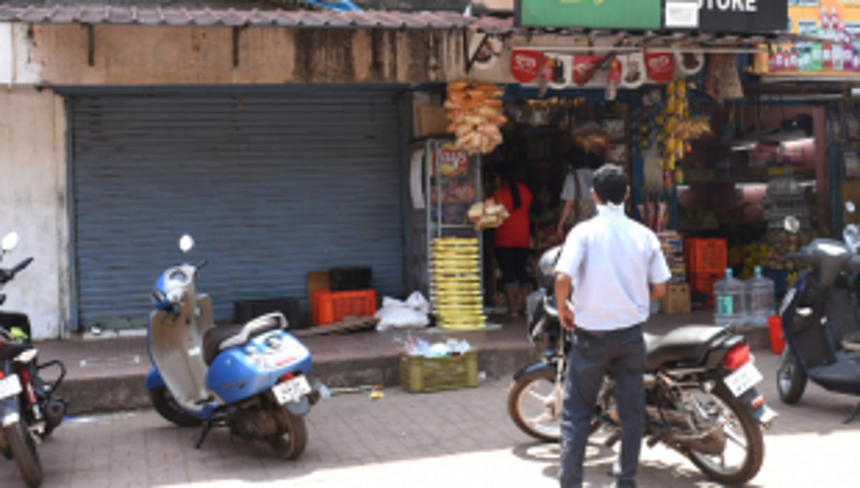
After five weeks there came the sound of vehicles on the streets, the rattle of shop shutters being rolled up, the excited chatter of employers and employees meeting for the first time since the lockdown. It appeared that Goa was returning to life again. But, the streets of Goa, especially those of the State capital Panjim and of Margao told a very different story.
On Monday, most shops continued to remain closed and some that had opened had their shutters half down or had just one of the shutters of the entrance opened, while the others remained firmly shut. The people out shopping were also few, and all were masked, standing at a distance from each other. Goa has not rushed into normalcy and Goans are showing that they are concerned of their health and that of others, some of them by still staying home and others who were out by maintaining social distancing norms. It was but a tentative return to a near normal time.

These are far from usual times, and there has been some confusion on the opening of stores. The government has to ensure that shop owners are not unnecessarily harassed. Take for instance the Corporation of the City of Panaji stating that shops in its jurisdiction will need the Corporation’s permission to open. Such unnecessary orders in the time of a lockdown should not be permitted. If the Centre has permitted certain shops to open, how does CCP decide that its permission is more important? Instead of easing the staggered lifting of the lockdown, such irresponsible actions only serve to create hurdles in an otherwise seamless process.
As Goa took this step on Monday, it has a week before May 3, when further relaxations in the lockdown are expected. At the video conference with Prime Minister Narendra Modi, State Chief Minister Dr Pramod Sawant has sought that the State borders remain closed and air and rail transport also stopped, while economic activity is allowed in the State. The reason proferred by Sawant for this is that Maharashtra and Karnataka have a large number of active COVID-19 cases and Goa has none. With Goa sharing borders with these two States, and there being a large number of vehicles carrying essentials crossing over to the State, the closure of the borders, excpet for essentials and emergencies, cannot be compromised with. They have to remain closed.
However, can Goa return to some extent of normalcy after May 3? Or does it need to extend the lockdown further? The debate on this is open with valid arguments on both sides. Goa, therefore, has to find the middle path on this and has a week to do so. The facts as they stand before us are that the last positive COVID-19 case detected in Goa was on April 3. After that hundreds of swabs of patients placed in quarantine have been sent for tests, and all the reports have returned negative. The seven positive patients in the State have all recovered and there is currently no active COVID-19 case in Goa.
Without a doubt, Goa is free of active COVID-19 cases, and the lockdown can surely be further eased in the State. By May 3, it will be a month since the last positive COVID-19 case was detected. Clearly, if there are enough precautions taken by the people themselves – and till now they have displayed a lot of responiblity in keeping the virus away – Goa can allow a lot more economic activity to occur, but only as long as the borders remain firmly shut.