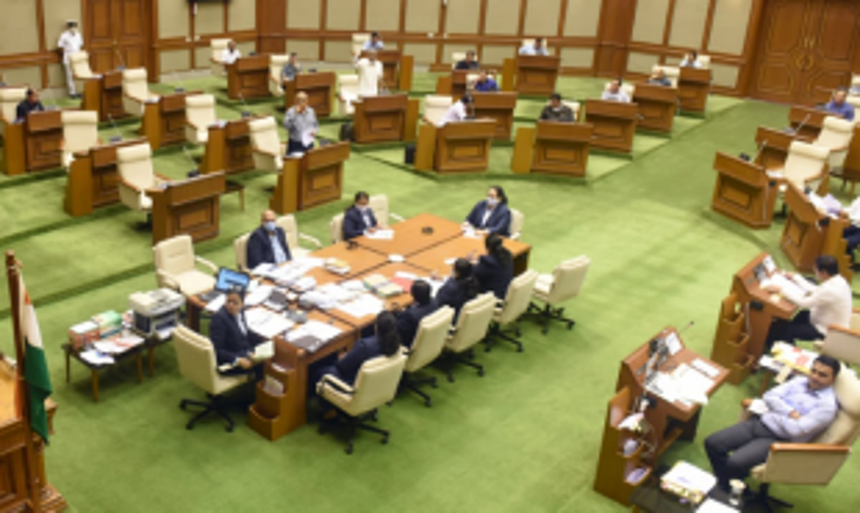
The lines of division in the State Assembly were clear. The treasury benches were in favour of the three linear projects, while the opposition stood united to oppose them, when the private member’s resolution on the issue came up for voting late into the night after a four-hour long debate. The opposition, in a rare display of unity, all stood as one in their places, as the resolution went for a division of votes. The count was 11 in favour of the resolution seeking that the projects be ‘scrapped in the interest of the public who have shown strong opposition to these three projects that threaten the ecology of the area’ and 20 against it. The only MLA from the ruling benches who spoke in favour of the resolution was Cortalim MLA Alina Saldanha, who said it was the ‘bounden duty of the government to protect the interest of the people’. Her voice too was not heeded.
As the government defended the projects as being necessary for the future, there was an assurance that coal handling would not be increased and refutations that the projects were not linked to coal transportation, but little said about the environmental degradation that the cutting of trees will cause. That point in the arguments was glossed over as politics took over in the debate. The solution that the government proposed was to wait for the report of the Central Empowered Committee of the Supreme Court that visited the State for an inspection and will be presenting their conclusions to the apex court. That of course is the only hope of the people who have been opposing the projects. Ironically, on the day that the MLAs were debating the issue in the Assembly, a little earlier the railway authorities were forced to stop the double laning work at Guirdolim under pressure from the people. So, obviously there is opposition to the project, which the government cannot deny.

In that respect, Leader of the Opposition Digambar Kamat posed a pertinent question during the discussion, when he asked, ‘Why is the government making it a prestige issue when entire Goa does not want it?’ He further said that the results of the Zilla Panchayat polls are not an ‘endorsement of three linear projects’. It is true that a substantial segment of the population is opposing the projects. There is that section that may be directly affected by having their land and heritage homes threatened by the projects, but there are thousands others who are up against the projects due to environmental reasons. The government has to take into consideration all these views before it decides on the projects. Yes, the CEC will have its report, but as was seen in the Assembly, with the treasury benches voting as one block for the projects, the government’s representation to the committee would be for them.
The political nature of the debate on the resolution was made further clear, as MLAs who are today in the opposition and voted in favour of the resolution have, during their time in government, defended the transportation of coal. There is therefore no guarantee that these MLAs will not change their stance if they get the opportunity to be part of a government again. Issues such as these should be debated outside of political lines as the main cause here is of Goa – the land and its environment. This should be viewed as a people’s issue and not as a political one. When politics enters into a dialogue, there are divisions caused. In the current matter this should be avoided as much as possible, as the cause is Goa, and there should be no compromise on this. Only the land should matter.