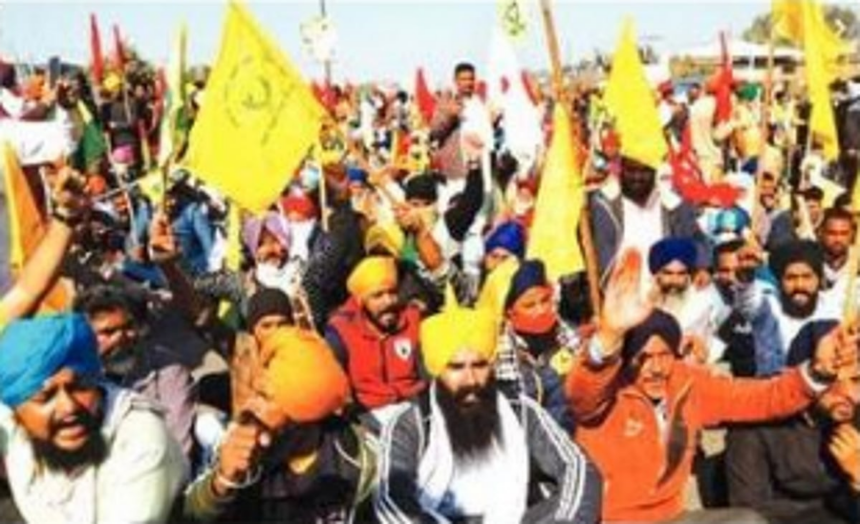
It was widely reported – in practically all the Indian media reports on the farmers’ protest in Delhi of the past week – that the farmers’ representatives had refused the central government’s hospitality, even water. The protests, against the new farm laws which will open the doors to big corporate players in agriculture while ending the miniscule government support now available to farmers, started in Punjab months ago but garnered no response from the centre. With the protests having converged massively on Delhi now, the government has started talks with the farmer unions, but these, according to the latter, has offered nothing. Except water, tea and lunch, all of which were refused by the farmers. They made do, instead, with refreshments brought from the langar at the main protest site at the Delhi-Haryana border.
The farmers themselves explained their behaviour variously.

‘The tea he’s offering has milk from our dairies,’ said one.
‘Let them come to our langar instead; we’ll serve them jalebis there,’ said another.
‘How can we eat here, when our friends are sitting on the road?’ asked a third.
The reporting of this refusal to break bread with the government by almost every Indian media house – less so by foreigners, despite sympathetic coverage of the protests – is a good indicator of its significance. But what is this significance? At first sight it looks like caste pride, for refusal to eat food from someone considered ‘low’ is the traditional norm among ‘high’ castes. But what is often forgotten is that the reverse is also true – accepting food is a traditional sign of being low and needy. Because, in caste society, offering food is not a sign of fraternity, but of high status. Food is shared between equals; this is breached only by charity offered by the high and mighty. In the past, this ‘charity’ might be of crumbs and left-overs, served in broken dishes or leaves (or coconut shells in Goa), sometimes even placed on the ground, to emphasize the lowness of the receivers; it might be served with dignity on rare Hindu religious occasions, but only to be followed by elaborate rituals of purification. Offering food outside one’s own close community is thus both a gesture of elite benevolence and of enforcing the caste hierarchy, and refusing this means refusing a position of subservience.
It is notable also that this governmental benevolence is not for all. Protesting is not uncommon in India, indeed, given how the mechanisms for justice function, it seems that no day can go by without people – workers, students, tribals, those in danger of losing homes or livelihoods – being on protest somewhere or the other. But they are not usually treated with respect. Many are ignored, others face state violence, some might be arrested, or at least have charges slapped on them, as in the Chandor protests. The anti-CAA protesters, for example, were never invited for discussions over tea; they were villified as anti-nationals. The farmer protests are clearly seen by the government as more damaging than others, at least partly because of the sheer numbers – reported to be over a lakh now – who have gathered, and the fact that they cut across both caste and class, from small/medium farmers and agricultural agents, to landless labourers. Hence the invitations and assurances, however half-hearted.
At the heart of the refusal, though, is the concept of langar. This word has been made world-famous today by the Sikhs, though it is of Persian origin and popularised by the Sufis first, meaning a kitchen serving free food to the needy. The Mughal emperors also ordered the opening of langars in times of war or natural calamity. The difference between these and the langars started by the early Sikh gurus is that the latter was deliberately intended to break caste barriers by eating together. Everybody, regardless of caste, religion, gender, or anything else, ate in the Guru’s langar. Even now, when Punjab is witness to violent caste discrimination, with caste being upheld by some Sikh communities themselves, the universal essence of the Sikh langar still lingers, with a reputation for feeding those in need, like Rohingya refugees in Bangladesh, war-affected in Afghanistan and Syria, the anti-CAA protesters in Delhi, and so on.
I have eaten at various religious kitchens, and remember the langar of Amritsar’s Golden Temple as being different. It was not the mixed crowd dining; crowds of strangers often eat at religious sites these days, and it is difficult to read an urbanised person’s background from their appearance. It can be different when you are recognised, as when an adivasi family, dressed traditionally, was first shooed away at the Ranakpur Temple in Rajasthan, and then – when other diners protested – served on the floor instead of at the tables where the others dined. The crowd eating at the Golden Temple seemed anonymously urban, but what was striking was how each one, upon finishing, took their steel dishes – not leaves/paper/plastic to be thrown away – to the row of sinks outside, cleaned them, and left them on a gleaming pile to be used by others. And how other visitors were volunteering in the kitchens, and in serving food. So one was both a provider and a receiver of food, and a cleaner as well. It felt different, like a glimmer of a new society that had been almost, but not quite, born.
In that sense, the success of the farmers’ protest in Delhi is important for all of us. Not just because the laws that they want repealed will worsen the existing situation of rural debt, food inflation and mass malnutrition. Not just because many Goans too are up in arms today, in an attempt to save land, livelihoods and future. But because it is connected to a culture worth remembering, one of the many regional cultures that challenge the prevalent casteist and exploitative one upheld by Delhi.
(Amita Kanekar is an architectural historian and novelist.)