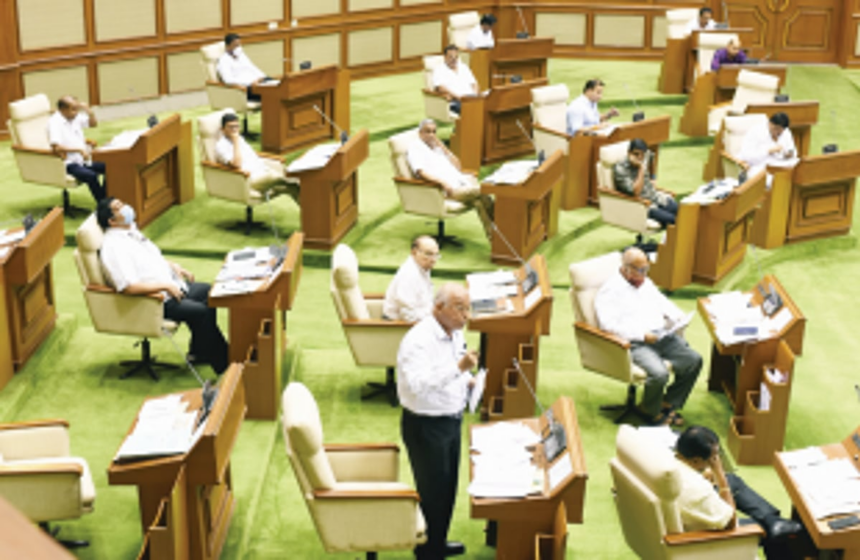
It is not surprising that when the BJP Government in Goa passed the Bhumiputra Adhikarini Bill in July this year, it drew immediate backlash. While the Opposition’s criticism of a sitting Government’s policies is fairly regular, the story of the Bhumiputra Adhikarini Bill is important because protests against the Bill came from within the BJP also. The Party’s Scheduled Tribe Morcha raised objections to the Bill — claiming that it hurts the sentiments of the tribal people of Goa by recognising somebody who is not native to Goa as ‘Bhumiputra’ (son of the soil).
Trying to extinguish the fire that now faced him, Chief Minister Pramod Sawant first tried to reassure the ST Morcha that the Bill shall be renamed to Goa Bhumi Adhikarini Bill, and eventually — under immense pressure from political parties including the Goa Forward Party (that had supported the BJP and joined the Government in 2017) — declared that the Bill shall not go to the Governor and will be allowed to get lapsed.

At the centre of this political storm was the most fundamental unit of our built environment – the house. Under the Bhumiputra Adhikarini Bill, any person living in Goa for 30 years is eligible to be recognised as ‘Bhumiputra’ and could stake claim on the property that they have been residing in. Goans took exception to this and it was conveyed by their representatives in the Assembly. A seemingly strong BJP led Government, having passed the Bill in the house, had to let it lapse.
Barring some States in the Himalayas and the North East, we do not see this sensitivity to the local land anywhere else as much as we see it in Goa. Goa is a hyper local society. For Goans, their immediate surroundings — the village, its football ground, local roads, peace and quiet, and overall functioning of the local Panchayat — are of immense value.
Political structures become even more organic in Goa due to a very low number of electors per Assembly Constituency (AC). In the 2017 Vidhan Sabha elections, for example, the average number of electors per AC in Goa was only 27,792. Compared to the nearby Maharashtra that had an average of 3,07,897 voters per AC in the 2019 elections, the number is low enough to radically distinguish the politics of the State from the rest of the country. Goan politics works from the ground upwards and brings to question extremely localised issues of land — unlike other Indian States. And this is where Goa’s strong anti-incumbency emerges from.
Narendra Modi’s BJP is not a Party that likes to govern from the grassroots upwards. And issues of land seem to be an important aspect of that. We see this trend across the country. The repeal of the special status of Jammu and Kashmir reflected this hard handed tendency to govern States from New Delhi in the most stark and violent form.
During the Assembly Elections in Assam also, the issue of land and who ‘should’ be allowed to buy land in which parts of Assam was glaringly present. After the BJP formed the coalition Government in Assam in May, 2021, the issue of land soon escalated to violent attacks by the State on the people whom it deemed ‘illegal occupants’ of Assamese lands.
A similar rhetoric of ‘Land Jihad’ and ‘illegal occupation’ was seen in the West Bengal Elections this year and along the same lines, The GNCTD Act, 2021 — passed by the Central Government — essentially took all powers away from the elected Delhi Government by providing the Lt Governor of Delhi with incontestable powers of overrule.
Delhi Master Plan, the document that lays down Urban Development strategies for Delhi —passed soon after the GNCTD Act that disempowered local Municipalities — was rendered a mere lip-service. In all of these cases, taking power away from local bodies and citizens of the States appears to be the modus-operandi.
Coming back to Goa, the State has seen another Legislative action that undermines the Goans’ rights on their lands. Soon after coming to power, the Goa Government amended the Town and Country Planning (TCP) Act of Goa — introducing section 16B. This section gave the TCP Board powers to change land use or zone of a piece of land upon application by the owner. Before the introduction of section 16B, the change of land use was only permitted for Government projects under section 16A. In recent years, these included a zone change for a permanent campus for the Institute of Information Technology at Sattari, and for a Bus Stand in Quepem. The introduction of 16B, however, opened this path up to private owners as well.
The Amendment faced strong resistance from citizen groups such as Goa Bachao Abhiyan and Goa Foundation who challenged it in the High Court, and a serious response from political parties with allegations of cronyism and corruption in the TCP Board. The criticism further intensified and land became an election issue in Goa following two major instances in November, 2021. First, when the TCP Board cleared 42 out of 43 applications for conversion of agricultural land into settlement and industrial zones and second, when the Government allowed the construction of a Bungalow in Old Goa Heritage Zone.
Amidst massive inflation in land prices in Goa that has made it difficult for Goans to buy land in their own State, a fear in Goans of losing their land rights to the forces of the market that are fuelled by the money flowing in from metropolitan centres like Mumbai and Delhi, and the frustration with the top down approach of the BJP characterised by a disregard for local bodies and disdain for the politics of grassroots; the upcoming elections in Goa will see land, heritage and housing become central issues. While it remains to be seen whether the growing centralisation of power by the BJP will generate a nation-wide electoral response, in Goa, however, it is evident that the politics of grassroots (and attacks on it) will determine which way Goans will vote this Valentine’s Day.
(Fahad Zuberi is an academic and writes about politics, culture & architecture)