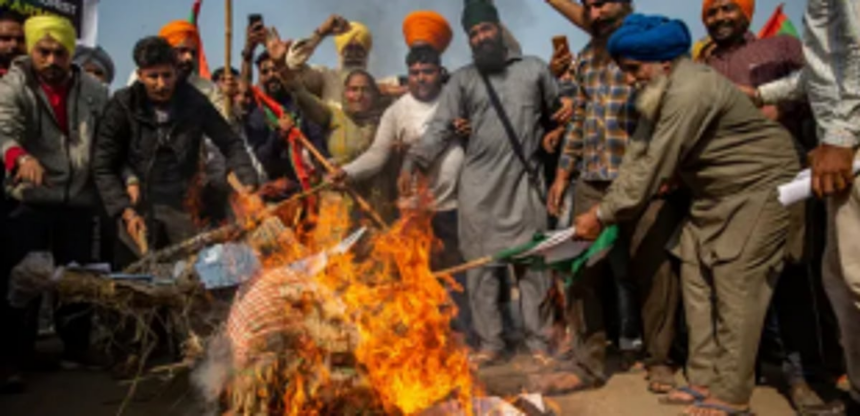
The present farmers’ agitation in Punjab against three farm bills passed by the government is a national issue. The three contentious farm bills are: the Farmers (Empowerment and Protection) Agreement on Price Assurance and Farm Services Act (FAPAFS), the Farmers Produce Trade and Commerce (Promotion and Facilitation) Act (FPTC) and the Essential Commodities (Amendment) Act (EC). These were passed hurriedly, ignoring serious objections within both Houses and opposition outside. The farmers contend that these bills will be extremely harmful to agriculture and will lead to corporate exploitation. These laws, they argue, have been enacted to involve big players in the trade of agricultural commodities by amending the Essential Commodities Act 1955 and withdrawing the Food Corporation of India (FCI) from public procurement of food grains like wheat and paddy. The farmers’ agitation in Punjab against the farm bills has disrupted the railway and road services in that state and the aam aadmi who has no access to private vehicle is in a state of anguish.
Expressing solidarity with the farmers, former chief minister of Punjab Prakash Singh Badal recently wrote to the president of India returning his Padma Vibhushan. This step he has taken in protest against the shocking indifference and contempt which the government is treating the ongoing peaceful and democratic agitation against the farm Acts. He lamented: “Black laws now implemented by the government have come as the proverbial last nail in the coffin of the country’s annadatas.” The farmer suicides accounts for 11.2% of all suicides in India. The National Crime Records Bureau of India reported that a total 296,438 Indian farmers have committed suicide since 1995. There are a number of conflicting reasons: anti-farmer laws, high debt burdens, poor govt policies, corruption in subsidies, inability to repay loans taken from landlords and banks, crop failure, personal issues and family problems. The farm bills have added to their woes.
Jai Jawaan Jai Kisaan was a slogan of the second PM of India Lal Bahadur Shastri in 1965 at a public gathering at Ramlila Maidan in Delhi. Soon after Shastri took over the prime minister’s post after Nehru’s death, India was attacked by Pakistan. At the same time there was scarcity of food grains to feed the millions of people in India. The people were starving to death due to lack of food. The country had to import the food grains to feed the hungry stomachs. Shastri gave the slogan to boost the morale of the soldiers to defend India and also to cheer the hard-working farmers to do their best to increase the production of good grains so that everyone gets daily rotti. In those crucial days the farmers toiled in the scorching sun and splashing rains and brought the country out of starvation.
India, from a food-begging country, became a food-exporting country; 70% of the people in India are farmers and for the past 70 years they have been serving the nation selflessly and with humility. The country owes a huge irreparable debt to its farmers. We pay our tribute to our kisans-annadatas who are slogging to supply bread on our tables every day and hope the govt decides in their favour.